What are Current Sensors?
Meet the Sensor: Current Sensors
Current sensors detect electric current and generate a signal proportional to that current. The signal, which may be analog or digital depending on the sensor and the application, can be used to display the measured current, stored in a data acquisition system for later analysis, or used for control purposes.
Requirements for current sensors vary based on the application, but generally include:
- High sensitivity
- High accuracy and linearity
- Wide bandwidth
- Low temperature drift
- Interference rejection
- IC packaging
- Low power consumption
- Low cost
Main current sensor types
Sensors differ in how they measure electric current and operate according to underlying fundamental physical principles, such as Faraday’s Law or Hall Effect.
Current transformer (CT) converts the current of a large-current or high-voltage circuit into a small current for monitoring using an ammeter or other instrument, and for current measurement and relays. CTs for AC have a primary coil and a secondary coil wrapped around an iron core and generate magnetic flux. CTs for DC use a Hall element to measure DC current. Other types of CT transformers include through-hole and shunt resistor. CTs are used in water pumps, wastewater and sewage pumps, and power plants and substations.
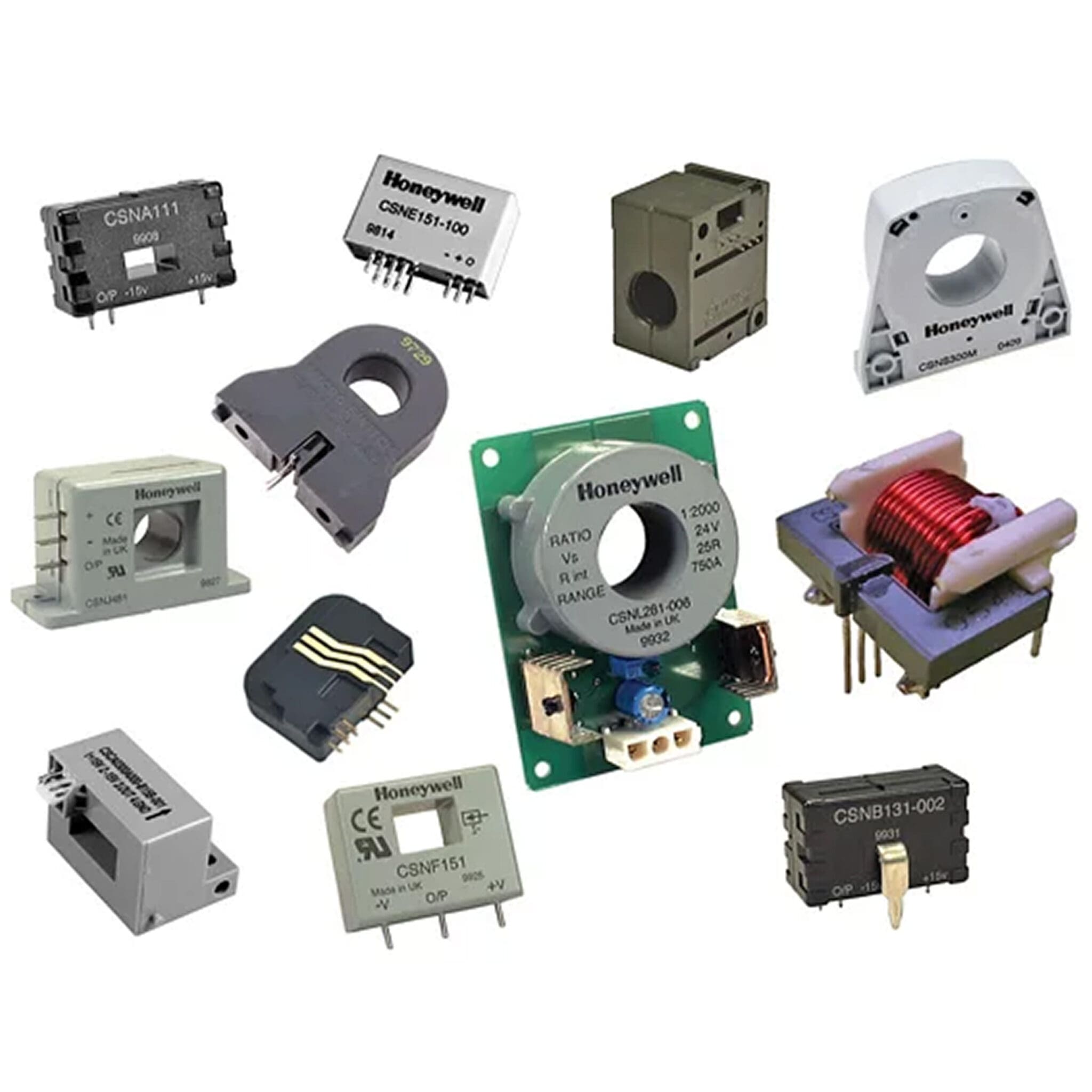
Chief offers Honeywell Industrial Automation current sensors, delivering precise and isolated AC/DC current monitoring for today’s advanced vehicle electrification systems. Built on decades of Honeywell engineering expertise, these sensors feature fast response times, rugged thru-hole designs, and minimal energy dissipation. They provide the reliable performance needed for the past, present, and future of vehicle power management.
Fluxgate current transducer operates on the measurement principle that the magnetic field created by the primary current to be measured is detected by a specific sensing element. Various methods for concentrating the field, driving the magnetic core, and sensing the field intensity are used based on this underlying principle. The resulting magnetic effects are used for primary current detection. Fluxgate current transducers include several types of isolated current sensors and voltage sensors.
Hall effect current transducer is named for its use of the Hall effect (discovered by Edwin Hall in 1879), which refers to the generation of a voltage difference in an electrical conductor. This transducer generates a voltage perpendicular to the flow of current in a conductor in the presence of a magnetic field. Hall effect current transducers are often used in applications that require isolation. They are contactless, providing galvanic isolation between the current source and their output. Hall effect current transducers can be open-loop or closed-loop.
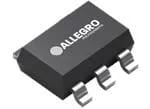
Allegro Hall Effect sensor from Mouser Electronics is a fully integrated Hall-effect-based current sensor IC that provides a galvanically isolated voltage output proportional to the sensed current. These sensors do not require an external sense resistor, simplifying system design and reducing component count. The ACS37041 and ACS37042 sensors feature an integrated conductor with low resistance for current measurement, reducing power losses and improving efficiency. The ACS37041 and ACS37042 employ a differential sensing technique with two Hall plates to effectively reject common-mode magnetic fields to ensure accurate and reliable current measurements.
Fiber optic current transducers use the Faraday effect (discovered by Michael Faraday in 1845) in which the polarization of light passing through a fiber optic loop changes in response to the magnetic field induced by the current. The core of this sensor contains a magneto-optic material that is sensitive to changes in the magnetic field. Fiber optic current transducers are commonly found in power distribution systems, electrical substations, and other high-voltage and high-power applications that require electrical isolation and accurate current measurements. They are known for their safety, reliability, and performance in environments with high electromagnetic interference.
Shunt resistors measure the flow of electric current in a circuit. They are used in a series, placed in parallel with the circuit element being measured. The current flows through the shunt resistor creating a voltage drop. Using Ohm’s law, the current flowing across the shunt produces a voltage drop proportional to the current. Shunt resistors come in various shapes, sizes, and materials. A common type is a low-resistance copper alloy in a chip form or a strip form.
Rogowski coil (introduced in 1912 by German physicist Walter Rogowski) is a flexible air-core coil encircling a current-carrying conductor that generates a voltage proportional to the rate of change of current. Its effectively measures rapidly changing or dynamic currents, such as those found in AC circuits. Rogowski coils are flexible and lightweight. Their measurement loops are available in a wide variety of circumferences, and their design allows for easy connection around existing conductors.
Markets and Applications
Automotive, Consumer, Industrial, Telecommunications, Medical, Military and Aerospace,
Current sensors are used in many applications including power supplies, energy management, battery management systems, renewable energy, variable speed and servo drives, motor control, factory automation, overcurrent and fault detection, ground fault detection, circuit breaker and rectifier protection, electric vehicles, automotive electronics, high precision measurements, welding, HVAC systems, and more.
Suppliers
Current sensors are available from many suppliers and distributors, including Chief Enterprises, Mouser Electronics, Avnet, DigiKey, TTI Inc., and Sager Electronics.
Like this article? Check out our other Meet the Connector and Connector Basics articles, our Connector & Cable Special Topics Market Page, and our 2025 Article Archives.
Subscribe to our weekly e-newsletters, follow us on LinkedIn, Twitter, and Facebook, and check out our eBook archives for more applicable, expert-informed connectivity content.

- Ceramics in Space: BME X7R MLCC - October 20, 2026
- Test & Measurement Product Roundup - October 20, 2026
- Advanced Connectivity-Automation, Robotics, AI, and Machine Learning - October 20, 2026