Three Trends in EV Batteries Advance the Quest for Fast Charging
A new architecture brings increased efficiency and lower cost.

EV battery technology continues to advance toward the primary goal of fast charging. A new architecture incorporates three trends that address decreased charging times, greater efficiency, and lower cost.
Trend #1: Replacing modules with cell-to-pack connectivity
Eliminating the modules and connecting the battery cells directly to the battery pack increases the amount of space available for battery packs in part by eliminating the walls of the modules. This “increases the energy density of the battery pack, a major lever for lowering cost,” said Boris Ketscher, product manager, E-mobility at TE Connectivity. Next generation batteries are comprised of one huge package instead of individual modules.
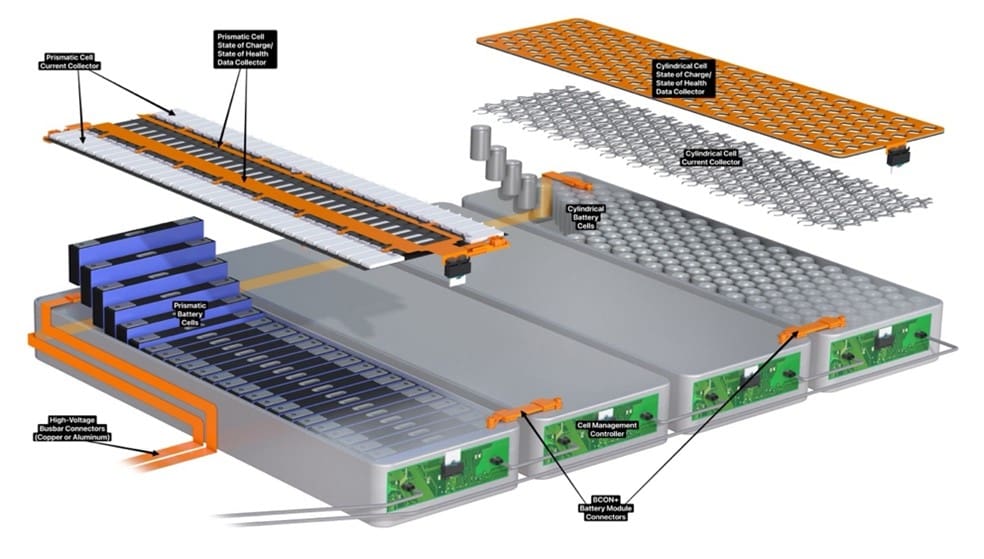
Battery modules
These modules (shown in the illustration above), which are smaller and easier to handle, made more sense when EV production was limited and battery assembly required a great deal of manual work. In the last 10 years, production has become automated as EV sales volumes have increased. “Weight doesn’t matter when you have a robot assembling it. That’s why we can do this now. It was more difficult with the lower volumes of the first generation of battery packs,” said Ketscher.
“The industry is trying to remove all the non-value-add components in the battery, and everything that is not storing energy is non-value-add. This even starts at the cell level. Increasing the cell size itself saves the space that you need to terminate the cell, for the cell enclosure, and so on,” said Jan-Philipp Trommershaeuser, product manager, E-mobility at TE. “In the same way, with each module that you remove from the battery pack, you will save the screws to mount the module, the cooling plates, and the bolted connections between each module, whether it’s the high power connection or a sense line connection to the battery management system.”
Trend #2: Transition to higher battery voltage
Battery advances have allowed a jump from 400 V to 800 V, which has facilitated fast charging. “We’re seeing EV manufacturers in China achieve charging times within five minutes to add 500 kilometers of range, and this is possible with an 800+ voltage architecture,” Ketscher said.
“In the future we’ll probably see 1000 V,” said Trommershaeuser. “If you increase the voltage, you can transport the same amount of power at a lower current, which brings some cost benefit. It also decreases losses in the system compared to the same power level with a higher current level, which further boosts efficiency.”
“Increasing voltage allows us to reduce, or at least not grow, the radius of the conductors. That means we can save money because a smaller-diameter cable or busbar uses less copper or aluminum,” said Ketscher.
“However, because automakers are increasing the number of cells within the battery pack, we’re seeing more connection points in the signal area, which is connected to the battery management system. Signals for temperature and voltage sensing are important for balancing the charge state of the cells, and therefore, for the overall health of the battery,” said Trommershaeuser.
Trend #3: Connector miniaturization and weight reduction
Smaller and lighter battery components increase energy efficiency and lower cost. In e-mobility, this contributes to longer range through weight reduction, which, along with fast charging, is a high priority. Increasing to 800 volts allows for a reduction in materials and no increase in size. “Otherwise, to maintain the same level of performance, you would need to double the diameter of all busbars,” said Ketscher.
With the shift from modular to cell-to-pack architecture, the size of the sense line increases. “These are flat, printed cables that pick up the temperature and the current or voltage on the different battery cells and bring it to the battery management system. We’re seeing sense lines with up to 60 conductors,” said Ketscher. Here, pitch (the distance between the middle of the first conductor to the middle of the next), as well as clearance (air distance), and creepage (surface distance), becomes important. “If you have two conductors that are too close together and the voltage peak is too high, you will have an electrical arc. This is the factor which most impacts all efforts regarding miniaturization. It is especially significant coming from the battery pack to the battery management system, where different connection systems are used. Successful connector miniaturization technologies require reliable capabilities and deep understanding of air and creepage distances so that issues can be mitigated before they happen, especially with connectors that have very small pitches or very small diameters.”
In terms of cost reduction, switching from copper to aluminum is another priority. “We enable our customers to move away from copper because aluminum is far cheaper, by a factor of six. There is an opportunity to reduce or get rid of copper, and we can support our customers with reliable connection systems to make it possible,” Ketscher said.
The battery is the heart of the vehicle and it is also the most expensive part. Innovations continue to reduce cost and charging time, while increasing reliability and efficiency.
Visit the Preferred Supplier page for TE Connectivity to learn more about the company and its products.
Like this article? Check out our other EV’s and HEV’s and Connected Vehicles articles, our Connector & Cable Special Topics Market Page and our 2025 and 2026 Article Archives.
Subscribe to our weekly e-newsletters, follow us on LinkedIn, Twitter, and Facebook, and check out our eBook archives for more applicable, expert-informed connectivity content.

- Custom Cable Assemblies: A Value-Add Solution - October 13, 2026
- Fiber Optics Product Roundup - October 13, 2026
- October 2026 Connector Industry News - October 13, 2026