Molex Views New Technology Horizons in Aerospace and Defense
The aerospace and defense industry is being reshaped by the rapid adoption of AI and the industry-wide shift to open standards. With its 2024 acquisition of AirBorn underway, and 2025 acquisition incoming, Molex has been launched into these critical markets and their cutting-edge engineering breakthroughs.

Molex has seized new opportunities in the aerospace and defense technology markets. Uniting the company’s might and global reach with the cutting-edge mil/aero expertise of AirBorn and Smiths Interconnect through its recent acquisitions, the company has been launched into this cutting-edge market technology area just as it’s about to experience seismic change. Molex recently released findings from a survey of more than 1,000 aerospace and defense design engineers revealing how AI adoption and open standards mandates are fundamentally transforming their industry. Connector Supplier discussed the findings with Justin McMath, VP Products at AirBorn, a Molex Company.
Connector Supplier: The aerospace and defense market is the connector industry’s largest market. How does Molex expect to see this area change in the next 10 years?
Justin McMath: Military and aerospace segments have long represented a large share of the interconnect industry, given the high price and complexity of these products vs. commercial markets. Like other segments, sustained growth will reflect underlying market volumes compounded by increasing penetration of technology resulting in higher content per unit. Within the aerospace and defense market, we expect different forces will shape the demand for our products over the next 10 years, so it’s important for us to stay vigilant regarding trends and customer needs.
Regarding commercial aircraft, a rebound in deliveries of narrow- and widebody jets will be accompanied by more feature-rich in-cabin passenger experiences as well as advances in engine and flight control systems to stretch fuel range or improve safety.
The defense sector is being reshaped by evolving geopolitical pressures and repositioning different types of conflict across theaters and geographies. There are trends supporting volume (e.g., replenishing munitions/expanding magazine depth, broader deployment of missile defense networks, accelerating procurement in Europe) as well as content per unit (e.g., technology insertion supporting electronic warfare, advances in autonomous and uncrewed systems, electrification).
As for space exploration and commercial space, there is tremendous momentum in continuing to access different orbits and deploy technology to enable new business concepts or advance global security. All of these goals will be enabled by new launch services providers along with increased commercialization of the supply chain.
The emerging landscape is shaped by AI adoption, persistent cost pressures, and the need to design for extreme environments. These forward-looking priorities will require a heightened level of innovation and expertise. Both new and familiar forces are reshaping the priorities that engineering teams must navigate. This raises the stakes for core engineering principles. The findings from our survey illustrate how these trends are creating immediate and tangible pressures on core reliability and compliance requirements.
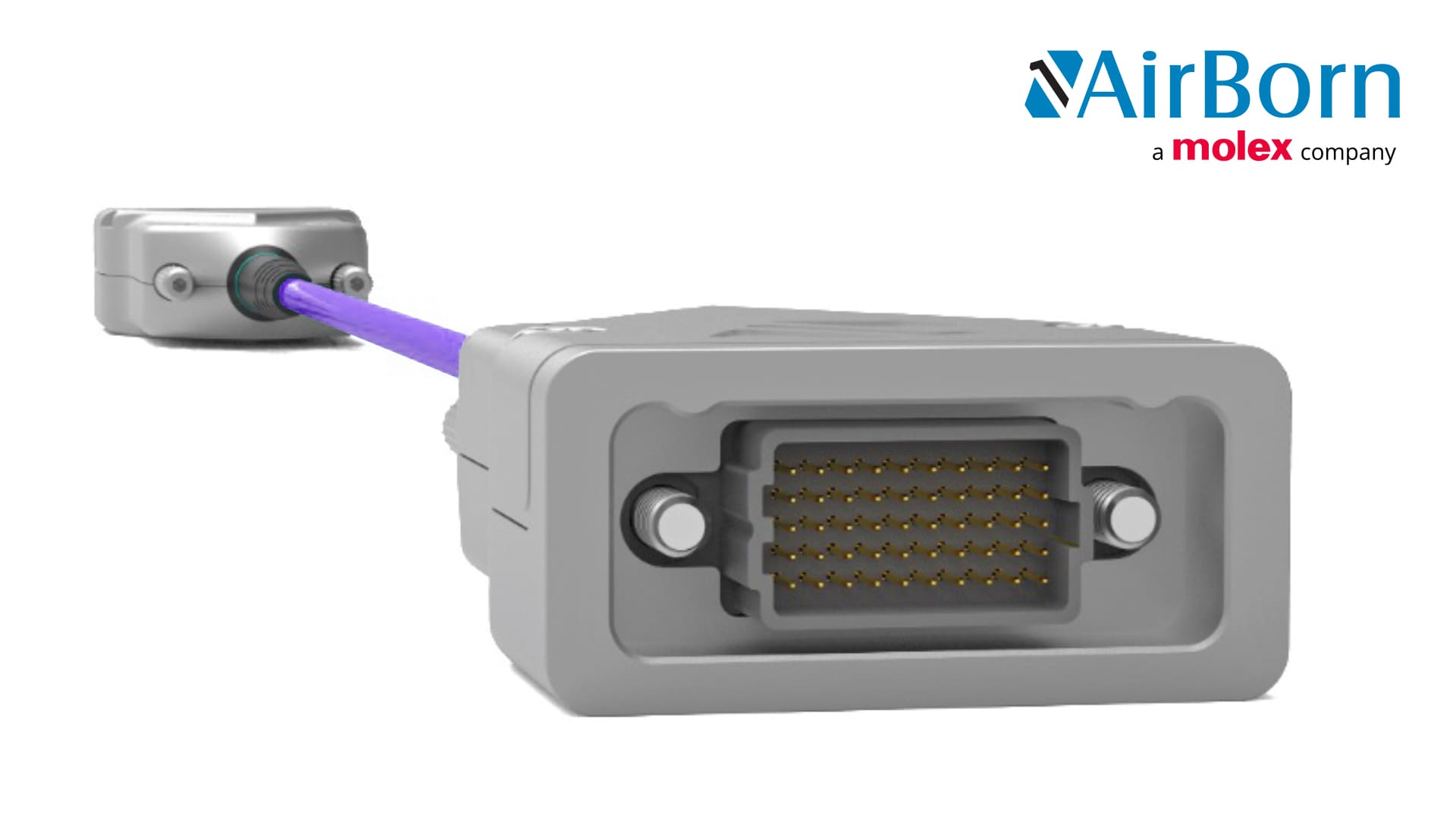
Molex AirBorn FOCuS AOC: FOCuS affords design flexibility by offering vertical board-mount, right angle board-mount, AOC cable I/O, and Copper Cable I/O. The copper and AOC cables have the exact same pin-out to offer the flexibility of using a copper cable for shorter lengths and easily changing to an Active Optic cable as needed.
What examples can you share about ways AI technology is already being used in this market?
Undoubtedly, there is a lot of potential for AI in this industry. In our recent survey, respondents suggested that AI tools would benefit the design process by increasing creativity, reducing costs, and facilitating testing. We also know from our work in high-speed and high-bandwidth interconnects that AI and machine learning (ML) algorithms are being used to further improve the functionality of controls and decision making onboard different systems across aerospace and defense segments. Of course, there also are numerous other applications that could help manage the total cost of ownership for equipment through maintenance, logistics, and operational improvements.
A near-universal belief in AI’s vast promise is fueling a powerful wave of grassroots adoption by engineers that is outpacing formal corporate governance. Almost all stakeholders surveyed (98%) expect AI-assisted design to be beneficial, with increased creativity cited as its top advantage. This optimism is driving engineers to use AI tools frequently, often outpacing formal corporate policies.
Survey respondents are concerned about increasing security as connected systems expand across mil/aero technologies. How is Molex addressing these concerns?
Concerns about security on connected systems stem from a few areas: cybersecurity of underlying technology, onboard signal/data integrity, and inappropriate access or denial of smart systems. Given Molex’s product exposure and use, our influence is primarily in the domain of onboard signal/data integrity.
Molex’s interconnect systems need to be shielded against interference to prevent unwanted emissions, which might betray either presence or the underlying signal being transmitted. Our products find homes in many sub-systems, which are designed to provide advanced protection against interference/jamming or could be used to identify and classify outside signals. This is an area where our customers are driving innovation, and Molex is keenly involved in ensuring the constituent components function as desired. Given advances in cyber capabilities and the nature of technology being developed, every party in the supply chain needs to be practicing diligent cybersecurity. Molex is pursuing level 2 certification to the Cyber Security Maturity Model Certification program (CMMC) to ensure appropriate management of this sensitive information.
How are open standards changing the way engineers approach new designs?
Open standards are helping engineering teams build from advanced designs and drive technology reuse of building blocks that could enable future scaling of capability or technology insertion. By using common standards and trusted architectures, engineers can focus on delivering capabilities without spending so much time on compatibility. As open standards are adopted, development timelines are simultaneously reduced and derisked. This lets the industry enjoy economies of scale on incremental volumes, which would have been challenging to provide without some measure of standardization.
An overwhelming majority (94%) of respondents in our survey hold a positive opinion about the value of open standards for improving new system designs. While this indicates strong and consistent agreement on the issue, Tier 1 and sub-system suppliers are less enthusiastic, likely because of concerns over increased competition and a loss of proprietary advantage.
What new mandates and standards are impacting, or will soon impact, design and component selection?
Each segment—and even some companies—have guided or mandated different approaches. In a 2024 memo, the U.S. Department of Defense stipulated that new systems are to be designed with a modular open system approach (MOSA)—an evolution of the previously employed Open Systems Architectures (OSA) and design practices. The level of definition of specific interfaces and the modularity required in MOSA systems are still evolving, but we’re starting to see more programs seeking modularity and consistency in architectures to achieve these goals. This approach also is carrying over to space exploration with companies adopting NASA standards for selection and up-screening of components that will be used in space environments. Meanwhile, commercial aircraft makers are establishing their own design standards and architectures. The result will help control their development timelines and procurement costs.
How does Molex participate in the development process behind these standards?
AirBorn, recently acquired by Molex, has been a participant in and supporter of VITA (VMEbus International Trade Association) for many years. As a member, Molex has the opportunity to collaborate with other suppliers and sponsoring customers to shape the direction of new standards, guiding generational improvements while facilitating a strong and competitive supply chain. Since the acquisition of AirBorn, Molex’s representation among the VITA community and participation in meetings has increased in frequency and depth.
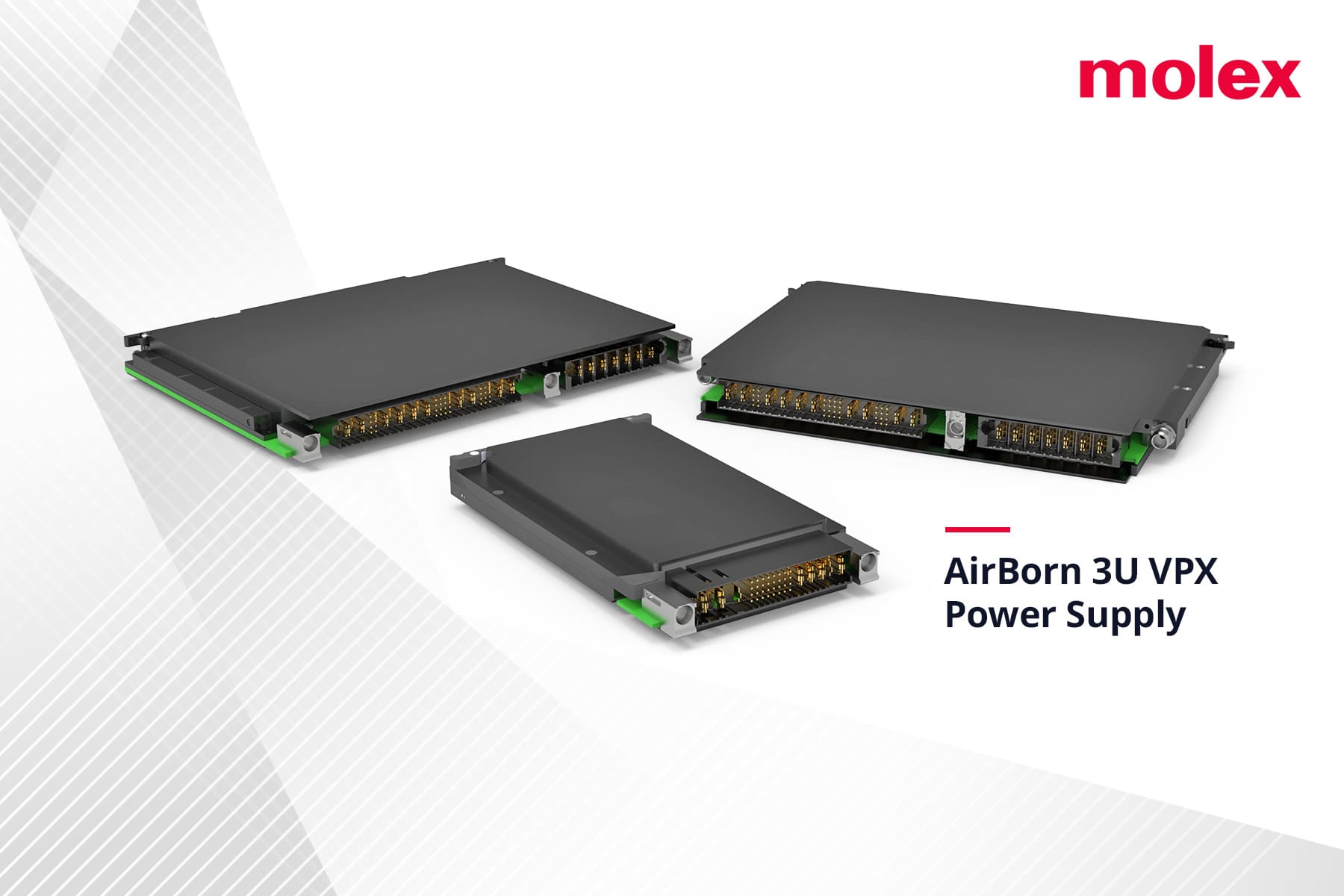
The AirBorn 3U VPX Power Supply delivers up to 1,000 watts of power in a compact form factor that’s one-third the size and weight of the award-winning 6U model, ideal for space-constrained aerospace and defense applications.
Power requirements and energy consumption are another area of concern. Can you tell me about the R&D Molex is doing in this area?
Aerospace and defense connectors must be designed, manufactured and tested in accordance with stringent military, space industry, reliability, and manufacturing quality standards while accommodating demands for higher data rates and reduced size, weight, power, and cost (SWaP-C).
According to our survey, rising power requirements (52%) and increasing security demands (48%) are the two most critical challenges for today’s design engineers. Survey data highlights a clear consensus on this shift, driven by increasing electrification and connectivity. Meeting this new reality requires advanced engineering expertise. Aerospace and defense companies must implement deliberate skill-development strategies. The results demonstrate that their strategic investments in capabilities are essential to maintaining a competitive advantage as well as highlighting key competencies, such as cybersecurity, which have become a shared responsibility.
Molex is helping customers address demands for ever-increasing data rates without exceeding their power budget (or melting down components!). While the differences in specific requirements and support are driven by industry, power and waste heat management are general challenges. Across different industries, Molex has developed high-current contact systems and housings to ensure safe handling at higher and higher power levels. Molex also has engaged in partnerships with cooling technologies providers to build integrated solutions for a subset of industries. Within our Aerospace & Defense Solutions division, we are developing and commercializing advantaged power supply cards for embedded compute applications. This provides balanced, clean power conversion with a higher power density than other marketed products, which lets customers save weight while better utilizing the space onboard their systems within the same power.
How has the 2024 acquisition of AirBorn expanded Molex’s ability to serve the Mil/Aero market? Can you share an example?
It is impossible to give just one example, as we are experiencing a heightened level of access as well as understanding about the nuanced needs of our A&D customers. Since the close of the acquisition, we’ve focused on sharing knowledge about technology, commercial fit, and service strategies that would create mutual benefit for customers. At the same time, AirBorn has benefited from Molex’s ownership in that there now is access to a deeper bench of resources, complementary technology, and capital that previously were not available to a smaller interconnect company. As a Molex company, AirBorn now also has access to a global manufacturing footprint and the latest developments in automation and process technologies.
Download Molex’s State of Design Engineering in Aerospace and Defense Survey Report to learn more.
Like this article? Check out our other Artificial Intelligence, Commercial Aviation and Innovation articles, our Connector & Cable Special Topics Market Page and our 2025 Article Archives.
Subscribe to our weekly e-newsletters, follow us on LinkedIn, Twitter, and Facebook, and check out our eBook archives for more applicable, expert-informed connectivity content.

- What Is an RFID Antenna? - October 13, 2026
- Connecting the Next Generation of EV Batteries - October 6, 2026
- What is an Antenna Connector? - September 29, 2026