oHFM: An Open Standard Brings Connector Discipline to FPGA Modules
Starting a new FPGA project typically requires a custom form factor, pinout, and thermal concept for every design. Now the Standardization Group for Embedded Technologies (SGET)’s new Open Harmonized FPGA Module, or oHFM, puts a new high-speed board-to-board interconnect at the center of the design.
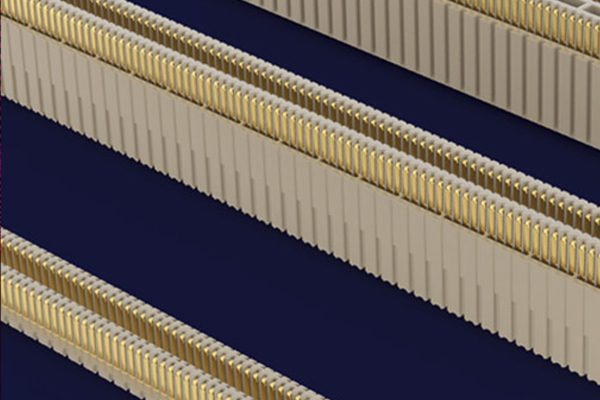
A new standardized interface is changing the way FPGA applications are designed. Previously, starting a new FPGA project typically required a custom form factor, pinout, and thermal concept for every design. Now the Standardization Group for Embedded Technologies (SGET)’s new Open Harmonized FPGA Module, or oHFM, puts a new high-speed board-to-board interconnect at the center of the design. While the standard was announced at Embedded World early in 2026, oHFM-compliant connectors are now becoming available.
“Things used to be propriety by design, no true cross-vendor compatibility. Every design started from scratch—contactor, pin-outs, thermal concepts, custom boards, incompatible modules, vendor lock-in, you name it. We thought FPGA development shouldn’t feel like a puzzle with missing pieces. Everything was tied to specific vendors, which meant high effort and low agility,” said Ansgar Hein, chairman of the board for SEGT. “We set out to fix it with oHFM Open Harmonized FPGA Modules.”
The new standard is a common module boundary that enables FPGA and SoC-FPGA modules from different vendors to share a carrier board. The specification is chip-vendor agnostic and supports devices from AMD, Intel’s FPGA business, Lattice, and Microchip, among others. The specification is free to download, while SGET members gain additional rights, including contributing to future revisions and commercial use of the standard. Founding members include semiconductor, module, and connector manufacturers.
“oHFM comes in two flavors, a solderable variant (oHFM.s) and a connector-based variant (oHFM.c),” said Hein. “No other standard I know comes in two variants that are so distinct.”
The first option, the oHFM.s SOM (system on module), has solder pads on the bottom of the module and is aimed at cost-sensitive, high-volume designs. It can be soldered directly on the PCB.
Alternatively, the oHFM.c SOM has connectors on the bottom of the module, with single or double row contacts. and is available in four sizes, from 30 × 30 mm with 332 contacts to 45 × 60 mm with 875 contacts. The connectorized version supports higher speeds and I/O counts. Its pluggable format makes it ideal for prototypes, evaluation boards, and in-field upgrades. It also serves harsh environment applications because it solders directly to the PCB, similar to the solder-on-module approach used for SGET’s OSM standard. oHFM.c and oHFM.s are not plug-compatible.
Both versions are based on the Samtec AcceleRate® product but the oHFM products are not the same as the commercially available Samtec products from which they are derived, said Matt Burns, Global Director of Technical Marketing at Samtec. Modifications have been made to that product to meet the SGET specification’s requirements, especially for ruggedization, critical for military and aerospace applications.
For example, the oFHM.s features a solder column instead of solder ball design. “When these families were originally introduced, we used solder ball termination, but solder column optimizes the processing of applying the connectors to the PCB. Solder column technology also improves alignment, especially as you’re bringing up new form factors like OFM, and offers improvement especially on cross talk at higher speeds,” said Burns. Other differences include pin densities, stack heights, weld tabs, and plating to conform to SGET’s specs.
Currently, Samtec is the only connector manufacturer supplying oHFM.c connectors. The standard is actually based on Samtec’s AcceleRate® HD and AcceleRate® HP connectors, although in the future other vendors could offer the open-source design.
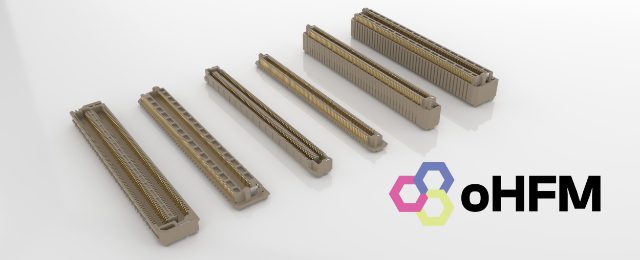
oHFM.c, available through Samtec, as well as Mouser, targets mid- to high-end FPGAs that need high I/O counts and high-speed interfaces, offering from 332 to more than 1,200 pins across its form factors.
Inside oHFM.c, the mechanical scheme scales with connector count. Size-S1 uses a single connector on a 75 × 50 mm module for low-end devices. Size-S and Size-M use two connectors, Size-L uses three, and Size-XL uses four on a 75 × 120 mm module. Extended variants add 20 mm of module length for more PCB area without moving up to a larger base size.
The standard’s module-side connectors are 320-pin receptacles mounted on the module’s bottom side, mating with plugs on the carrier, providing high-density channels on a 0.635 mm pitch with performance targets of 64 Gb/s PAM4 or 112 Gb/s PAM4. Each is designated J1 to J4 on the module, and each mates with the matching P1 to P4 plug on the carrier.
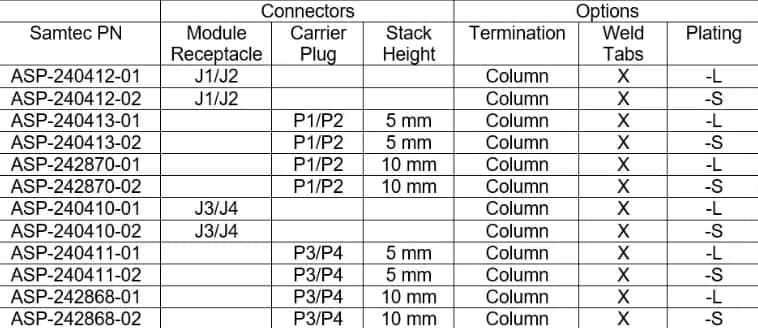
Within each connector, several Samtec technologies contribute to the effectiveness of the standard. The Edge Rate® contact system helps align the narrow edges of the contacts with the connector body, reducing broadside coupling and crosstalk. Additionally, the board attachment method uses an IPC Class 3-compliant solder column technique. This is the highest manufacturing standard and enables oHFM designs to meet the requirements for industrial and medical designs. Class 3 compliance ensures reliability in critical systems designed for long service life and exposure to harsh environments, such as military, medical, and space systems.
Visit SGET or Samtec to learn more about the oHFM standard.
Like this article? Check out our other High-Speed and Standards articles, our Industrial Market Page, and our 2026 Article Archives.
Subscribe to our weekly e-newsletters, follow us on LinkedIn, Twitter, and Facebook, and check out our eBook archives for more applicable, expert-informed connectivity content.

- oHFM: An Open Standard Brings Connector Discipline to FPGA Modules - November 3, 2026
- Connectivity Is Reshaping Police and Security Vehicle Fleets - September 8, 2026
- Thermal Management Strategies with Liquid Cooling Connectors - August 11, 2026