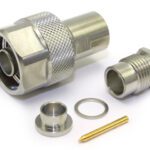
Custom Cable Assemblies: A Value-Add Solution
A custom cable assembly meets the customer’s requirements, reduces assembly time, ensures consistent signal integrity, and simplifies supply chain management.
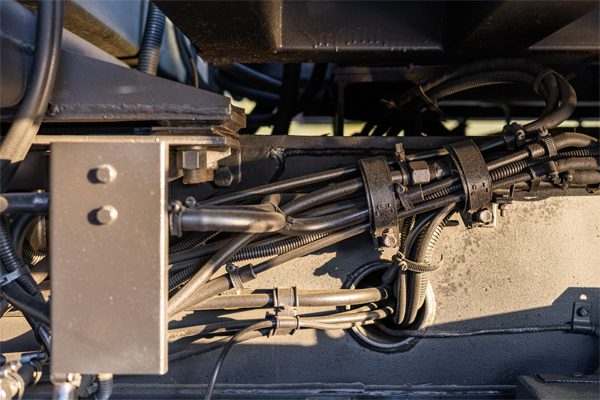
Cable assemblies streamline system integration and maximize reliability. Custom cable assemblies ensure that every component meets all the specific and unique requirements of the application with a complete, ready-to-install solution.
“The term, custom cable assembly, essentially speaks for itself,” said Tanner Rogers, cable solution product specialist at Amphenol PCD. “It gives the engineer, the contractor, or the customer the ability, and I would say autonomy, to design something that integrates with their current platform and meets their exact specification requirements.”
Incorporating a ‘one of one’ element has advantages over a COTS (commercial off-the-shelf) product that is widely available. A custom cable assembly gives the customer greater control, particularly for something that will be used for one system only. “Whoever designs the actual cable has design authority, which can be a competitive advantage,” said Rogers. “A custom cable assembly can be modified in a specific way for the application it’s going into.” For example, in battleground environments a cable on an aircraft or a military truck likely will be exposed to intense vibrations and environmental conditions like dust, rain, mud, and even EMI. A custom solution allows for designing the cable assembly with protection from the specific environmental conditions it will face.
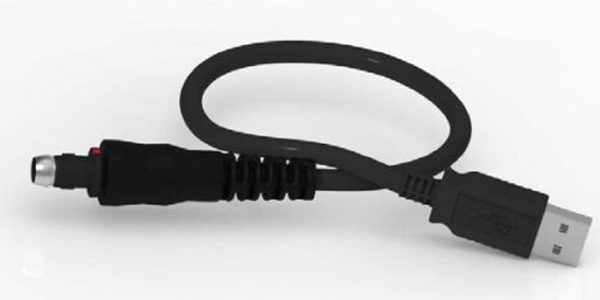
Amphenol PCD offers Nett Warrior-compatible solutions with extensive customization capabilities to meet the unique demands of military communications and tactical applications — misson-ready solutions built for reliable performance in the field, from tailored cable assemblies to ruggedized interconnect configurations.
One important customization option for harsh environments is overmolding. “This is one of our main capabilities at PCD. Overmolding provides that extra sealed protection for the cable. Something that you just buy off the shelf wouldn’t have that level of protection in terms of sealing of the actual cable and assembly,” Rogers said. “For this reason, a lot of what we see in the defense industry is custom because the applications that the cables are going into and the requirements they need to meet are critical.” Off-the-shelf solutions often have the advantages of a lower price and being more readily available, however they are meant to accommodate a broad range of applications and they typically don’t have the ability to meet unique and targeted requirements at this level.
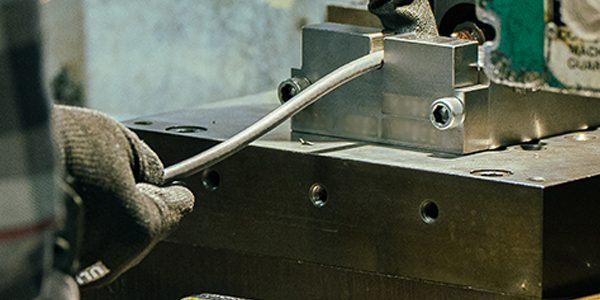
Amphenol PCD’s overmolding capabilities provide durable, reliable protection for cable assemblies in demanding environments. These custom solutions enhance strain relief, environmental sealing, and long-term performance to meet the unique requirements of aerospace and defense applications.
Value add
Rogers explained that, from an Amphenol perspective, value add describes the full valued solution available to a customer in the form of a fully customized assembly. “Rather than the customer having to identify, purchase, and assemble the individual components, we can do that all for them. When we make a custom cable, we get all the components that go into the assembly — the connector, the back shell, the actual raw cable itself, and anything else that’s necessary — and we do all the manufacturing to build that assembly in-house. This includes terminating the cable to the connector, the overmolding, the testing,” he said. “We can most likely get the components at a lower cost, so we can give them a less expensive, more ruggedized, and more durable assembly than what they can make in-house, so they can focus on their top level solution.”
The process
The process of developing a custom cable assembly varies somewhat from customer to customer, depending on how clear and detailed they are about what they need.
“The customer might start by submitting a paragraph of what they’re looking for to PCD or filling out the custom cable intake form on our website. Our engineering team will take that information, most likely ask additional questions, and mock-up a drawing of a cable assembly, if the customer doesn’t supply one. The drawing will illustrate something completely unique and custom, based off what the customer needs,” said Rogers. “They might ask for a 20-gaugewire, a connector with 12 contacts, with a size 18 shell that can connect to their system. Our engineers will then design a 2D drawing and a 3D CAD model of the assembly, all from scratch — using their experience and doing research to make sure they’re pulling the right components — and propose that to the customer for review.”
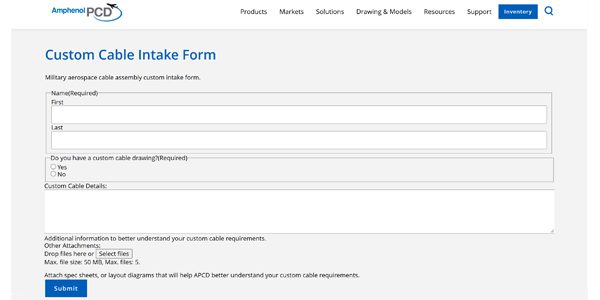
Explore Amphenol PCD’s online Custom Cable Inquiry Form to share your project requirements and find the right interconnect solution for your needs, from custom configurations to application specific solutions.
“Usually the more established customers, like the Lockheed Martins or the Northrop Grummans, already have their designs established. They know what they want, and we just build based off their drawing. The smaller customers typically need recommendations, so we get on a call with them and talk through it,” said Rogers.
All this information allows the engineers to create the cable assembly that best meets the customer’s requirements, while also reducing assembly time, ensuring consistent signal integrity, and simplifying supply chain management.
Visit the Preferred Supplier page for Amphenol PCD to learn more about the company and its products.
Like this article? Check out our other Cable Assemblies articles, our Connector & Cable Special Topics Market Page and our 2026 Article Archives.
Subscribe to our weekly e-newsletters, follow us on LinkedIn, Twitter, and Facebook, and check out our eBook archives for more applicable, expert-informed connectivity content.

- Custom Cable Assemblies: A Value-Add Solution - October 13, 2026
- Fiber Optics Product Roundup - October 13, 2026
- October 2026 Connector Industry News - October 13, 2026