High Voltage Interlock for Commercial Vehicles: A Must-Have or a Nice to Have?
When designing industrial and commercial transportation vehicles with high-voltage batteries and related systems, manufacturers and system integrators face an important question: Is a high voltage interlock, or HVIL, necessary at every high-voltage interface?

Article Contributed By Daniel Domke, Senior Manager, Product Management, Industrial & Commercial Transportation, TE Connectivity
For trucks, buses, construction equipment, and mining vehicles, the answer is complex and can have implications beyond a single connector. An unnecessary component or monitoring circuit can add system complexity, create another potential failure point and even affect vehicle uptime. While there’s no question that HVIL can serve an important safety function, using it indiscriminately or misunderstanding its purpose can add cost and complexity without delivering the expected benefit.
Understanding HVIL
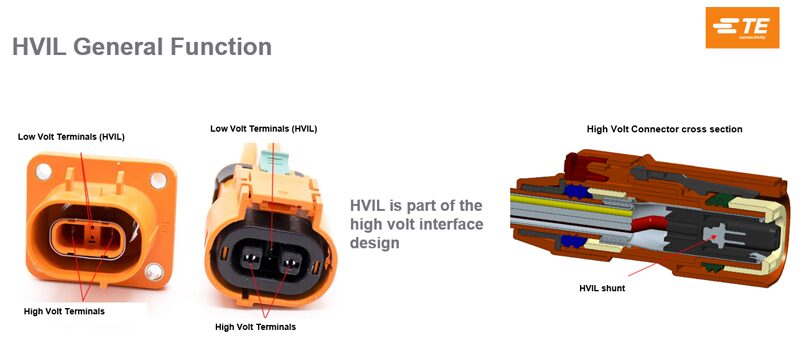
The primary purpose of HVIL is to help prevent arcing when a high-voltage connector is disconnected while current is flowing. The function itself originated in industrial applications but has since been adopted in transportation systems to support safer high-voltage operation.
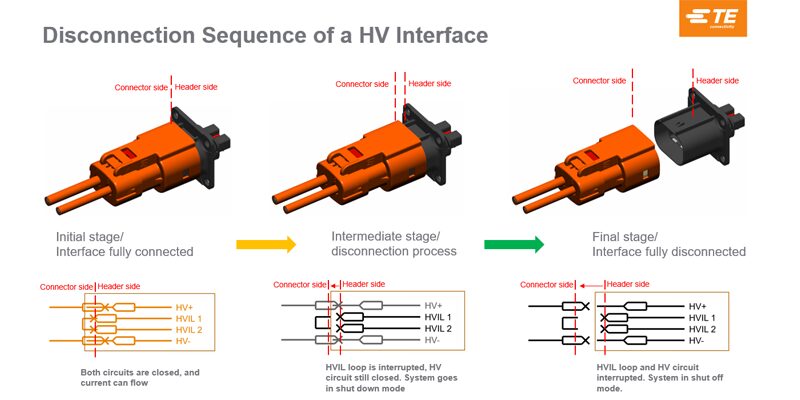
At its core, HVIL is a monitoring function integrated into a high-voltage interface through an additional low-voltage, low-current loop. During connector disconnection, the HVIL loop is designed to open before the main high-voltage terminals separate. That interruption signals separate system logic to shut down the main current path before the high-voltage connection is fully opened.
This sequence is central to HVIL’s intended function. When the interface is fully connected, both the HVIL and high-voltage circuits are closed. As disconnection begins, the HVIL loop opens while the high-voltage circuit remains temporarily connected, initiating system shutdown. The high-voltage terminals then separate after the system has had an opportunity to respond.
This operating principle is relevant to all high-voltage systems in all vehicle types and segments, but particularly industrial and commercial transportation vehicles since trucks, buses, construction equipment, and mining vehicles can include high-voltage interfaces across several systems such as battery, charging, powertrain, and various auxiliary applications like heaters or hydraulic pumps.
Three common misconceptions about HVIL
- HVIL confirms whether a connector is fully and correctly mated. A closed HVIL loop may be interpreted as evidence that the connector is properly inserted, but connector presence assurance is not HVIL’s intended purpose. The function is designed to identify the start of a disconnection sequence, not to provide comprehensive confirmation of interface status during vehicle operation.
- HVIL acts as a circuit breaker. Someone servicing a vehicle may disconnect a high-voltage connector with the expectation that the interlock will immediately make the system safe. While HVIL provides a signal to separate shutdown logic, it does not itself interrupt the main current path or act as a circuit breaker.
- HVIL directly protects individuals from touching high-voltage components. HVIL is specifically designed to support the prevention of arcing during connector disconnection under load. Therefore, treating it as a broader protective mechanism can create misplaced confidence in the system.
The timing, safety and complexity challenges of HVIL
Even when HVIL is used for its intended purpose, its effectiveness depends on timing. If a connector is pulled quickly, the interval between the HVIL contacts opening and the main power contacts separating may be only one to three milliseconds. However, a complete system shutdown may require close to one second, meaning the system may not have enough time to remove power before the high-voltage terminals separate. While this does not make HVIL irrelevant, it means engineers must evaluate the function as part of the complete vehicle system, considering the connector’s disconnection sequence, system shutdown behavior, and the time available to respond.
Integrating HVIL can also affect interface geometry, mechanical tolerances, tooling, assembly, and validation. For instance, additional cables may require routing, fixation and protection, increasing complexity and limiting opportunities for automation. What’s more, each interlock circuit can introduce another potential failure point. A broken wire, poor contact or damaged section of insulation can interrupt the loop and trigger a warning or vehicle shutdown even when the primary high-voltage system remains functional. For trucks, buses, construction equipment, and mining vehicles, unnecessary shutdowns can directly affect availability and uptime.
It’s important to understand that more HVIL interfaces do not necessarily create a safer or more reliable vehicle. If a truck has 50 high-voltage interfaces but system analysis determines that only 20 require HVIL, selective implementation could eliminate 30 unnecessary potential failure points while preserving the function where it provides a defined benefit.
Making HVIL a system-level decision
Vehicle architectures are often evaluated application by application, with battery, charging, and powertrain teams including similar monitoring functions as a precaution. At the complete vehicle level, some conditions may already be monitored elsewhere, and duplicating those functions can add complexity without providing a meaningful additional benefit.
HVIL should therefore be considered at the system level. Instead of asking whether it should be included everywhere, engineers should consider its specific purpose at each interface, whether the system can respond within the available time and whether the condition is already monitored elsewhere. Ultimately, HVIL is a must-have where system analysis demonstrates a need and where the interface and shutdown logic can support its intended purpose. At other interfaces, omitting it may reduce cost and complexity while improving overall vehicle reliability.
At TE Connectivity, we work directly with manufacturers and system integrators to evaluate complete high-voltage architectures and make technically grounded decisions about HVIL implementation. The goal is to apply HVIL in the right location, for the right reason, and as part of a system capable of responding as intended.
To learn more about HVIL, visit TE Connectivity.
Like this article? Check out our other Batteries articles, our Transportation Market Page, and our 2026 Article Archives.
Subscribe to our weekly e-newsletters, follow us on LinkedIn, Twitter, and Facebook, and check out our eBook archives for more applicable, expert-informed connectivity content.

- Printing at the Edge of Possibility: How TE Connectivity Leverages Micro-3D Printing - October 13, 2026
- A Five-Layer Clad Solution for High-Performance Battery Interconnects - October 6, 2026
- High Voltage Interlock for Commercial Vehicles: A Must-Have or a Nice to Have? - September 29, 2026