Interconnects in the Entertainment Industry
From live theater and recorded music to video wall backdrops, connectors and cables play an essential role in the entertainment industry. To make sure the show goes on, these components must be rugged as well as precise and evolve to meet the latest trends in media.
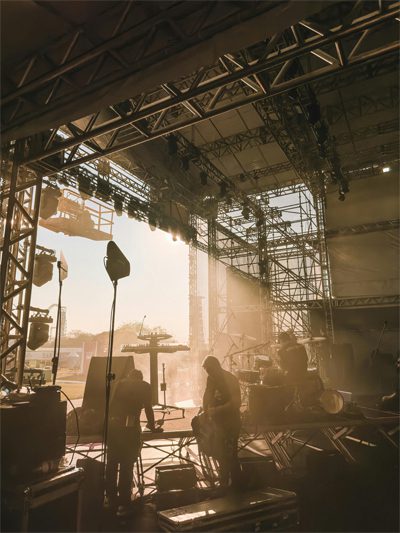
Before Brant Mathiason worked in the connector industry, he was an end user in the LED video display world. One day setting up a test run in preparation for an AC/DC concert, he was dismayed to see a truck run right over a Neutrik opticalCON connector and cable; he thought for sure the equipment was ruined. “Luckily, we were in a gravel parking lot and the gravel kind of displaced the weight on the connector, rather than it taking a direct hit on asphalt. Everything worked really well and I was sold on Neutrik’s quality,” said Mathiason. “That was the moment I went from being a user to being an advocate. I can’t imagine being the one responsible for stopping an AC/DC show because a fiber connector failed. It didn’t, and that changed how I thought about this product category entirely.”
Commercial versions of most common AV connectors aren’t roadie-proof, says Mathiason, now a customer solutions engineer at Neutrik. “If connectors are built to survive the way roadies handle gear, they can survive just about anything.” Film sets, TV studios, recording studios, and arena shows are essentially harsh environments. Ruggedized and high reliability components help protect entertainment events from rough handling, set vehicles, weather, and electromagnetic interference. The right connectors help ensure that the show goes on.
Mathiason said that Neutrik’s design team learns from user experiences to create connectors that endure the real-world conditions of the entertainment industry while maintaining focus on pure sound and vision. “We use virgin materials for gold platings, not recycled metals that might have trace contaminants. The thickness of the plating matters too. If you look at a cheap guitar cable plug that gets dragged across a concrete floor, you’ll see scratches in the plating, and that’s where intermittent signal noise comes from,” he said. “We actually design our own plastic and rubber formulations, glass fibers, and other materials, rather than just using off-the-shelf materials. Those compounds have to handle everything from desert heat to freezing temperatures, and UV exposure for outdoor use. We run UV tests at 600 and 1,400 hours depending on the application.”
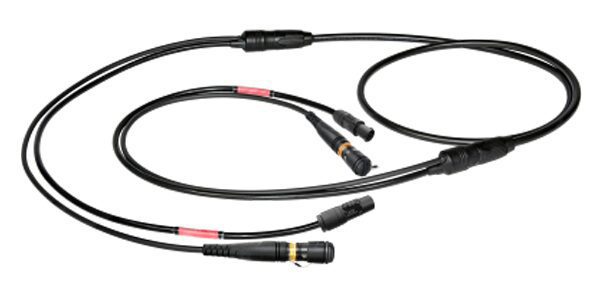
Neutrik’s opticalCON POWERSPLIT is a multi-channel solution based on the opticalCON and powerCON TRUE1 connectors. Perfect for applications where a high volume of cabling is required, one hybrid cable can replace up to 7 standard cables, reducing spooling efforts, weight, and space requirements.
Historical accuracy matters
The three-pin XLR connector, also known as a Cannon plug, has reigned supreme in professional audio for decades. Its balanced signal design rejects interference across long cable runs, making it indispensable for live sound reinforcement, broadcast, and studio recording. A Neutrik XLR cable connector even starred in a closeup graduation scene in the series finale of “Stranger Things”; a NC3FXX was used in a microphone setup. But sharp-eyed audiophiles noticed a problem: The connector wasn’t available in 1989, when the episode is set. “Unfortunately, it is not historically accurate. That connector wasn’t introduced until July 2000,” said Mark Boyadjian, Customer Solutions Director at Neutrik.
“You see incorrect connector use all the time in TV and movies. I saw it in the Julia Childs series as well. We weren’t even in business when that show was set. Some shows have AV historians on staff to ensure products used are historically accurate. We’ve worked with the technical director for ‘Nashville,’ and other shows.”
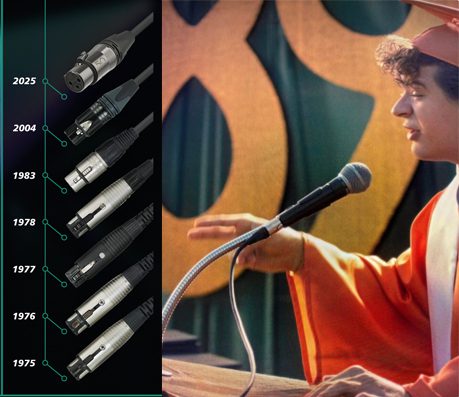
So many end users know Neutrik connectors from high school theater and music experiences that when a Neutrik NC3FXX connector appeared in the “Stranger Things” finale, many viewers knew from experience that the model wasn’t historically accurate.
Sound, signal, safety, and speed
Protecting sound quality remains a top consideration, and changing technologies in recording, microphones, and speakers have pressed connector companies to improve their products to maintain signal clarity and exclude interference in environments where multiple types of equipment are present.
“The plating quality directly affects signal quality. A scratched or inconsistent contact surface creates noise, especially with low-level signals like a microphone,” said Mathiason. “On the electrical side, we build EMI shielding into our metal housings so that the connector itself acts as part of the ground path for shielding. That’s increasingly important as more gear goes digital and wireless. You have cell phones, wireless microphones, cell towers, all kinds of radio frequency noise in the environment. A clean, properly shielded connector keeps that off your audio lines. And as network speeds increase — going up into high-speed Ethernet and fiber — signal integrity becomes even more critical. Grounding and shielding aren’t optional features; they’re fundamental.”
During live events, speed is of the essence as crews race to change equipment very quickly in dim lighting. AV connector design has evolved to prioritize user friendliness. Around 1980, Neutrik introduced an updated XLR connector with tool-less assembly, said Mathiason. “Earlier connectors used small screws for strain relief, and in a dark backstage environment, if you dropped one of those screws, you had to dig out a whole new assembly. Our founders developed a chuck-style strain relief — think of how a drill tightens a bit with a hand-twist — that made terminating cables fast and reliable without any tools.”
These same operating conditions could introduce shock risks. The next big evolution in entertainment connectivity addressed the safety factor. “In the early ’80s, Neutrik noticed that people were using quarter-inch audio plugs to connect high-powered speakers, which created a shock hazard and a mess of mismatched connections. That led to the speakON connector — a locking speaker connector that borrowed the tool-less strain relief concept and added real protection,” said Mathiason. “From there came the powerCON family for locking power connections. People were using speakON connectors for power, and if the labels fell off, you could accidentally swap a speaker signal cable with a power cable into the same-looking connector. PowerCon solved that with offset keying so the two can’t be mixed up.”
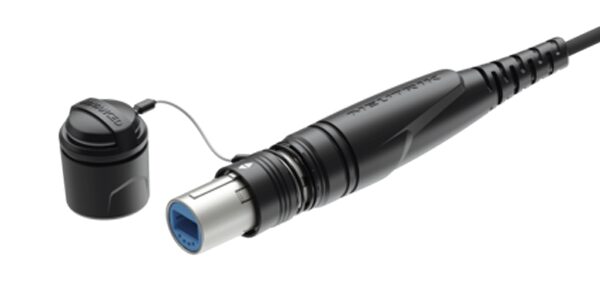
The stainless steel armoring of Neutrik’s opticalCON ARMORED cable is enormously robust to resist extraordinary abuse. Even with the armoring, the cable remains flexible and easy to handle. It accommodates two PC optical channels based on conventional and proven LC connectivity protected by a ruggedized and durable all-metal housing.
“Then networking came along, and we developed the etherCON — essentially a ruggedized RJ45 in the same footprint as an XLR, so it fit the same panel cutouts people already had in their equipment racks. And as fiber optics grew, we built the opticalCON family, which now goes up to 48 fibers in a single connector. Each generation listened to what the industry needed next.”
Entertainment today
Live performance widely includes LED video walls, and this technology is now moving into film and television. “In the last five or six years, massive, curved LED walls have become a major part of how films and TV shows are made. The technology has evolved incredibly fast. For a setup like that, you’re essentially deploying a large-scale live event production inside a studio,” said Mathiason. “The LED tiles themselves are typically powered by powerCon connectors and networked via etherCon. If you have very large data runs — say, getting signal from a central processor out to different sections of the wall — opticalCon handles that. Then you have all the lighting fixtures on top of that to match the ambiance of the background image, plus the entire audio chain for any live sound capture.”
“The video processing technology has gotten so good that the seams between panels are virtually invisible on camera, and the resolution is high enough that you can’t detect the LED pixel structure. It’s seamless. The price drop in high-resolution LED components over the last decade is really what made it viable — costs came down, processing power went up, and now it’s standard practice at major studios.
Entertainment technologies continue to change and the connectors behind them must evolve in tandem. At the 2026 NAB conference, Neutrik released the opticalCON TRUE1 Data Series environmentally sealed connectors for heavy-duty and harsh environment applications of entertainment equipment like PA systems, signs and LED screens, or lighting. “This series has locking, IP-rated versions of USB-C, Cat 6A Ethernet, and a compact two-fiber opticalCon — what we’re calling opticalCon Duo — all in the same D-series form factor that our panel-mount connector line established. The outer housing is the same across all of them; only the internal modules change. That’s a big deal for system designers because it simplifies panel layouts and inventory.,” said Mathiason.
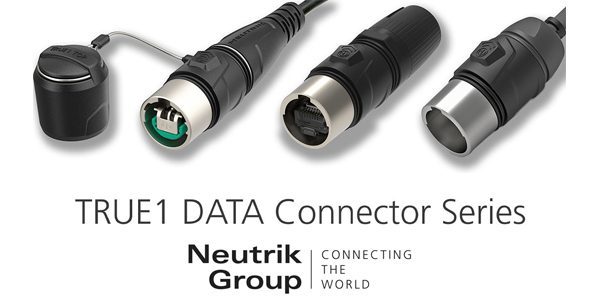
“For the etherCon update, we specifically moved the latch from the panel-mount side to the cable connector side, so disconnecting is now a one-hand operation — press and pull. The opticalCon Duo is roughly half the length and diameter of the previous opticalCon, which matters in tight rack situations. The immediate application for these data connectors is production facilities where people are moving very large files locally — a drive that takes hours to upload over the internet gets sent across the room in a locking, ruggedized connection. Production houses also like having a panel-mount breakout connector for USB-C so that when the port wears out from constant plugging and unplugging, they replace a $50 panel connector rather than a $10,000 piece of equipment.”
For this rapidly changing market, a focus on flexibility and quality enables set and sound designers to be prepared for the unexpected. In 2025, the annual Tomorrowland music festival in Belgium suffered a major fire two days before the show. “Our team in Europe mobilized immediately, got the right connectors and cable infrastructure in place, and the concert went on at a sister venue,” said Mathiason. “Every type of connector I’ve talked about was involved: fiber, power, data, audio. The show happened because the people and the product were there when it counted.”
Like this article? Check out our other Ruggedized, Displays and Quality articles, our Connector & Cable Special Topics Market Page and our 2026 Article Archives.
Subscribe to our weekly e-newsletters, follow us on LinkedIn, Twitter, and Facebook, and check out our eBook archives for more applicable, expert-informed connectivity content.

- Connectivity Is Reshaping Police and Security Vehicle Fleets - September 8, 2026
- Thermal Management Strategies with Liquid Cooling Connectors - August 11, 2026
- Rodent-Resistant Electronics - July 28, 2026