5G RedCap Bridges the Gap from 4G to 5G
This streamlined network makes upgrading to a faster network cost effective for companies that want more than 4G but don’t need all the bells and whistles of 5G.
The arrival of the 5G mobile network brought several major improvements including ultra-fast speeds (eMBB), ultra-low latency (URLLC), and massive device connectivity (mMTC). Compared to 4G, 5G is 100 times faster and can connect to 100 times more devices (1 million per square km). Its lag time for sending and receiving information is below 1 millisecond, compared to ~10 to 50 milliseconds on 4G. While these improvements benefit a wide range of applications and users, they are more than what is needed for many IoT applications. 5G RedCap (reduced capability) makes upgrading cost effective for companies that want more than 4G but don’t need all the bells and whistles of 5G.
“5G RedCap is developed to serve use cases which are not optimized for typical 5G. It offers lower bandwidth and fewer features but also reduces the complexity and power consumption of regular 5G. 5G RedCap is suitable for applications like industrial sensors, wearables, or video that require higher data rate than LTE or other radio protocols,” said Rodrigo De La Peña Gutierrez, Antenna Technical Marketing Manager, EMEA at KYOCERA AVX.
Also called 5G NR-Light, as a scaled-down version of 5G, 5G RedCap is ideal for IoT applications needing greater speeds and lower latency, but not at the extreme levels (or the cost) of 5G. It supports peak data rates far higher than 4G LTE CAT-1, for applications like video surveillance or smart grid monitoring that need more data throughput. With latency comparable to 4G LTE, it supports industrial automation and other applications that require near real-time data communication. 5G RedCap can bring safety and efficiency to industrial settings by supporting wireless sensors that monitor and control machinery. It can transmit security video in real-time and improve the reliability and efficiency of power grids.
Wearables, devices that monitor utility meters, devices for asset tracking, and similar applications that transmit small bits of data benefit from this streamlined, mid-tier, cellular network. Power is required to generate a signal, to send it out, and to receive it, and 5G RedCap reduces cost by reducing the amount of power it takes to perform these functions. This may be because fewer signals are being transmitted or due to decreased bandwidth. This makes more power available to the device itself. Improved power efficiency helps extend battery life in battery-powered IoT devices.
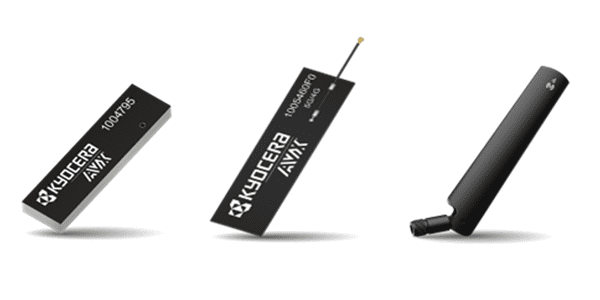
KYOCERA AVX 5G RedCap antennas for IoT applications requiring low-mid data rates, improved power consumption, and lower cost.
Existing wideband antennas can be tuned to the correct frequencies, which are determined by the carrier. The previous generation, 4G or LTE, typically required two antennas per platform, main and diversity. This IoT revolution and its very low data rate — the narrow band IoT or LTE-M — needs only a single antenna. Lower data rates mean lower cost and enable more devices onto the networks. The 5G side is evolving as well toward simpler, lower data rate, and ultimately lower cost. Customers are looking for low power which translates to better battery, lower battery cost, and lower product cost.
Visit the Preferred Supplier page for KYOCERA AVX to learn more about the company and its products.
Like this article? Check out our other articles on our Sensors/Antennas Market Page, and our 2025 and 2026 Article Archive.
Subscribe to our weekly e-newsletters, follow us on LinkedIn, Twitter, and Facebook, and check out our eBook archives for more applicable, expert-informed connectivity content.

- Custom Cable Assemblies: A Value-Add Solution - October 13, 2026
- Fiber Optics Product Roundup - October 13, 2026
- October 2026 Connector Industry News - October 13, 2026