How to Choose Micro-Connectors for Drones: 4 Criteria
Drones and UAVs are faster, smarter, and lighter than ever. Learn how to specify the right high-performance interconnects for these machines.
By Nicomatic
As drones evolve to carry more sophisticated payloads and operate in harsher environments, connector design plays an increasingly important role in ensuring performance, durability, and signal integrity. In particular, micro-connectors are critical to drone and UAV performance. Very small, lightweight connectors link power systems, sensors, cameras, navigation modules, and flight controllers. They must deliver reliable connectivity while minimizing the weight they contribute to the overall system.
Choosing the right micro-connector can determine whether a drone delivers stable flight, clean data transmission, and long-term reliability or suffers from costly failures in the field. Engineers evaluating options must balance electrical, mechanical, and environmental demands while minimizing size and weight.
Four essential criteria stand out in this selection process: size and weight, ruggedness against shock and vibrations, electrical performance, and mechanical reliability. Understanding how these criteria interact helps design teams select interconnects that meet mission-critical requirements and also contributes to how efficiently the drone can be manufactured, maintained, and upgraded.
Four essential criteria to consider when choosing micro-connectors for drones and UAVs
- Size and weight
Drones and UAVs are becoming faster, smarter, and lighter, which requires high-speed, high-performance cables and connectors that optimize weight, performance, and durability. In addition, drones and UAVs feature electronic systems that must withstand extreme conditions, including military and aerospace environments.
For critical defense and security applications, drones and UAVs fully depend on the quality of their internal equipment. Engineers that specify electronic connectors for these applications must prioritize robustness, lightness, and reliability to ensure autonomy and endurance, whether used for transport, surveillance, tracking, or intelligence gathering.
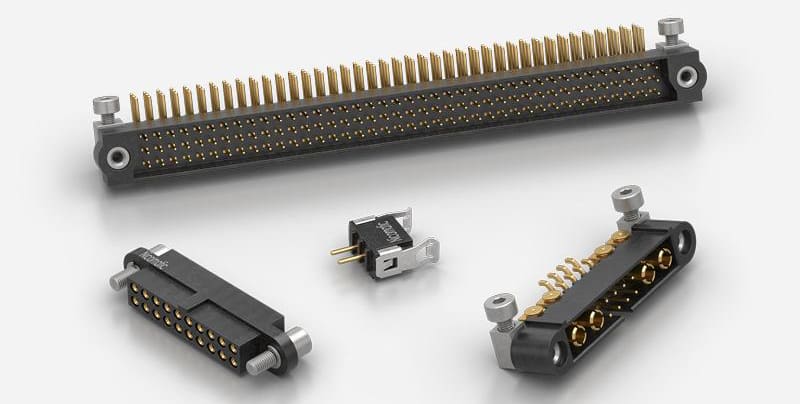
Some connector selection strategies save space without compromise. Consider components that combine power, signals, data, or RF in a single hybrid connector. In these mixed configurations, multiple types of contacts are grouped in a single housing. This enables:
- Significant space savings
- Simplified harness routing
- Improved connection reliability by reducing the number of critical interfaces
Hybrid configurations are ideal for compact embedded systems like drones, where every gram and millimeter count.
- Resistance to shocks and vibrations
Drones undergo significant mechanical stress, including shocks during takeoff and landing, and continuous vibrations in flight. These forces can weaken connections and lead to malfunctions. Connectors compliant with MIL-55302 and MIL-83513 standards are solid choices for durability.
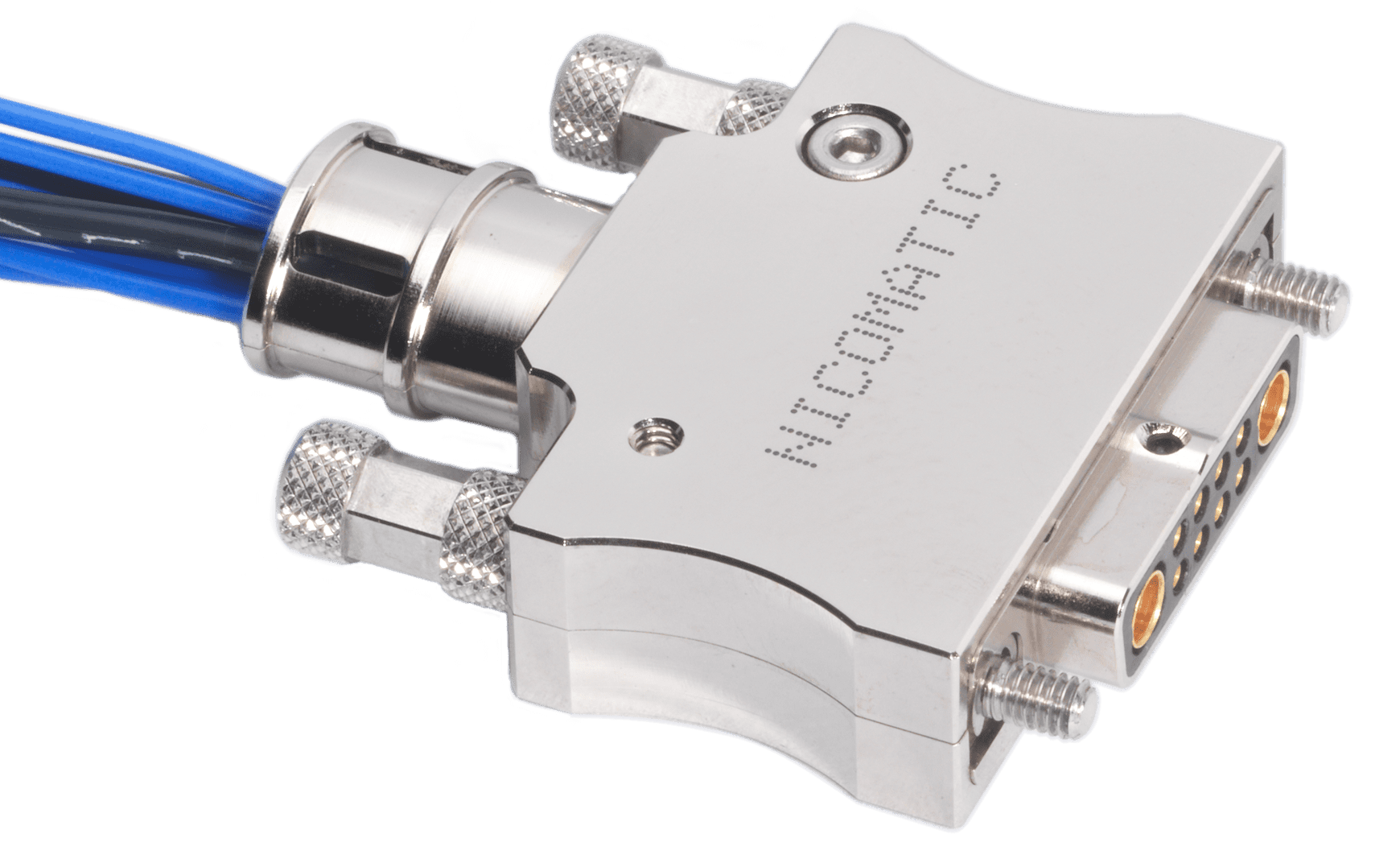
Other features to consider include:
- Captive screws
- Quarter-turn locking systems
- Integrated positioning guides
These solutions prevent the loss of small parts, simplify assembly, and facilitate maintenance, especially during field operations.
- Limiting electromagnetic interference
Electromagnetic interference (EMI) is a major threat to drones. Their dense electronic environment and reliance on wireless communication make them vulnerable. EMI can disrupt critical operations or even cause loss of control. Best practices to reduce EMI interference include:
- Use metal backshells to ensure shielding continuity through the harness.
- Integrate seals filled with conductive particles to reinforce electromagnetic sealing at interfaces.
- Protect cables with shielding accessories (braids, metal sleeves).
- Favor integrated plates to improve mechanical integration and limit failure zones between the connector and structure.
Micro-connectors with EMI shielding ensure stable circuit operation even in demanding environments.
- Reliable service life in harsh environments
Drones and UAVs require components that are ruggedized to withstand extreme conditions. Whether it’s desert heat or Arctic cold, connectors must handle varied temperatures, as well as dust and moisture.
Choosing durable and high-quality micro-connectors ensures consistent performance throughout the mission. High quality, resilient components reduce maintenance, extend inspection intervals, and generates long-term savings.
Other criteria to consider when choosing interconnects for drones:
- Ease of maintenance through practical locking systems: captive screws, quarter-turn, tool-free
- Compatibility with production constraints: Easy integration in surface-mount (SMT), through-hole (THT), or manual cabling for prototyping and serial production.
- Modularity and scalability: Possibility to evolve or reconfigure the system without redesigning the entire interconnect architecture.
- Traceability and compliance: Clear marking, error-proof coding, compliance with MIL, EN, or IPC standards based on final application.
- SWaP-C optimization: Every component must contribute to minimizing size, weight, power consumption, and cost, while ensuring reliability.
Visit Nicomatic to see more solutions for drones and UAVs.
Like this article? Check out our other High Density, High-Reliability articles, our Military and Aerospace Market Page and our 2025 Article Archives.
Subscribe to our weekly e-newsletters, follow us on LinkedIn, Twitter, and Facebook, and check out our eBook archives for more applicable, expert-informed connectivity content.

- The Challenges of Electric Flight: How Engineers Are Rethinking Power - October 20, 2026
- Printing at the Edge of Possibility: How TE Connectivity Leverages Micro-3D Printing - October 13, 2026
- A Five-Layer Clad Solution for High-Performance Battery Interconnects - October 6, 2026