Designed to Survive: The Critical Role of Connectors in Harsh Environments
Harsh environments leave no margin for error. Whether deployed deep underwater, high in the sky, inside surgical equipment, or on the battlefield, connectivity must perform flawlessly under extreme conditions. Exposure to vibration, shock, temperature extremes, moisture, chemicals, and electromagnetic interference turns a simple interconnect into a mission-critical component.

Article contributed by Casey Cavender, CFO, Kensington Electronics Inc.
From aerospace and defense systems to medical devices, industrial automation, and offshore energy applications, connectors are expected to maintain signal integrity, power delivery, and mechanical stability where failure can mean mission loss, safety risks, or catastrophic downtime. In these environments, reliability isn’t a feature, it’s a requirement.
When connectivity fails: real-world consequences
In harsh environments, connector failures rarely announce themselves clearly. They often appear as intermittent faults—momentary signal losses, unexplained resets, or degraded performance that disappears during bench testing but resurfaces in the field. A systems engineer responsible for unmanned platforms once summarized it bluntly: “When the connector fails, the system doesn’t degrade gracefully—it just stops.”
In defense and security applications, a connector that loosens under vibration can instantly cut off live video or sensor data from an unmanned ground vehicle, leaving operators blind mid-mission. In mining and heavy industrial automation, a failed interconnect can shut down equipment thousands of feet underground, turning a small component issue into prolonged and expensive downtime.
In these systems, connectors are often required to support high-speed data, power, and control signals simultaneously, while maintaining mechanical stability under constant vibration and shock. Backplane and embedded system architectures used in mission computers, vehicle electronics, and ruggedized control units place additional demands on connector design, particularly in terms of signal integrity and retention force.
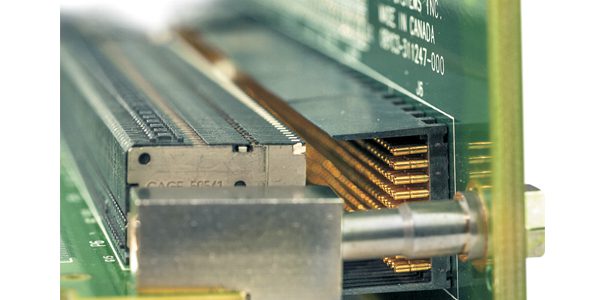
Smiths Interconnect, KVPX+ Series
One example of an engineering response to these challenges can be seen in ruggedized backplane connector solutions such as the KVPX+ Series from Smiths Interconnect. Designed for defense and harsh-environment embedded systems, KVPX+-style connectors address the need for high-density, high-speed data transmission while maintaining mechanical robustness in applications exposed to sustained vibration and impact. “When connectivity is carrying situational awareness or control data, even a momentary interruption can have outsized consequences,” one defense systems engineer noted.
The rise of USB-C as a universal interface for data, video, and power transmission has introduced a new challenge in harsh environments. While USB-C offers clear advantages in terms of performance and interoperability, its origins in commercial electronics mean that standard implementations are not inherently suited for sustained vibration, shock, or field handling common in military and industrial systems.
In defense vehicles, unmanned platforms, and ruggedized industrial equipment, USB-C connections may be used to support high-speed data links, video feeds, or power delivery to mission electronics. In these applications, maintaining secure mating and signal integrity under vibration becomes just as critical as electrical performance.
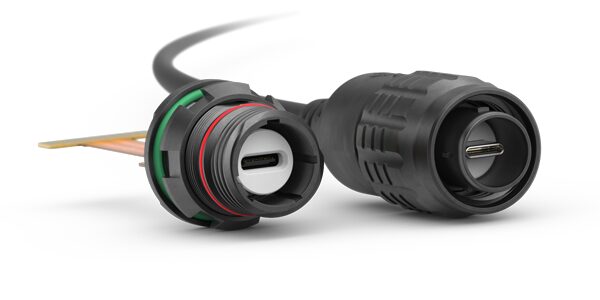
Fischer Connectors USB-C
The evolution of USB-C in harsh environments underscores a broader reality: vibration and shock, not bandwidth, remain the dominant threats to reliable connectivity. One example of how this challenge is being addressed can be seen in ruggedized USB-C connector designs developed by Fischer Connectors. By integrating mechanical locking approaches originally developed for harsh environments, such as ratcheting-style retention mechanisms, ruggedized USB-C solutions can preserve full USB-C functionality, including high-speed data transfer, video transmission, and power delivery, while meeting military and industrial environmental requirements.
“The interface itself isn’t the problem,” one systems engineer observed. “It’s making sure it stays connected when the environment is doing everything it can to pull it apart.” This evolution reflects a broader trend across defense and industrial sectors: adapting familiar, high-performance interfaces to environments where mechanical security and reliability are as important as bandwidth or convenience.
While defense and security systems often emphasize mission electronics and situational awareness, many of the same vibration-driven challenges extend directly into military vehicles and heavy industrial platforms.
Military vehicles and mining systems: designing for continuous vibration and impact
Military vehicles and mining systems operate in environments where vibration and shock are not occasional stressors, they are constant operating conditions. Tracked and wheeled military platforms, rail systems, and heavy mining equipment generate continuous vibration combined with sudden impacts from terrain, recoil, or material handling. Over time, these forces can loosen traditional locking mechanisms, leading to intermittent electrical contact that is difficult to detect during testing and even harder to diagnose in the field. “The worst failures aren’t total failures,” one field engineer explained. “They’re the ones that flicker just enough to make you chase ghosts.”
In these applications, connectors must maintain mechanical engagement and electrical continuity despite sustained vibration, repeated shock events, and frequent handling during maintenance or reconfiguration. Ease of use is also critical, as connections are often made in confined spaces, under poor visibility, or while operators are wearing gloves or protective gear.
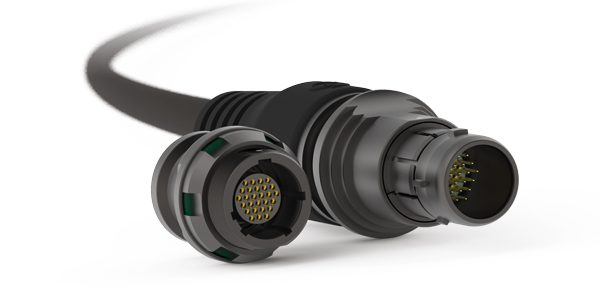
Fischer Connectors UltiMate Series
One engineering approach to this challenge can be seen in ruggedized connector designs that incorporate mechanical locking systems intended to resist loosening under dynamic loads. For example, Fischer Connectors has applied a ratcheting-style locking mechanism in its UltiMate series to address environments where vibration-induced unmating is a primary failure mode.
In the UltiMate size 15 contact configuration, this approach supports up to 27 contacts within a receptacle measuring 25.8 mm in diameter, while withstanding random vibration levels of up to 37.8 gRMS, exceeding the vibration profiles encountered in most ground vehicles and many aerospace applications. The same configuration is also designed to tolerate shock loads of up to 300 G, reflecting the impulsive forces common in off-road mobility, rail transport, and heavy industrial equipment.
Importantly, this level of mechanical robustness does not come at the expense of usability. Locking mechanisms intended for harsh environments must balance retention force with intuitive operation. In field conditions, connectors that require excessive force or complex actions to mate can slow maintenance and increase the risk of improper engagement. “If a connector can’t be connected correctly the first time in the field,” a systems integrator noted, “its vibration rating doesn’t really matter.”
By enabling secure mating and unmating through a simple rotational motion, ruggedized locking designs allow operators to establish reliable connections quickly and confidently, even in tight spaces or under adverse conditions. This balance between mechanical security and human factors is a recurring theme in successful military and mining system designs.
Medical devices: reliability under sterile, repetitive stress
Medical equipment presents a unique harsh-environment challenge. In addition to mechanical reliability and electrical performance, connectors must withstand repeated sterilization, strict size constraints, and intuitive operation in clinical settings where ease of use directly impacts patient safety.
One real-world example comes from the field of electrophysiology, where a medical device manufacturer sought an alternative to traditional high-cost, autoclave-compatible connector solutions. The application involved electrophysiology catheters used to map the electrical activity of the heart to detect arrhythmias.
These minimally invasive procedures access the heart through a small incision—typically in the groin—threading a disposable catheter through blood vessels rather than relying on open-heart surgery. The approach significantly reduces patient recovery time, but it places demanding requirements on the supporting hardware.
In this case, the connector needed to support up to 82 contacts in a compact form factor, deliver consistent electrical performance, and survive multiple autoclave sterilization cycles without degradation. Ease of use was equally critical, as clinicians rely on fast, reliable connections in time-sensitive environments. “In medical devices, connector failure doesn’t just mean downtime,” one biomedical engineer explained. “It means repeating procedures, delaying diagnoses, or compromising workflow in the lab.”
Smiths Interconnect’s D Series is designed to withstand up to 20 autoclave cycles. Utilizing a high strength polymer for both the plug and receptacle, the D Series is selectively loaded with up to 82 hyperboloid contacts, allowing conformity to most device requirements.
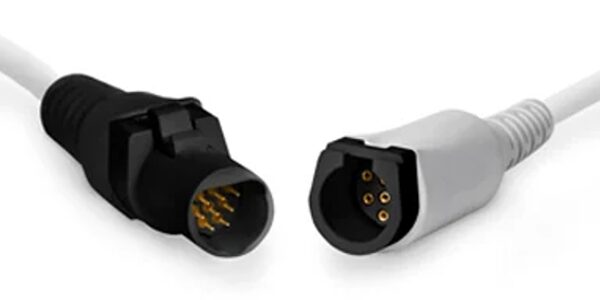
Smiths Interconnect D Series
Why contact technology matters in sterilized environments
Repeated autoclave exposure—commonly reaching temperatures around 250 °F (121 °C) for extended durations—introduces thermal stress, moisture ingress risk, and material fatigue. Traditional contact designs can lose spring force over time, leading to increased contact resistance or intermittent connections.
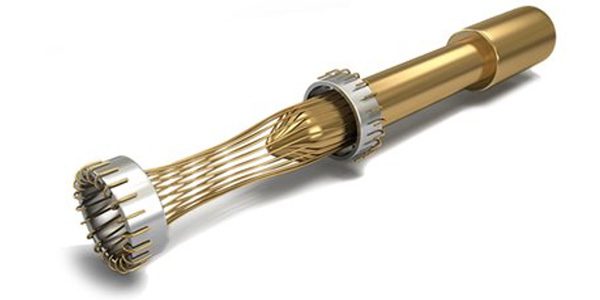
Hyperboloid Technology
In applications like this, contact geometry becomes as important as materials and sealing. Technologies used by Smiths Interconnect, such as its hyperboloid contact design, distribute contact force across multiple points rather than relying on a single beam or spring. This multi-point engagement helps maintain consistent electrical performance even after repeated sterilization cycles. “In healthcare, reliability has to be repeatable,” a design engineer noted. “A connector that survives one sterilization cycle isn’t enough, it has to survive multiple cycles without changing behavior.”
In addition to sterilization and reliability, many medical devices also face extreme space constraints, particularly in portable diagnostic equipment, wearable systems, and minimally invasive tools. In these applications, connectors must deliver reliable signal performance while occupying as little physical space as possible.
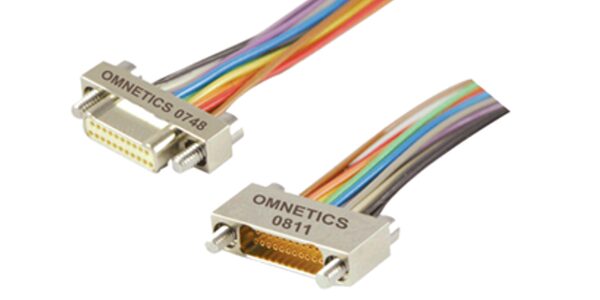
Omnetics Nano-D Series
One approach to this challenge can be seen in miniature, high-density connector solutions such as the Nano-D and Nano Circular families from Omnetics, which are commonly selected for medical and life-science devices where size, weight, and precision are critical. These designs allow engineers to integrate multiple signal paths within compact assemblies while maintaining the mechanical stability required for repeated use and handling. “In medical designs, miniaturization can’t come at the expense of reliability,” one product engineer noted. “The connector still has to perform the same way every time.”
Aerospace systems: reliability where size, weight, and vibration converge
Aerospace applications present a distinct harsh-environment challenge where size, weight, and reliability are inseparable design constraints. Avionics, satellites, unmanned aerial systems (UAS), and spaceborne instrumentation operate under continuous vibration, extreme temperature variation, and strict SWaP (size, weight, and power) limitations. In these environments, every gram and every cubic millimeter matters, yet reliability cannot be compromised.
Unlike ground-based systems, aerospace platforms must maintain signal integrity and mechanical stability while exposed to sustained vibration during launch or flight, rapid pressure, and temperature changes. There are also limited opportunities for maintenance once deployed. Connectors that are oversized or overly complex can introduce unnecessary weight and integration challenges, while connectors that lack mechanical robustness risk intermittent failures that are difficult or impossible to service after deployment.
“In aerospace, you don’t get a second chance to reseat a connector,” one avionics engineer explained. “Once it’s in the air or in orbit, it has to work.” To meet these demands, aerospace connectors are often required to deliver high contact density in extremely compact formats while maintaining secure mating under vibration and shock. This balance is particularly critical in avionics modules, flight control systems, and sensor payloads where multiple signal paths must be routed through limited space.
One example of this design approach can be seen in miniature connector solutions developed specifically for high-reliability aerospace and defense applications. Omnetics has addressed these requirements through its Nano-D and Nano Circular connector families, which are designed to provide high-density connectivity in ultra-compact, lightweight form factors.
Nano-D connectors, based on a scaled-down D-style interface, enable engineers to pack a high number of contacts into space-constrained avionics assemblies, while Nano Circular connectors offer a cylindrical alternative suited for applications where rotational alignment and vibration resistance are key considerations. Both formats are commonly selected in aerospace systems where maintaining electrical performance under vibration must coexist with aggressive SWaP targets.
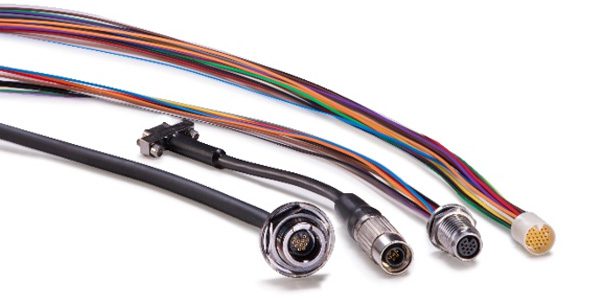
Omnetics Nano Circular connectors
Ease of integration is also a factor. Aerospace manufacturing and assembly often require precise, repeatable mating without excessive force or complex handling, especially when connectors are installed in densely populated assemblies or hard-to-access locations. “The challenge isn’t just making the connector survive vibration,” one systems engineer noted. “It’s doing that while keeping the connector small enough that it doesn’t drive the rest of the design.”
By addressing vibration tolerance, contact density, and mechanical stability within miniature designs, aerospace-focused connectors demonstrate how harsh-environment reliability can be achieved without sacrificing size or weight. As aerospace systems continue to push toward greater functionality in smaller platforms, connector solutions that successfully balance these competing demands become essential elements of overall system reliability.
Engineering responses: designing for reality
To survive these conditions, harsh-environment connectors rely on more than rugged housings. Secure locking mechanisms prevent accidental unmating under vibration and shock. Advanced sealing technologies protect against moisture and chemical ingress. Careful material selection preserves electrical performance and mechanical strength over long service lives.
Usability matters as well. “If a connector requires perfect conditions to mate,” a defense systems engineer observed, “it’s not designed for the real world.” Field maintenance, gloved operation, and rapid deployment all influence connector performance in ways that rarely show up on datasheets.
Rethinking the role of the connector
Many teams only recognize the true role of the connector after a failure occurs. In harsh environments, connectors are often among the most mechanically stressed components in the system, yet they are frequently specified late in the design process. “We validated electronics and software for months,” one project engineer admitted, “and the issue that brought the system down was a connector we assumed was ‘good enough.’”
Connectors in harsh environments do far more than pass signals. They are expected to tolerate vibration and shock, resist environmental ingress, and support maintenance and reconfiguration, often under time pressure and far from controlled conditions. When these demands are underestimated, the connector becomes the weakest link in an otherwise robust system.
The overlooked variable: how the connector is selected
Even the most capable connector can fail if it’s misapplied. Many failures trace back not to poor design, but to incomplete context during selection.
Environmental ratings alone rarely tell the full story. How often will the connector be mated and unmated? Will operators be wearing gloves? Is vibration continuous or impulsive? Is chemical exposure occasional or routine? “Most connector failures don’t happen because the part was wrong,” an experienced engineer noted. “They happen because someone didn’t ask the second or third question.”
At this point, connector selection shifts from a procurement task to a risk-management decision.
Reliability is a team effort
Successful harsh-environment systems are rarely the result of component choice alone. They emerge from collaboration—between design engineers, buyers, and technical specialists who understand not just specifications, but deployment, maintenance, and lifecycle realities.
In applications where downtime, rework, or failure carry real cost, the role of the supply chain partner extends beyond fulfillment. Organizations that pair technical expertise with a high-touch service model, ensure decisions are informed, responsive, and accountable—qualities that become critical when systems move from design into deployment. “When the system is deployed, nobody remembers who selected the connector,” an operations engineer observed. “They only remember whether it worked.”
Projects that incorporate early technical guidance, cross-manufacturer perspective, and long-term support reduce surprises in the field and make reliability repeatable—not accidental.
Designing for what actually happens
Modern harsh-environment applications demand high-speed data transmission, optimized size and weight, and fast, secure mating for field service. As commercial interfaces migrate into industrial and defense systems, the challenge becomes clear: convenience and performance must be matched with durability and mechanical security. The most advanced technology is only as reliable as its most vulnerable connection.
The connector as a mission-critical decision
In harsh environments, connectors are no longer commodity parts. They are mission-critical decisions that directly affect safety, uptime, and system performance. Whether deployed in aerospace, defense, medical, industrial, or energy applications, a single connector failure can outweigh the cost and complexity of every other component in the system. Engineers and buyers who recognize this early—who design for vibration, moisture, temperature, and real-world handling—avoid the painful lessons learned by many before them.
“You don’t notice a good connector,” a veteran engineer concluded. “You only notice the bad ones. And by then, it’s already too late.”
Ultimately, connectors designed to survive harsh environments are not defined by a single specification, but by how well they endure the realities of use over time.
Visit Kensington Electronics Inc. to learn more.
Like this article? Check out our other Harsh Environment articles, our Military and Aerospace Market Page and our 2026 Article Archives.
Subscribe to our weekly e-newsletters, follow us on LinkedIn, Twitter, and Facebook, and check out our eBook archives for more applicable, expert-informed connectivity content.

- Printing at the Edge of Possibility: How TE Connectivity Leverages Micro-3D Printing - October 13, 2026
- A Five-Layer Clad Solution for High-Performance Battery Interconnects - October 6, 2026
- High Voltage Interlock for Commercial Vehicles: A Must-Have or a Nice to Have? - September 29, 2026