What is a Power Cable?
Power cables are used in the transmission of electrical energy to, for example, run a motor, light a bulb, or charge a battery. In the power industry, power cables are categorized as high-tension (designed for higher voltages to carry bulk electrical power to substations), or low-tension cables (low voltage for final local distribution of electricity to homes, offices, and small buildings at standard household or commercial levels). Insulation is used to manage electrostatic stress, thermal resistance, and capacitance. Factors such as conductor size, voltage drop, and heat determine how much current the cable can carry safely and efficiently.
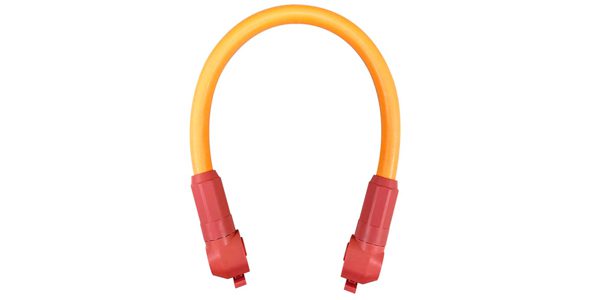
Origin & Development
Power cables have been around since the 1800s and the origin of electrical distribution. They have undergone significant changes in design and materials over the decades. From basic bare conductors to natural insulators like jute and rubber to engineered dielectrics (paper/oil, and later synthetic polymers like PE and XLPE) to today’s engineered composite systems with conductor shields, insulation shields, metallic shielding, and jacketing layers optimized for specific stress and thermal profiles. Current innovation is focused on high-voltage transmission for renewables (offshore wind, HVDC interconnectors), smart cables with sensors for predictive maintenance, and sustainability (recyclable materials, lower-carbon aluminum).
Design Highlights
The core specification checklist, based on standard industry design guidance, includes:
- Ampacity. Ampacity is the maximum electric current, measured in amperes (amps), that a wire or cable can carry continuously without getting too hot and damaging its insulation. Ampacity is affected by wire size, material, insulation rating, and the environment. NEC, IEEE, ICEA, and others publish ampacity tables covering common installation conditions to prevent premature cable failure.
- Voltage rating and voltage drop. Cables must handle the maximum operating voltage. The voltage drop over distance must be kept within acceptable limits for efficient delivery.
- Insulation material and temperature class. Thermoplastic insulation is easier to process but more prone to deformation at higher temperatures, while thermoset insulation offers better heat resistance and long-term thermal aging, making it common in industrial/high-demand settings. Common conductor temperature ratings run from 60 °C to 90 °C for typical use and go up to 1,200 °C for special-purpose cable.
- Conductor material, diameter, and stranding. Conductor materials vary in heat resistance, so consider expected service temperature first. Then evaluate current-carrying capacity without exceeding the insulation’s temperature rating.
- Derating factors. The required reductions due to ambient temperature (heat), cable bundling, or installation conditions and methods.
- Environmental exposure. Moisture, chemical exposure, UV light, and temperature all affect cable performance and lifespan. Indoor cable used outdoors will quickly deteriorate from sun, moisture, and temperature extremes.
- Fire/safety performance. Fire performance standards vary by application and jurisdiction. Key classifications include UL 1277 (tray cable for industrial applications) and TC-ER (tray cable for exposed run applications).
- Shielding. Shielding is required for power cables primarily when operating at high voltages (typically above 2,000V to 5,000V) or in environments with strict electromagnetic compatibility needs. The dielectric field created in energized cables causes electrical stresses when unshielded cables come in contact with the ground. Shielding increases the insulation’s lifespan.
- Mechanical/installation factors. These include termination environment (sealing, strain relief, enclosure choice), hazardous-area compliance, and connector compatibility with regional plug/socket standards (NEMA, IEC 60320, IEC 60309, etc.).
Connectorization
Termination Method
For general-purpose low-voltage power cable, such as the AC/DC hookup wire used in equipment, appliances, and industrial control (e.g., 18-10 AWG stranded copper), termination depends heavily on current level and whether the joint needs to be field-serviceable.
- Crimp is the dominant termination method for stranded power cable in the 22 AWG–4/0 range. Lugs are a standard termination method where electrical connections are made using lugs, and crimped ring/spade lugs or crimp-barrel pin/socket contacts are the default choice for anything from small-gauge signal-adjacent power wire up to heavy battery cable, because crimping gives a consistent, vibration-resistant, gas-tight connection without heat-related insulation damage. Crimp termination is tooling-dependent and attention to this will prevent quality issues.
- Solder is mainly used at the low-current end. Solder cups are terminal ends into which conductors are inserted before soldering, typically using a 60-40 rosin-core alloy and PCB. Solder termination joins wires directly to a printed circuit board. Solder is less common in industrial power applications because it’s more labor-intensive, harder to inspect at scale, and the joint is more brittle under vibration than a crimp.
- IDC (insulation displacement) is a mass-termination connector for flat cable that eliminates stripping. IDC is seen on ribbon/flat cable power buses (some card-edge or panel-level power distribution) but rarely on round jacketed power cords.
- Screw/terminal block and compression termination are commonly used at the heavy gauge/utility end. Screw terminals make connections using screws, and heavier building/utility cable typically uses compression lugs or mechanical set-screw lugs rather than crimp-pin connectors, since the conductors are too large for small connector housings.
- Field-terminable connectors (crimp-in-place or screw-cage housings assembled on-site) are common where cable length or routing can’t be predicted at time of manufacture, e.g., NEMA/IEC plug ends, Anderson Power powerpole housings, or circular power connectors with field-installable crimp contacts.
- Pre-Terminated vs. Custom Assembly. Pre-terminated / off-the-shelf assemblies are widely available for standard interfaces. Standard AC cords (NEMA 5-15P to IEC C13, for example) are typically purchased pre-terminated. Custom harness/cable assembly is typical for applications with non-standard length, routing, connector mix, or environmental sealing requirement. Custom cable and harness assembly houses maintain relationships with major connector manufacturers like TE Connectivity, Molex, and JST specifically to secure the correct precision tooling for each terminal design.
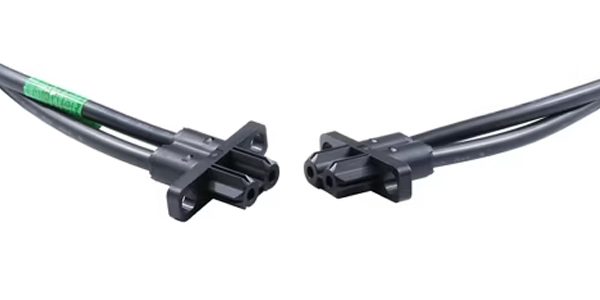
Molex offers complete off-the-shelf cable solutions for power cable assemblies.
Common Mistakes
- Contact/barrel size mismatch to wire gauge. Every crimp contact has a rated AWG range; using a contact barrel sized for 20-24 AWG on 18 AWG wire (or vice versa) gives a crimp that’s either too loose (high resistance, pull-out failure) or over-compressed (nicked strands, reduced conductivity). This is probably the single most common field failure in power cable assemblies.
- Current/temperature rating mismatch between cable and connector. A cable rated for the actual load current can still be paired with an undersized connector contact, creating a bottleneck that overheats at the connector rather than along the cable run — connector current rating always needs to be checked independently of cable ampacity, not assumed to match.
- Voltage rating / creepage-clearance mismatch, especially mixing connectors rated for different regional standards (e.g., using a connector rated for 125V NEMA service in a 250V IEC application). Physical compatibility (same pin shape) doesn’t guarantee electrical compatibility.
- Regional/standards mismatch on plug-and-cord sets — the same C13/C14 IEC connector shape carries different current ratings in the U.S. (15A) versus Europe (10A), so a cord that mates physically may not be rated for the load if it crosses regions.
- Skipping strain relief on crimped or soldered joints — vibration fatigue at the termination point is one of the most common root causes of intermittent power connections in the field.
Markets & Applications
Military/Aerospace, Energy, Consumer, Datacom/Telecom, Industrial, Automotive, Transportation,
Military ground vehicles, hypersonic and next-gen missile systems, soldier power and connectivity systems, avionics and cockpit systems, airframe power distribution, engine and nacelle wiring, UAVs/drones, satellite subsystems, launch vehicle systems, shipboard power and lighting distribution, submersible/submarine systems, offshore platforms and subsea production equipment (control pod, pilot control valve, and electric pumps), power generation and transmission (utilities), residential energy, data centers and commercial buildings, manufacturing, electric vehicles, railways and material handling, mining and infrastructure.
Technical Specifications
Check manufacturer datasheets for current and complete specifications. The interfaces and safety minimums are standardized, but construction details, materials, and performance beyond the minimum vary widely by manufacturer, industry segment, and voltage class.
| IDENTIFICATION | |
| Cable Type | Power/hookup wire, cord, or multi-conductor power cable |
| Standard(s) | UL (AWM styles), NEC/NFPA 70, IEC 60227/60228, MIL-DTL-24643 (shipboard), MIL-DTL-22759 (aerospace), ICEA S-95/S-97, NEMA WC — varies heavily by market segment |
| Category | Power/energy transmission |
| CONSTRUCTION | |
| Number of Conductors | 1 (single-conductor) up to multi-conductor (2–4 typical for AC power; higher counts in control/power hybrid cable) |
| Conductor Material | Copper (most common) or aluminum (cost-sensitive, larger-gauge utility runs) |
| Conductor Gauge / AWG | Driven entirely by ampacity need; 30 AWG (fine hookup wire) to 4/0 and larger (battery/utility cable) |
| Conductor Stranding | Solid (fixed installation) or stranded (flexible/portable applications); stranding class (e.g., Class B, C, K) affects flexibility |
| Insulation Material | PVC (cost-sensitive), XLPE (thermal performance), EPR/EPDM (flexibility, harsh environments), PTFE/FEP (high-temp aerospace/mil) |
| Shield Type(s) | When present: braid, foil, or foil+drain wire — mainly for EMI-sensitive or mixed power/signal harnesses, not standard AC power cord |
| Shield Material | Tinned copper braid or aluminum/polyester foil, when shielding is used |
| Jacket Material | PVC, XLPO/LSZH (low-smoke zero-halogen), CPE, neoprene, or TPE depending on flex/environmental needs |
| Overall Diameter (OD) | Not a fixed spec — scales directly with conductor count/gauge and insulation/jacket thickness |
| ELECTRICAL PERFORMANCE | |
| Voltage Rating | Defining spec — LV (up to 1kV), MV (1–35kV), HV (35kV+); rated voltage is almost always listed as a primary identifier |
| Current Rating | Defining spec — ampacity, tied directly to conductor gauge, insulation temp rating, and installation/derating conditions |
| ENVIRONMENTAL | |
| Operating Temperature Range | Varies by insulation: ~60–90 °C for standard PVC/XLPE cable; up to 200–260 °C for PTFE/FEP aerospace-grade insulation |
| Flame Rating | UL VW-1, FT1/FT4 (Canada), or MIL low-smoke/flame-retardant requirements for shipboard cable |
| MATERIALS & COMPLIANCE | |
| RoHS / REACH | Commonly required/certified, especially for cable sold into EU or consumer/commercial equipment markets |
| Halogen Free | Increasingly common as a spec line item (LSZH/LS0H), especially shipboard, rail, and data center applications where smoke toxicity in fire matters |
| CONNECTORIZATION | |
| Compatible Connector Families | Highly application-dependent — NEMA/IEC 60320 (AC cord sets), MIL-DTL-5015/38999 (mil/aero circular connectors), Anderson Powerpole, ring/spade lugs, terminal blocks |
| Termination Methods | Crimp (most common), compression lug (heavy gauge), solder (light gauge/legacy), screw terminal |
| Contact / Pin Size Match | Must be matched to conductor AWG range per connector manufacturer’s spec |
| Tooling | Connector-specific crimp dies or hydraulic compression tools; no universal tool across families |
Suppliers
Amphenol Communications Solutions, Anderson Power, Axon Cable, JPC Connectivity, Molex, Neutrik, Samtec Inc., Trexon, Prysmian Group, Southwire Company LLC, Nexans, LS Cable & System Ltd, NKT a/s
Distributors
Avnet, Heilind Electronics, Kensington Electronics Inc., and Mouser
Related Products
Like this article? Check out our other Meet the Connector and Connector Basics articles, our Military and Aerospace Market Page, and our 2026 Article Archives.
Subscribe to our weekly e-newsletters, follow us on LinkedIn, Twitter, and Facebook, and check out our eBook archives for more applicable, expert-informed connectivity content.

- How We’re Creating Connections for Life - October 16, 2026
- What Is an RFID Antenna? - October 13, 2026
- Connecting the Next Generation of EV Batteries - October 6, 2026