Commercial Satellites are Driving the Space Economy
The market for commercial satellites, and the data they gather, is growing. Uses for the information gained from highly detailed images are as varied as tracking wildfires and comparing how much traffic certain parking lots are getting.

Space has long been a proving ground for technology, and while many advancements — perhaps most notably GPS — have come from military and defense applications, commercial enterprises are driving the space economy today. From commercial space travel to satellite installations, industries are moving into new territory.
Research remains an important aspect of space, and a variety of space-specific applications assist in governmental and commercial exploration, including rovers and unmanned vehicles that can explore the surface of planets and moons, and satellites fitted with cameras and mirrors that gather images in space and of the Earth from space.
“If you think about government satellites, in the past they were very large, exquisite weather satellites, communication satellites, GPS satellites, very large optical surveillance tracking satellites, or some combination of all those in one platform. Today that’s changed,” said Martyn Acreman, defense market director at Materion. “Instead of one very large satellite up there to do the job, we’re much more focused on constellations of small, even micro, satellites, that cover a broader area.” Many applications, from forecasting weather to analyzing crops to monitoring the effects of global warming, have commercial and scientific implications. Launching smaller satellites, and more of them, is less expensive than one giant satellite, and if one is damaged or lost, the mission can continue.
To use electronics in space, several specific challenges must be overcome. Developing components, choosing materials, and designing systems that can perform reliably in extremely harsh conditions for extended periods of time is an ongoing concern. Smaller and lighter, the battle cry of technology, is especially significant for equipment going into low earth orbit or beyond because of the impact size and weight have on launch costs.
“Just about every spacecraft that gets launched has some kind of electronics — avionics, mission computer. Generally, those electronics are in some kind of housing, a structure that holds electronics in place,” said Acreman. The materials used for those housings require certain capabilities. One is thermal management. “Our materials have good thermal conductivity, a relatively low coefficient of thermal expansion. They’re isotropic materials, so they tend to expand and contract equally in all directions.” This is important for eliminating the heat generated in an electronics assembly.
Structural stiffness and support for those assemblies, as well as low density, are also critical considerations. “We offer high stiffness materials with low density. The lighter they are, the cheaper they are to launch.”
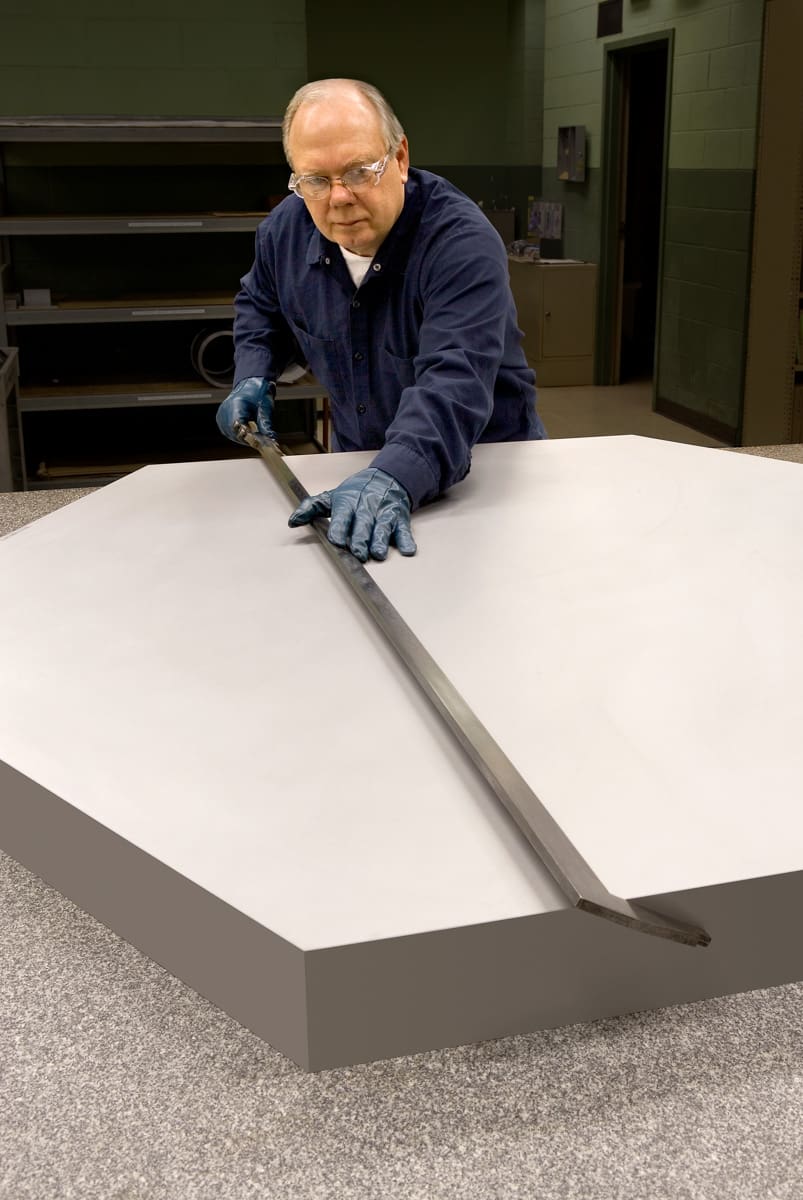
Materion employee checks the exact specifications of a beryllium metal mirror blank needed for the James Webb Space Telescope.
Thermal management
“Thermal management is a growing field in avionics and electronics, not just in space. Everybody is trying to put more electronic power density in a smaller area and that generates heat. You’ve got to get that heat away from the electronic components. Materials can help you do that,” said Acreman.
Beryllium and AlBeMet aluminum-beryllium, a metal matrix composite (MMC) developed by Materion, are materials that perform well for thermal management without adding size and weight. AlBeMet MMC maintains a relatively low coefficient of thermal expansion (CTE). “The connections from these electronic components can expand and contract, and if they do it at differential rates it’s possible to break those connections over time. So, matching the CTE of the material you’re using is very important in these applications,” Acreman said. In addition, AlBeMet material has a high specific stiffness. “It doesn’t move around or change shape. If you pack a lot of electronic components closely together, the last thing you want is for things to move and electronic components to touch.”
Reflectivity and stability
Materials also play a role in designing space mechanisms that must be positioned and moved, such as laser comms. Fast steering mirrors on satellites handle the laser communications (how satellites communicate with each other and with the ground). “Optical systems for laser communication has grown over the last four or five years and will continue to grow. Basically, what’s most important in a reflective optical system is the reflectivity and the shape (the figure) of the mirror,” said Acreman. “To make a very stable mirror you want a low CTE isotropic material like aluminum-beryllium or beryllium that has low creep, high stiffness, and good strength. Stability is crucial because these optics have to move quickly with precision and stop quickly to perform their function. Any movement of the structure will cause the optic to lose focus or lose its focal length or just distort the optical image.”
Reflectivity is the result of the smoothness of the surface finish and the optical coatings applied to the mirror. Often the goal is reflectivity in a specific wavelength. “A good example is the use of bare polished beryllium on the James Webb Space Telescope mirror. Bare polished beryllium is not a very good mirror in the visible or in the UV, but it is highly reflective in the infrared (IR),” said Acreman.
Optical coatings
Optical coatings are applied mainly to planar or flat surfaces, slightly curved surfaces, and sometimes on active detectors or active silicon wafers, in order to manipulate light. The coatings are chosen either to block or let through specific wavelengths. “We have coating capabilities from 190 nanometers in the UV all the way up to 20 microns in the long wave IR,” said David Harrison, product manager-space at Materion. “There are various coating processes. Most are what we call physical vapor deposition systems. These are vacuum systems that apply energy to a material to release the atoms and redistribute them onto the substrate in a variety of configurations to manipulate the light that we’re trying to address.” In addition to consumer or commercial applications, they are used for high end space optics, for Earth imaging, or even exploration missions such as to Mars and Jupiter.

Earth imaging from a satellite.
Multi-spectral imaging
In multi-spectral imaging, multiple filters are incorporated on one assembly, to create multi-layer images, such as those by Landsat and Worldview.
“The filter, if you will, is substituting the window on a detector and allows different wavelengths in different regions. For Earth imaging, the satellite is typically in a low Earth orbit looking down at the planet and takes images or pictures in all these different wave bands from the same detector from the same camera. Then it takes those pictures and puts them together to look in very fine detail at a variety of things. Some are monitoring agriculture, some are monitoring oceans, some check carbon releases and residual gases in the atmosphere. That’s what this type of filter is used for,” said Harrison.
The resolution depends on the number of bands and how narrow they are. “The filter gets bonded directly onto a detector package so that you can get very clear, precise and detailed images from extremely far away. Some of these filters and detectors, the combination of them, can practically read a book over your shoulder from space,” Harrison said. “Our customers tell us what wavelengths they want to see and how many pixels they want to get each wavelength based on how they plan to use this.”
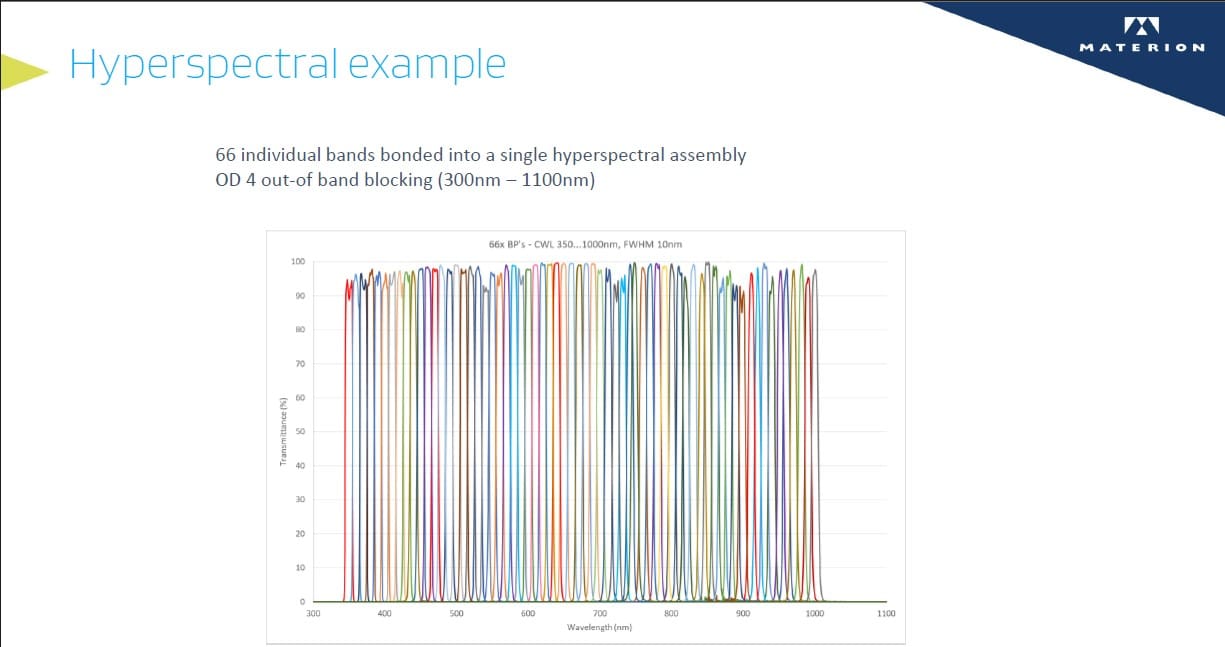
Materion’s custom hyperspectral filter assemblies offer more than 100 different bands bonded together for extremely precise imaging.
The market for commercial satellites gathering data to sell is growing. Uses for the information gained from highly detailed images are as varied as tracking wildfires and comparing how much traffic certain parking lots are getting. “Space has changed so much in the last 10 to 12 years. It was so costly and difficult to get items into space in the past. Prior to the advent of these smaller satellites, lower-end commercial applications didn’t make sense. Now they can put dozens of satellites up for so many different purposes,” said Harrison.
Visit the Preferred Supplier page for Materion to learn more about the company and its products.
Like this article? Check out our other Materials articles, our Transportation Market Page, and our 2025 Article Archives.
Subscribe to our weekly e-newsletters, follow us on LinkedIn, Twitter, and Facebook, and check out our eBook archives for more applicable, expert-informed connectivity content.

- Ceramics in Space: BME X7R MLCC - October 20, 2026
- Test & Measurement Product Roundup - October 20, 2026
- Advanced Connectivity-Automation, Robotics, AI, and Machine Learning - October 20, 2026