The Pros and Cons of Artificial Intelligence in Military Applications
From autonomous drones to robotic ground vehicles, AI is increasingly embedded in modern defense systems. While the adoption of AI offers strategic advantages, it also introduces risks, ethical debates, and operational challenges.
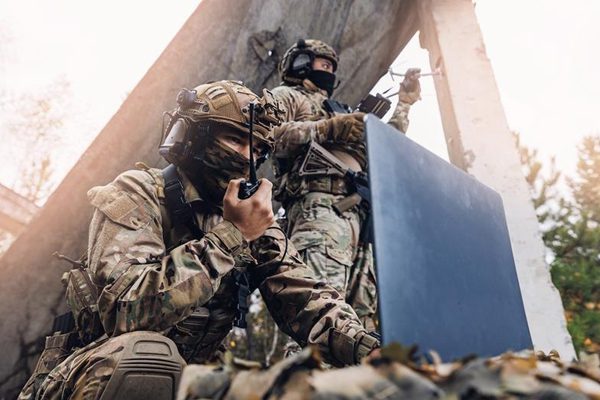
Article contributed by PEI-Genesis
The integration of AI into defense systems is a global trend. At the 2025 Global Summit on responsible AI in Military Operations, representatives from 42 countries met in Delaware to deliberate on the ethical integration of artificial intelligence in military operations. However, AI technology has already been deployed in current conflicts, such as Russia’s war in Ukraine and Isreal’s operations in Gaza. The U.S. War Department has integrated Google Cloud’s Gemini into its military platforms. China has reportedly used Meta’s Llama to create its own military AI tool. In this rapidly evolving environment, countries are working to set legal and ethical frameworks, such as the EU AI Act, which entered into force in 2024, establishing guidance for the use of AI in public and commercial spheres — but it does not yet extend to military and defense sectors. AI technologies are already tested and deployed in applications such as:
- Autonomous drones for reconnaissance and strike missions
- Ground robots for explosive ordnance disposal (EOD)
- Electrical combat vehicles for navigation and targeting
- Surveillance and sensors for real-time data analysis

Amphenol 2M Series from PEI-Genesis is a lightweight, micro-miniature mil-spec circular connector that can withstand harsh environments in applications such as armored vehicles, data acquisition equipment, aero planes, helicopters, avionic calculators, missiles, and drones.
Advantages of AI in Military Technology
The use of AI in military software provides several operational benefits that protect humans and improve efficiency.
Enhanced soldier safety
AI allows dangerous tasks to be performed by autonomous systems instead of human personnel. Tactical ground robots, for example, can navigate hazardous terrain or handle explosives, reducing direct risk to soldiers.
Reduction of human labor and fatigue
Combat environments place extreme physical and mental stress on soldiers. By delegating tasks such as piloting vehicles or analyzing vast datasets to AI systems, human personnel can focus on higher-level decision-making, logistics, and mission planning.
Improved decision-making and target accuracy
AI excels at processing large volumes of data at high speed. This capability supports real-time battlefield awareness, helping commanders identify threats earlier and execute more precise strikes. Drone and sensor data analyzed by AI systems can detect patterns that may be overlooked by humans.
Risks and limitations of AI in defense
While promising, AI in military applications presents serious concerns around security, decision-making, and unpredictability.
Cybersecurity threats
AI-driven systems are vulnerable to hacking, data manipulation, and adversarial attacks. A compromised AI platform could expose sensitive information or even be turned against its operators.
Ethical and legal concerns
The deployment of autonomous weapons raises significant ethical questions. If machines are capable of making lethal decisions, accountability becomes unclear. Critics argue this could lower the threshold for armed conflict or lead to wars fought predominantly by machines.
Unpredictability and system failures
AI systems can behave unpredictably, especially when operating autonomously in complex combat environments. Malfunctions or misidentifications may lead to unintended civilian harm, making accountability and control critical issues.
Emerging AI-Powered Military Technologies
Two notable AI-driven systems currently in development stand out.
Autonomous combat vehicles
These vehicles integrate sensors, radar, and machine learning algorithms to navigate terrain, detect threats, and operate with minimal human input. Their autonomy allows military units to redeploy human resources for more complex operations.

ITT Cannon HDx Series of high-density circular connectors offers a small form factor (SFF) connector solution for applications where space and weight savings are essential. Available in a breakaway or screw-lock breakaway coupling style and an anti-glare, non-reflective Ruthenium plating, the ITT Cannon HDx Series enables USB, HDMI, or Ethernet high-speed data transmission commonly seen in military ground vehicles, soldier-worn equipment, factory automation, and robotics.
Robotic dogs for tactical support
Robotic dogs are designed for reconnaissance and logistical support. Equipped with omnidirectional cameras, night vision, and radar systems, they enhance situational awareness and reduce soldier exposure to hazardous environments. They can also transport supplies or gather intelligence in real time.
Technical Infrastructure Requirements
For AI-driven military systems to operate effectively, they require robust electronic and data infrastructures capable of withstanding harsh environments. Key considerations include:
- Vibration resistance to prevent disconnections in moving vehicles.
- Sealed connectors for protection against dust and water.
- High-temperature tolerance for deployment in extreme climates.
Reliable electrical connectors are essential for ensuring continuity of operations, particularly in combat environments where system failure is not an option.
The Future of AI in Warfare
The debate over the role of AI in modern warfare continues, balancing operational efficiency against ethical responsibility. What is clear is that AI will remain central to defense strategies worldwide. Nations must therefore not only invest in AI technologies but also establish safeguards, regulations, and fail-safes to ensure responsible use.
Learn more about military interconnect solutions for the AI era at PEI-Genesis.
Like this article? Check out our other Artificial Inteligence articles, our Military and Aerospace Market Page and our 2025 and 2026 Article Archives.
Subscribe to our weekly e-newsletters, follow us on LinkedIn, Twitter, and Facebook, and check out our eBook archives for more applicable, expert-informed connectivity content.

- A Five-Layer Clad Solution for High-Performance Battery Interconnects - October 6, 2026
- High Voltage Interlock for Commercial Vehicles: A Must-Have or a Nice to Have? - September 29, 2026
- Case Study: A Partnership to Improve Rail Health - September 29, 2026