electronica 2026: A Sense of Things to Come
Last week, the electronics industry gathered in Munich to get a preview of the latest generation of components that will help shape the future of technology. Connector Supplier visited interconnect experts from around the world to learn more about the solutions that will make designing tomorrow’s technologies possible. Find out what we saw at the show.
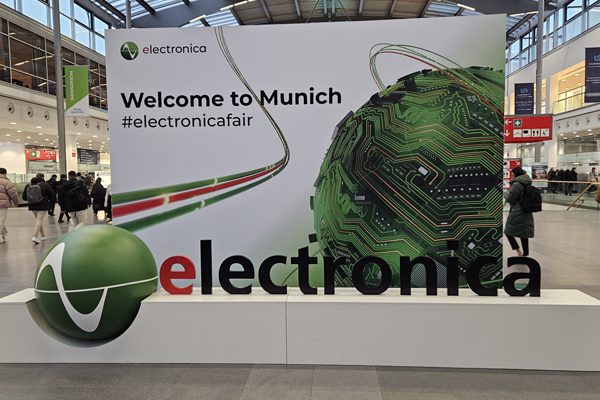
The electronics industry’s premier trade fair set new records in Munich last week as 3,512 exhibitors and over 86,000 attendees gathered for electronica 2026. While just over half of the exhibitors came from abroad, Germany’s strong regional interconnect companies made a dominant and impressive showing of both expertise and cooperation. The European companies emphasized precision design, efficient and sustainable production, and component quality. Collaboration has helped advance research and manufacturing even while companies — many still family owned — maintained distinct identities. Global connector suppliers and distributors also demonstrated broad portfolios and line cards, market expertise, and ambitious projects. Many exhibitors promoted their involvement in open computing and new standards, including the now finalized single-pair Ethernet connector, another indication of the importance of collaboration to achieve the electronics industry’s expansive goals.
Business is strong. Just about every booth seemed to have grown since electronica 2024. The fair continued its years-long focus on the All-Electric Society theme, showcased in products aimed at infrastructure, transportation, and IoT technologies. Military and aerospace dominated many booths, with embedded, high reliability, and harsh environment designs on display. Robots danced between booths and greeted visitors, some companies shared video of their fully automated facilities, and others featured AI actors promoting products in booth videos. However, the dominating technology at this year’s show was clearly artificial intelligence. Many companies showcased high-speed, high-power interconnects and cooling strategies destined for data centers. Those that didn’t focus on data centers focused on the technologies AI is bringing to life. Regardless of regional base, nearly all companies have integrated AI into their product focus, company processes, or outreach efforts.
Some concerns were in the air — unavoidable in a week that included a Microsoft meltdown, the NVIDIA scandal, service outages at major banks, and a U.S. nationwide aviation shutdown that left some electronica fairgoers stranded in Munich into the weekend. On a components level, many suppliers acknowledged challenges related to tariffs and to the global automotive market slowdown. Companies that focus on the automotive market focused on diversification, instead highlighting other areas of expertise. One supplier predicted that the down cycle is entering its fourth quarter, meaning that attention is already swinging back to vehicle design.
Across markets and suppliers, products highlights centered on high-speed board-to-board connectors, RF solutions, optical interconnects, and power connectivity. Requirements are rising for every market as AI influences all systems, so suppliers demonstrated their ability to respond to requests for higher data rates, greater power demands, ruggedization, and miniaturization — in other words, the usual advances, pushed even further. Here’s what we saw.
Day 1
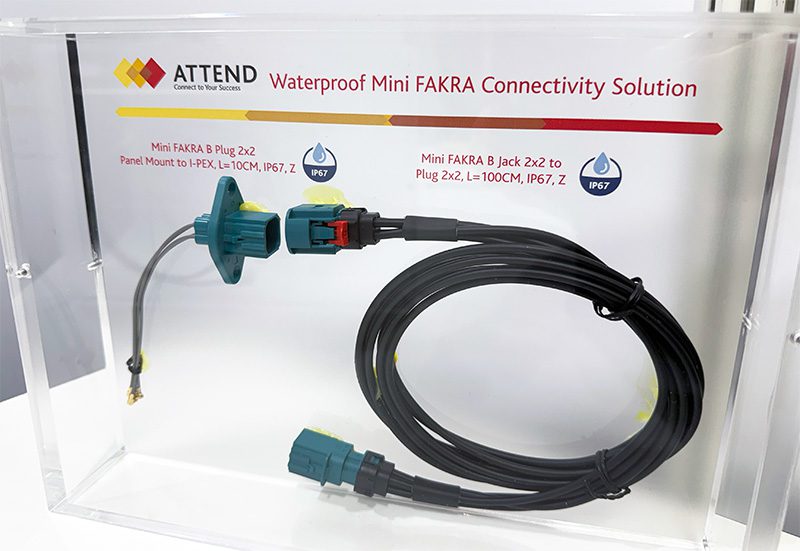
ATTEND showcased waterproof Mini FAKRA connectivity solutions. This familiar automotive interface is sealed for outdoor machine vision systems, where multiple cameras and sensors feed a single control unit. According to Leon Hung, product division director, demand for these products emerged first in the U.S. and China and is now growing in Europe. ATTEND also showed a circular USB-C connector and cable system designed for harsh environments, and a rugged circular connector with a twist quick-lock that is rated for more than 3,500 mating cycles, far beyond the roughly 100 cycles typical of standard designs.
ITT Cannon’s booth showcased the company’s Trident range, now available with custom contact layouts that combine power, signal, and high-speed contacts in the existing shell, an approach aimed at autonomous agricultural and off-road equipment. ITT Cannon is also integrating Rosenberger high-speed contacts into its own rugged shells, pairing a contact system that vehicle manufacturers already know with housings built for harder use. For defense customers, the company displayed a VG-qualified CA Bayonet connector with a tin-zinc finish, a response to the phase-out of cadmium in new German military designs. A ruggedized M12 Ethernet connector for outdoor rail applications rounded out the display.
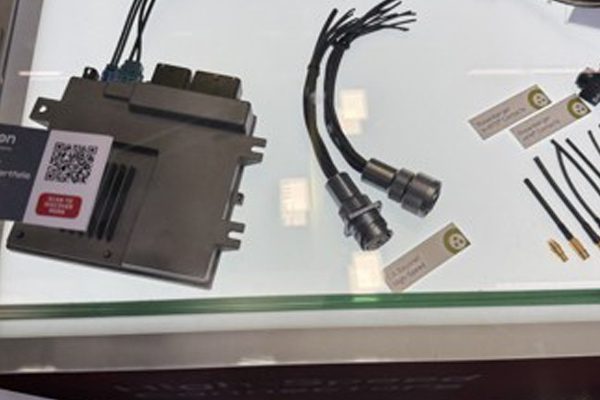
Rugged interconnect assemblies on display at the ITT Cannon stand.
EDAC Group focused on robotics, drones, and warehouse automation, particularly for the micro-D and D-sub connectors in its NorComp line. (The EDAC group brings together the EDAC, NorComp, MH, and Northern Tech brands.) Magnetic pogo connectors are gaining ground as well, especially in medical and Test & Measurement equipment, where blind mating and quick release serve equipment users.
One interface for single-pair Ethernet
Single-pair Ethernet (SPE) promised to bring Ethernet all the way to the sensor over one twisted pair, but for years competing industry groups backed two different connector interfaces, and device makers waited to see which would prevail. Last year the two groups agreed on a single mating face and numerous suppliers displayed the new standard at electronica.
Weidmüller’s version of the SPE connector is now available. “We are first to market with the new connector,” said John Froustet, senior director, product portfolio management at Weidmüller. He compared the earlier uncertainty to the VHS and Betamax debate: Customers did not want to design in the format that would lose. With one mating face established, he said, device makers can begin designing sensors, switches, and controllers with the confidence that they will connect to other manufacturers’ equipment.
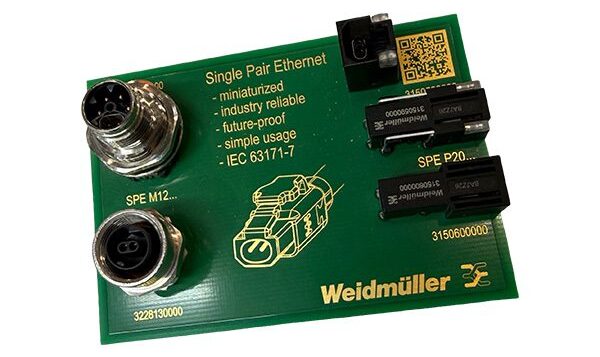
Weidmüller’s single-pair Ethernet connectors
Weidmüller demonstrated the technology with an environmental sensor that reports temperature, humidity, and carbon dioxide levels from a vertical farming display to the cloud over SPE. The company also showed the expansion of its SNAP IN connection technology, which accepts stranded wire without a ferrule and releases with a lever, into smaller and larger sizes, including a power version rated at 600 V UL.
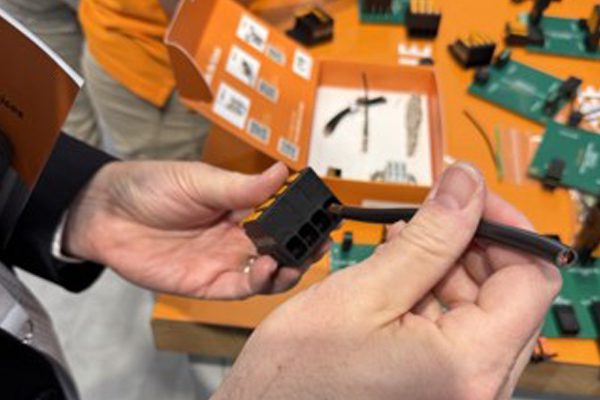
A connector demonstration at Weidmüller’s hands-on counter.
Custom becomes the norm
Many suppliers described a changing business model in which customers arrive with a problem and expect the connector, cable, and sometimes even the sensor to be engineered together. ATTEND’s Hung said the company now thinks in terms of the total solution, not only the connector or the cable, and that it will take on customized designs in small quantities. Greenconn reported that customized work now exceeds its standard product business. Weidmüller pairs standard options such as printing and key coding with a business unit dedicated to fully custom designs.
Suppliers are also investing in the information engineers need to make a selection. Weidmüller’s online tools let users search by application, compare products side by side, check stock by warehouse, and request samples that ship worldwide within 72 hours. EDAC Group is putting more emphasis on test reports, drawings, and 3D models in its product introductions.
Help for the production floor
Würth Elektronik devoted part of its stand to a problem that begins after the connector is chosen: getting it onto the board. Stephan Bächle, field application engineer, walked the Connector Supplier team through the company’s press-fit tooling. Würth produces a board support matched to the customer’s own circuit board, 3D printed from the customer’s design data, with ceramic inlays for small production runs and aluminum for larger ones. The support holds the board at the right points and protects surface-mount components during pressing. Connector-specific REDCUBE press-fit stamps work with presses already on the market.
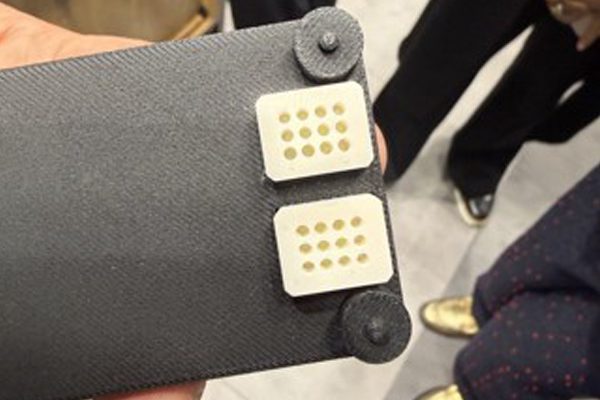
Würth Elektronik’s press-fit board support uses ceramic inlays to hold the circuit board during pressing.
Würth also showed a tri-metal plating of tin, zinc, and nickel as a lower-cost alternative to gold for harsh environments, its WR-BTB board-to-board connectors in 0.4 mm and 0.5 mm pitch for high-speed protocols such as PCI Express 4.0, and its SKEDD direct plug-in connector, which plugs straight into the circuit board without a mating part and carries 16 A per pole.
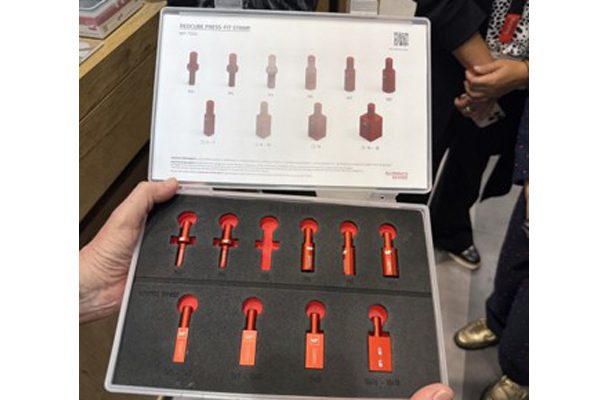
Connector-specific REDCUBE press-fit stamps from Würth Elektronik.
Day Two
On day two, Connector Supplier viewed products ranging from tiny 1.25 mm board connectors bound for small satellites to beefy energy storage connectors rated in the hundreds of amps. What tied the day together was how suppliers presented them. Again and again, the display started with an application and worked back to the part.
Adam Tech rebuilt its stand around markets: industrial, automation, transportation, datacom, and energy. Chris Brana, product marketing manager, said custom work now accounts for roughly 30 to 40% of the business, often in the form of an adjustment to a standard part or a custom cable assembly. The company is preparing for its 40th anniversary in 2027.
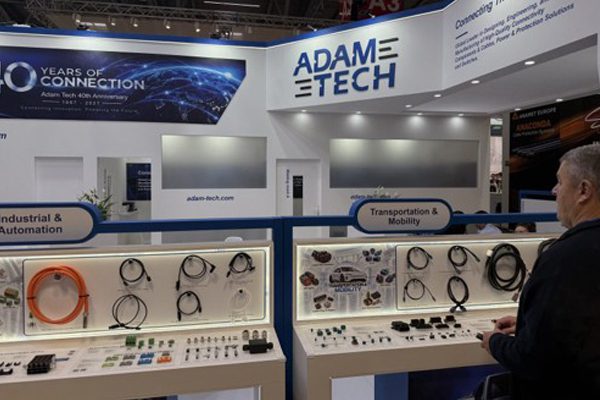
Adam Tech will mark 40 years in business in 2027.
Infinite Electronics (a group comprised of Bulgin, L-com, Pasternack, Transtector, and PolyPhaser) focused on data center connectivity, drone connectivity, and industrial automation. Mark Berry, vice president of product and portfolio management, said the company’s 18 manufacturers can combine components from across companies into one solution for a customer, delivered under a single part number.
Mark Cranmore, senior RF interconnect product line manager, said availability of parts is the biggest problem facing drone makers in the U.S. He showed a demonstration unit assembled from in-stock components that reached him within a week. Build-to-length RF cable is another growth area for the group.
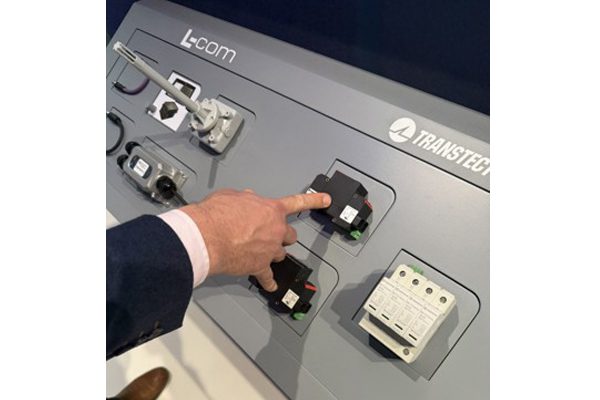
L-com and Transtector products share one application panel on the Infinite Electronics stand.
At Harwin, the XPi service gives customers access to dedicated engineers who help select a connector, modify a standard part, or build a complete cable assembly, including assemblies that carry other manufacturers’ connectors. Ben Green, head of brand and PR, said the service extends the cable assembly and application engineering work the company already does. The company’s low-profile, dual-row Gecko connector continues to make inroads in space, aviation, and UAV applications. Named for the little green lizard, its high-reliability performance in a distinctive green housing makes it a standout despite its small size.
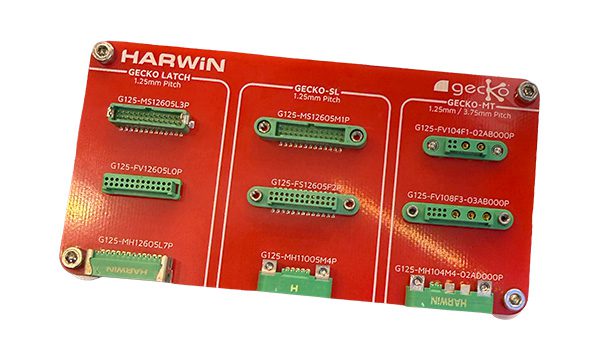
A Harwin Gecko sample board, with 1.25 mm pitch connectors in signal and mixed layouts.
Higher current was a common thread across suppliers. Adam Tech showed energy storage connectors rated up to 350 A for battery systems. It has also extended its ESMC board-to-board series with a 2.54 mm power version and a hybrid that combines power and signal, alongside the existing 1.27 mm signal version.
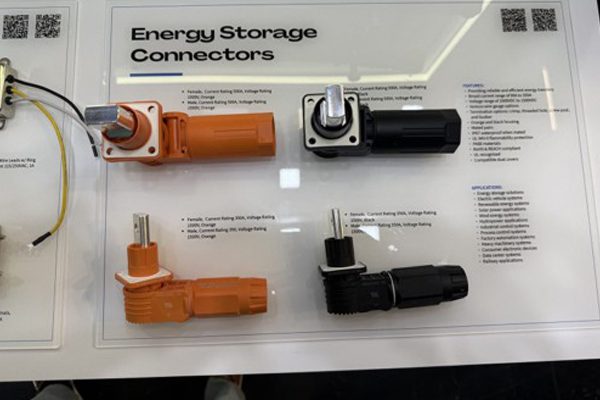
Energy storage connectors from Adam Tech.
Harwin’s Kona connectors carry 60 A per contact. Bulgin, long associated with sealed connectors in the 30 to 40 A range, is moving into higher-power products aimed at data centers. Lumberg displayed its high-current contact elements and a power version of its RAST connector rated to 1,000 V.
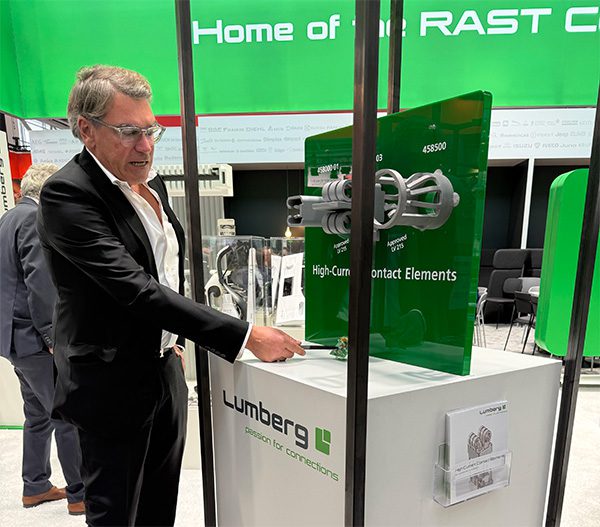
Kai Rotthaus shows Lumberg’s high-current contact elements.
Lumberg calls its stand the home of the RAST connector, and the news there was size. RAST 2.5 is the widely used system in appliances and vehicles. The company’s displays included many of Europe’s top consumer brands. RAST 1.5, with a 1.5 mm pitch, is about 43% smaller. Kai Rotthaus, head of marketing and corporate communications, pointed to vehicle lighting as one driver. LED lighting that follows the curves of a car body needs many small circuit boards stacked behind it, each with its own connector, and the installation space sets the pitch.
Sealed connectors for harsh environments filled much of the Bulgin display, including environmentally sealed connectors rated IP68 and IP69K and a single-pair Ethernet connector for rugged data links. Other displays showcased battery connectors and custom capabilities.
While the automotive market is slow now, that will change, and connector companies are preparing for a bigger move toward higher voltage. At the Aptiv stand, Juergen Mandel, who works in business development for high-speed data technology, explained the shift from 12 V toward 48 V systems. Loads such as PTC heaters and cooling fans can draw 3 to 6 kW, and at 48 V they can be served with thinner, lighter wiring. Aptiv is also bringing its interconnect brands, including Winchester Interconnect, under the Aptiv name.
CNLINKO, a Shenzhen manufacturer of industrial circular connectors, showed four series. The YM series uses a corrosion-resistant plastic body for salt spray and acidic conditions. The LP series is a quick-disconnect connector that can be operated with one hand. The BD series has a flush-mounted snap design that saves space outside the enclosure, and the DH series has an all-metal body. The stand grouped them by use, from uncrewed surface vessels to solar installations and factory automation.
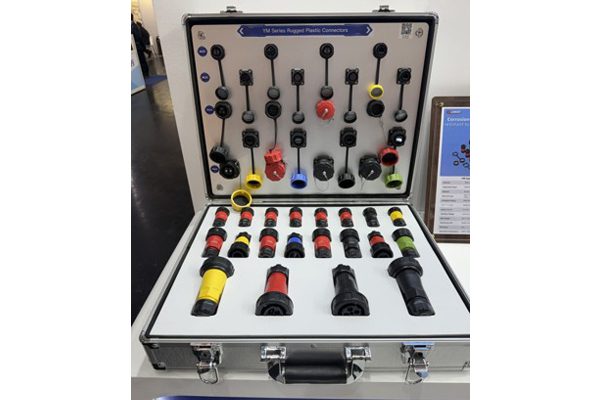
CNLINKO’s YM series connectors in a sample case.
Day 3
Day three took the Connector Supplier team to suppliers working on a wide range of data center solutions, custom and standard products, miniaturized connectors, and automation in manufacturing and distribution.
Joel Boone, senior manager of product marketing for device connectivity at Phoenix Contact USA, said energy is where most of the company’s connector development is going, whether the application is a data center, an automated factory, or the grid. The stand included a display of server power shelves with Phoenix Contact connectors inside.
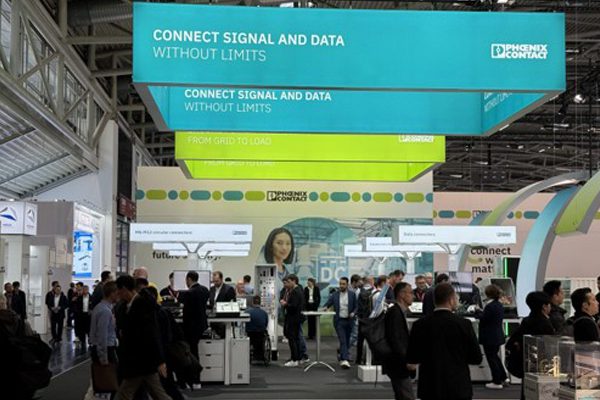
The Phoenix Contact stand at electronica 2026.
Next to the power shelves stood a concept display for 800 V DC distribution. Boone said higher-voltage DC is where data centers are heading, but the architecture is not settled, and standards from the Open Compute Project are still to come.
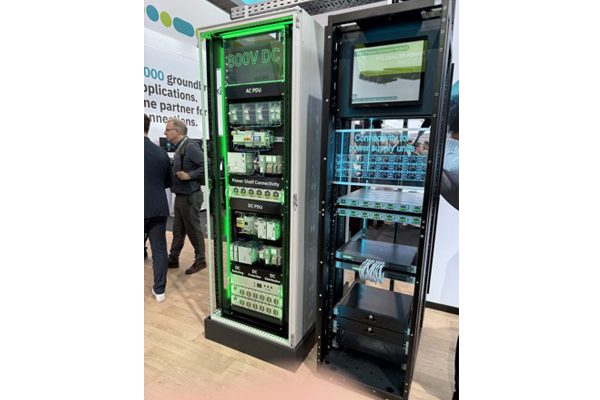
A concept display of 800 V DC rack power at Phoenix Contact.
A second display covered battery energy storage. Boone said the first U.S. storage projects were tied to EV charging, and that the demand he sees now comes from public utilities, usually paired with solar.
Amphenol LTW is approaching the rack from the cooling side. General manager Luc Kan said cold plates are the common way to cool high-power servers today, and that he expects more designs to immerse the whole server in dielectric fluid as chip power keeps rising. Connectors for those systems have to work submerged, and their materials have to hold up against the coolant, which differs from one fluid supplier to the next. LTW’s modular, immersible interface can be adapted to each rack design, part of its data center range. Adoption will take time, Kan said, because immersion is new territory for server engineers.
Amphenol LTW is known for waterproof connectors, and Kan said the company is preparing connectors for deeper water. Underwater drones and robots, cleaning robots, and fish farms are among the applications that require sealed connectors and where sensors stay submerged permanently. New products are on the horizon for these markets. Stay tuned.
Preci-Dip, the Swiss maker of precision-machined contacts and connectors, builds its own turning machines and automation and does its own plating. Lyle Otremba, executive director of business development for North America, said that control over the process is what lets the company change over quickly and take on custom work. The catalog holds about 20,000 products, he said, but roughly 90% of OEM customers now ask for a custom solution . Otremba said the company machines more than eight million components a day in its Swiss and U.S. factories. Clément Bidault, Preci-Dip’s product development engineer, said he works through a design with customers who know the problem but need help specifying or designing the perfect part.
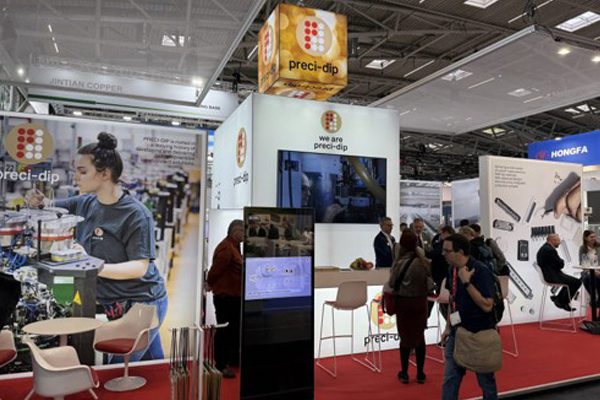
The Preci-Dip stand.
Spring-loaded contacts were the center of the Preci-Dip sample case. Otremba showed a high-current spring-loaded pin and a miniature connector that holds 100 spring-loaded contacts for high-speed signals. A spring-loaded pin with a ground shield around it can replace a coaxial RF connector in some designs, he said.
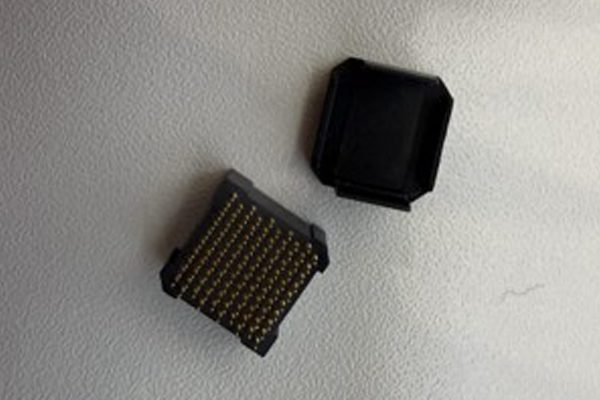
A miniature Preci-Dip connector with 100 spring-loaded contacts.
Preci-Dip also showed a magnetic breakaway connector. It was originally developed for a monitoring station beside a hospital bed, where cables were damaged when equipment was pulled away in a hurry. The same design is now used on seismic sensor pods for oil and gas surveys, where it replaced a screw-on connector.
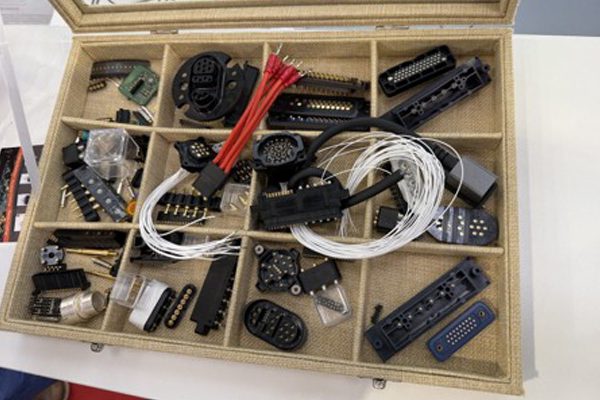
Samples from Preci-Dip, including spring-loaded and magnetic connectors.
At Kyocera AVX, Sebastian Schneider, vice president of sales and marketing for the connector segment, said about 80% of the company’s connector business is automotive, much of it custom housings and headers built for one customer. Vehicle makers are consolidating control modules and choosing more off-the-shelf parts, so the company is adding standard products to its connector range in both automotive and industrial lines.
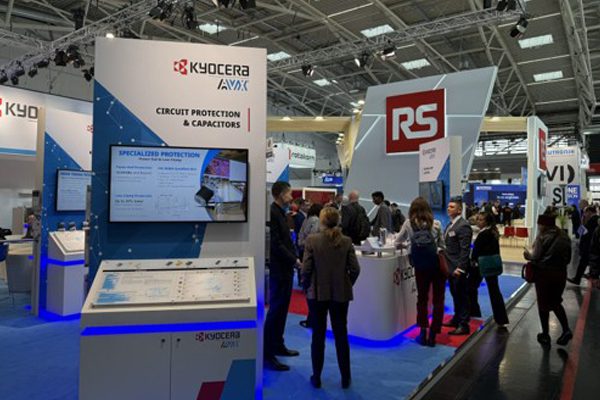
The Kyocera AVX stand.
One example is the company’s capacitor holder, which connects the capacitor through insulation displacement contacts, so no leads are bent or soldered. A larger housing shown on the stand combines a connector, a capacitor holder, and press-fit pins, so the assembled board is pressed into place with no soldering step.
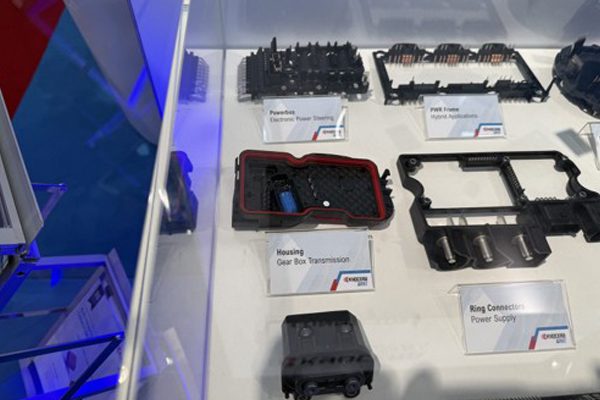
Automotive housings on the Kyocera AVX stand.
Floating board-to-board connectors, whose contacts tolerate some misalignment between the two boards, appeared at two stands. Phoenix Contact’s board-to-board range covers three pitches and includes floating and high-speed versions built for industrial temperatures and vibration. Kyocera AVX showed a floating connector that can be mated blind, where the connectors are hidden once the boards come together.
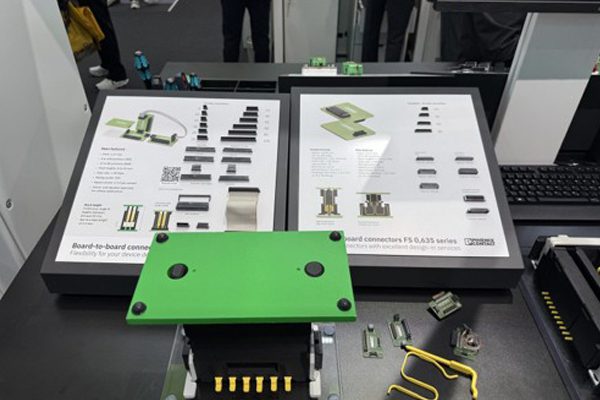
Board-to-board connectors at Phoenix Contact.
Phoenix Contact’s Push-X termination closes on the wire when the conductor is pushed in, with no tool. Boone said it accepts stranded wire without a ferrule. A timed wiring challenge invited visitors to test this speedy process for themselves at the booth.
The company also showed its ICS electronics housings, including sealed versions, housings sized for single-board computers, and options for heat sinks and touch displays. Marvin Paul, who manages housing products, demonstrated a slim modular system with snap-in circuit boards and push-in connectors.
DigiKey sponsored the show and featured a huge booth with interactive exhibits, video, and a glimpse into the supply chain networks that make this Minnesota distributor able to serve small and large customers with speed. It doesn’t hurt that the company also has the largest selection of top products. Heather Fulara, DigiKey’s Vice President of Interconnect, Electromechanical, and Industrial Automation, said that the company’s customer base begins at the student and maker level and continues into the early career era and beyond. The electronics industry is going through a transition in which seasoned talent is retiring and young engineers are coming into the industry looking for knowledge.
Day 4
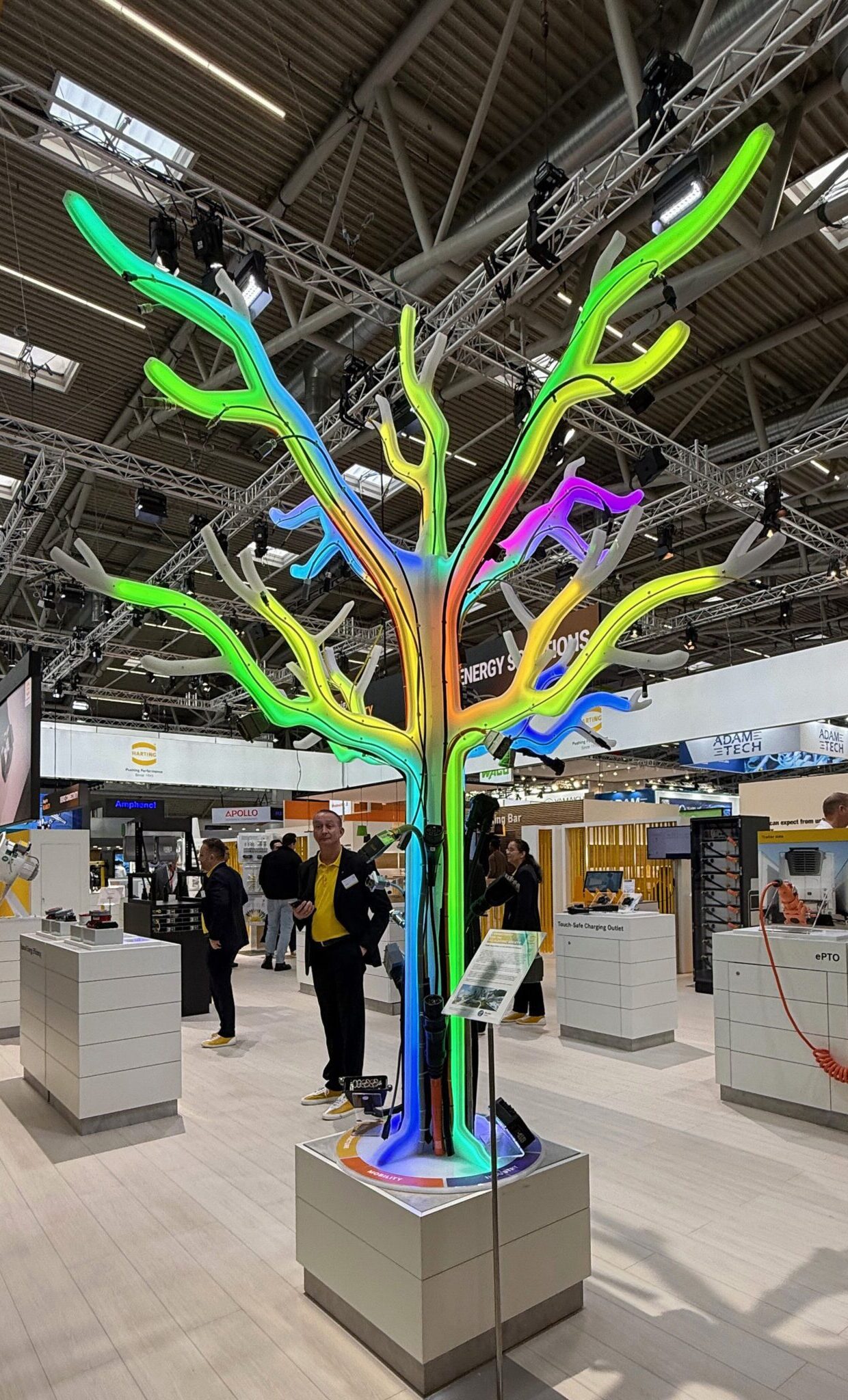
HARTING’s “Cable Tree”
On the final day of the show, the Connector Supplier team made a lightning round, visiting many more booths, although attendees with rolling luggage were already leaving and some exhibitors were closing down booths. The sheer vastness of this trade show makes it difficult to visit them all and take in every new product and innovation. But we stopped in our tracks multiple times to check out outstanding displays. Yokowo’s smart textile systems — including a sensor-laden smart diaper — and automotive lineup were a unique offering. Advanced Interconnections showed solutions for military and aerospace applications such as satellites, where interconnect products that limit off-gassing are essential. Mill-Max prioritized materials innovation and high reliability for its MIL/aero lines and spring-pin connector system. METZ CONNECT showed its spin on the new SPE interface, plus connectors for home building technologies, especially for the German market. The company’s 50th anniversary is this year. The WAGO booth also celebrated an anniversary this year — 75 years. WAGO showed its picoMAX pluggable system, the MCS (micro connector system), and connectors for building automation control panels. HARTING is the master of modularization, and its booth featured its Domino connector system, in which modular units for various functions can be combined in one housing to create a custom interface. This company’s rugged products for rail, heavy equipment, and data centers made a show of power, energy, and might. We liked the neon “connector tree” display at the booth too. Samtec had a presence at two booths at this year’s show. The main booth featured the latest high-speed board-to-board connectors, RF solutions, optical interconnects, and power connectivity. Samtec also had a demo at Edge Lab Live, a special exhibition dedicated to embedded computing, the Internet of Things, and edge AI.
The spirit of collaboration was in full force here as companies and organizations showed open and standard solutions, live demonstrations, and opportunities for engineers to explore the technologies behind the next generation of intelligent systems. Innovative displays, innovative products, and industry optimism made electronica 2026 a fascinating review of the industry as it stands at the beginning of a new era in technology. See you in two years.
Like this article? Check out our other articles on Trade Shows and High-Speed, our Sensors/Antennas Market Page, and our 2026 Article Archive.
Subscribe to our weekly e-newsletters, follow us on LinkedIn, Twitter, and Facebook, and check out our eBook archives for more applicable, expert-informed connectivity content.

- electronica 2026: A Sense of Things to Come - November 17, 2026
- oHFM: An Open Standard Brings Connector Discipline to FPGA Modules - November 3, 2026
- Connectivity Is Reshaping Police and Security Vehicle Fleets - September 8, 2026