New Micromobility Technologies Empower the Individual
The transportation landscape has dramatically changed in many countries as advanced electric bicycles, scooters, and other micromobility technologies help ease congestion and pollution, and empower individuals to travel with ease.

The tremendous growth of micromobility in the post-pandemic era is a natural result of the convenience, affordability, sustainability, and freedom human-scale transportation offers. Electric technologies for recreation and commuting took off during this period, converging around small, lightweight electric vehicles (LEVs). Electric bicycles, scooters, pedalos, and motorcycles offer an affordable alternative to expensive parking costs and hard to source car parts during supply chain shortages. Technology and battery advancements, ushered in by shared advancements across automotive, motorcycles, and bicycle manufacturers, arrived during the same time period. Connector suppliers have worked with vehicle makers to develop specialized components to serve these designs.
“We’ve seen our eBike business increase about 25-30% in the past five years, especially in Asia,” said Gerry Sui, ACDRA Connector Corporation. User-friendly features like plug-and-play interfaces and improved sealing capabilities have helped support the adoption of eBike technologies, he says. Another innovation is the V-Swap, a battery swap connector that prioritizes safety and user experience to make it easy for users to quickly remove the vehicle’s battery when they arrive at home or work for a recharge.
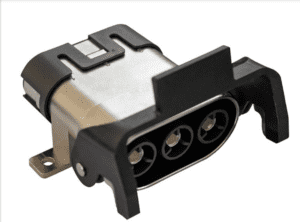
ADCRA’s V-Swap connector supports e-mobility applications with an IP68 rated ( 1 meter, 48hours) interface with a secondary locking latch, double-sided HVIL for higher reliability, and optional thermistor integration for temperature monitor.
The LEV market is a growing center of innovation, with high market support to keep the focus on continually improving the charging and riding experience. Personal transport has long been a practical mode of transport in high-density Asian and European countries. The U.S. Department of Energy reported sales of 1.1 million electric bikes in 2022 (four times the number sold in 2019), and the same year, 2.1 million e-bikes were sold in Europe. In China, an estimated 350 million electric two-wheelers of various forms are on the roads. In the years since, bike retailers report that sales of electric bikes outpace sales of pedal bikes, spurred by rapid advancing technologies and design.
Integrating new technologies
New technologies in the micromobility market mirror advances occurring in the automotive market — with some human-scale capabilities. Wireless technologies like Bluetooth and IoT enable vehicle-to-infrastructure data exchanges, helping riders choose routes to avoid traffic and preserve battery life, locate convenient recharge points, enhance vehicle security, or conduct real-time fleet management.
In the latest e-bike models, AI and machine learning features learn individual riders’ preferences and behavior to help monitor biometrics, track performance, or make equipment adjustments to enhance comfort and performance. These interactions between the LEV and the user, their phone or watch, and the surrounding infrastructure require the integration of Bluetooth, IoT, and an ecosystem of high speed connectors, sensors, and antennas, all securely connected.
Hirose’s DF57H is a connector that serves smaller, agile applications like robots, consumer electronics, security systems, cameras, and eBikes. It is lightweight, durable, and CSA/UL certified, making it a flexible option for designers of small consumer power applications, including micromobility and robotics.
“This is our most popular product for the ebike application globally,” said Michael White, technical marketing specialist at Hirose. “It’s a small, locking, wire-to-board connector for powering small devices and components, which there are a lot of in micromobility. Sensors, cycle computers, LED lights, turn signals, all benefit from a secure and lightweight connector. There lots of small peripherals in a vehicle and this is a good connector for those applications.”
Durability is a key requirement for vehicle applications of all sizes, which need to stay secure in conditions that include constant vibration, shock, and weather. Dependable connections prevent disruptions to the flow of energy and data In LEVs, the rugged connector design must be balanced by small size and weight. Less weight helps extend vehicle range by minimizing payload and also makes it easier for users to lift and carry their vehicle for storage or transport.

Hirose’s SnapBee connector, also called to DF57H, is used in a wide range of eBike applications.
Connector design plays a role in securing these connections. Instead of a bulky traditional rugged shell, Hirose’s product has an integrated swing-lock and plug retention features. “The DF57F’s locking mechanism are great for ebikes and scooters for the added mating retention and security,” said White.
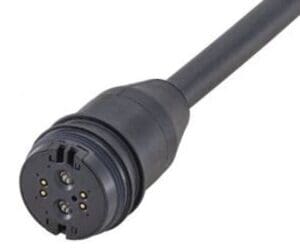
Rosenberger’s RoPD connector system is ideal for many LEV connection applications – including battery changing and charging – where frequent connection and disconnection is required.
Rosenberger’s RoPD connector series was specifically designed for micromobility applications, as well as drones and unmanned ground vehicles. Magnets are the key to securing a durable connection in these rugged use applications. The RoPD are particularly suited for data communication and power transmission of voltages up to 60 V and current loads up to 40 A. The magnetic locking and precise self-mating capability prevents any accidental or forced disconnection and therefore possible damage to the connector or the LEV. Furthermore, the high tolerance pin and socket design allows many mating cycles.
Easy recharging
ITT Cannon’s portfolio of connectors for electric vehicles includes advanced charging products for cars. In a scaled down adaptation of that concept, ITT developed a custom product in its collaboration with scooter maker Unu Motors. To improve portability and convenience, Unu needed a connector that would enable the scooter’s battery to be removed and recharged separately from the vehicle. It needed to be lightweight yet robust. Additionally, Unu wanted to manufacture the contacts in China, closer to production and point of sale for this huge market.
ITT designed a bespoke compact interconnect system that fit the unique form factors of the battery, scooter, and charging dock. ITT Cannon’s teams in Germany and China collaborated to craft a unique set of connectors with high-performance canted coil socket contacts for the battery and corresponding pin contacts for the scooter and charging dock. All manufacturing, including the cable assembly process of crimping the cables onto the connectors, took place at an ITT Cannon facility in China near unu’s manufacturing partner.
To learn more about the companies in this article, visit the Preferred Supplier pages for ACDRA, Hirose Electric, ITT Cannon, and Rosenberger.
Like this article? Check out our other Connected Vehicles and EV’s and HEVs, our Transportation Market Page, and our 2025 Article Archives.
Subscribe to our weekly e-newsletters, follow us on LinkedIn, Twitter, and Facebook, and check out our eBook archives for more applicable, expert-informed connectivity content.

- Connectivity Is Reshaping Police and Security Vehicle Fleets - September 8, 2026
- Thermal Management Strategies with Liquid Cooling Connectors - August 11, 2026
- Rodent-Resistant Electronics - July 28, 2026