IMS2025 Brings New RF/Microwave Interconnects
The world’s foremost microwave conference, the IMS symposium features everything from basic technologies to components to systems, including the newest 0.6 mm connectors, waveguides, and interconnect technologies.
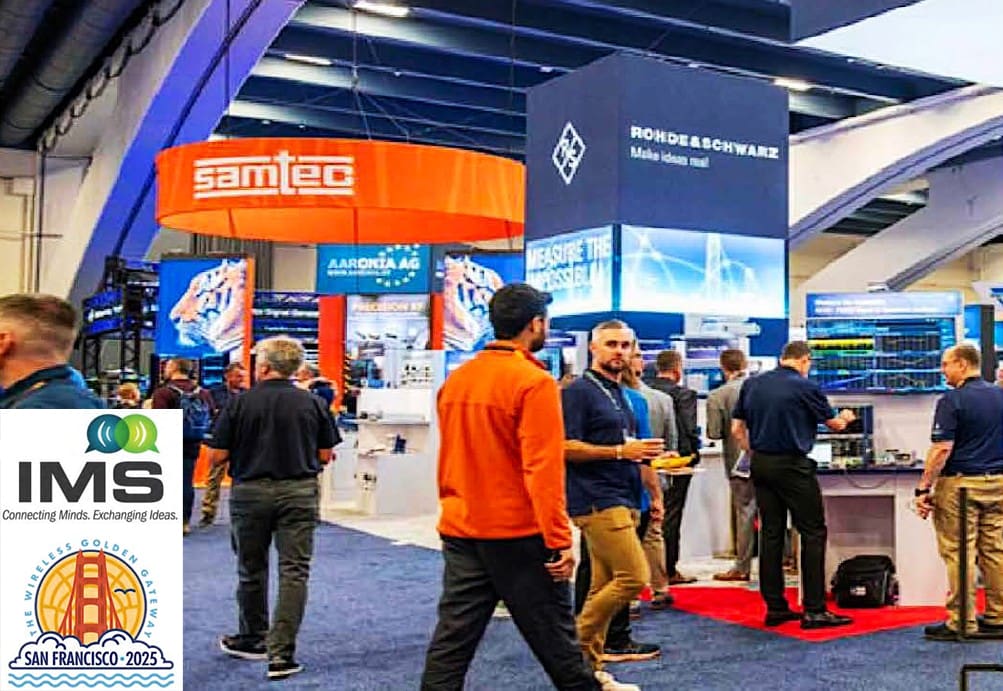
Photo by LylePhotos.com
The IEEE MTT-S International Microwave Symposium is the world’s foremost conference covering RF through millimeter wave and terahertz. Microwave Week combines IMS with the IEEE RFIC Symposium and ARFTG Conference. Together, they encompass everything from basic technologies to components to systems, from potentials for 0.5mm connectors to waveguides for THz, and latest interconnect technologies.
IMS 2025, held June 15-20 at the Moscone Center in San Francisco, drew over 9,000 attendees from 55 countries and more than 500 exhibitors. Event sponsors, including Samtec, Eravant, Millimeter Wave Products (Mi-Wave), showcased waveguide components. Keysight and Rohde & Schwarz demonstrated equipment for Test & Measurement. Analog Devices, Marki Microwave, MACOM, and Qorvo displayed components and assemblies. Most major suppliers of RF coax connectors and waveguides had a presence in the exhibition hall.
Connectors at Wave Guide Frequencies
Most components needed for 5G and startup for 6G already exist, except for those needed to use coax for 220 GHz. Problems relate to parts optimization and application design.
The highest frequency coax connectors on display were the 0.6 mm in Anritsu’s ME7838G mmWave VNA System, 70 kHz to 220 GHz, which should cover 5G and future 6G frequencies. The 0.6 mm interface is not compatible for standard coax coupling and instead uses a mating junction with a standard UG-387 waveguide flange to connect by first lining up the alignment pins and then mating the flanges.

Anritsu MA25400A Module with 0.6 mm interface with waveguide flange, for 220 GHz operation. Anritsu’s similar adapter MA25300A uses a 0.8 mm coax connector with standard threaded coupling for 145 GHz.
Other test equipment suppliers, such as Copper Mountain Technologies, offered equipment to 170 and 220 GHz using third-party extenders, such as Eravant, with waveguide interfaces. Virginia Diodes (VDI) offered module extender configurations to 330 GHz using connectors and waveguides compatible with Keysight and other Test & Measurement suppliers.
Onsite and virtual IEEE standards committee meetings were held during IMS. Attendees (including this author, representing Bishop & Associates) for Working Group IEEE-P1785 included inputs for IEEE P3136 on waveguides to support advanced industry needs. Published reports by the 23IND03 RF 4 6G standards group included Extending Frequency Range of Coaxial Measurements “for the 0.5 mm connector to at least 220 GHz,” which suggested potentials for new 0.5 mm coax connectors. We’ll wait until IMS 2026 to see if it materializes.
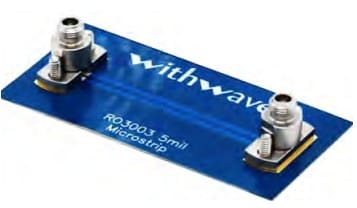
Exhibitor inputs indicate growing interest for use of 0.8 mm coax connectors for D Band between 110 and 170 GHz for wireless 5G and 6G backhaul and radar applications. Several sources for 0.8 mm connectors and cables were seen, including Anritsu, Southwest Microwave, SPINNER, Telent Microwave (China), Waka Manufacturing (Japan), Withwave (South Korea), and Yuetsu Seiki Co. (Japan). Flann Microwave and Eravant offer 0.8 mm to waveguide adapters. Vertical launch 0.8 mm connectors by Withwave are shown below with VSWR < 1.8 @ 145 GHz. Most suppliers stated that their 0.8 mm connectors conform to design requirements of the IEEE-287.1-2021 standard (IEEE 287.2-201 covers performance testing).
Expanded Product Offerings
Bill Rosas, president of Signal Microwave, said his team spent almost more time explaining board-mounted testing than discussing the company’s connectors. Signal Microwave offers a new design guideline.
It seemed that there were as many suppliers with waveguides and waveguide components as there were coaxial connectors. Cable suppliers stressing phase matching and stability included Samtec, Smiths Interconnect, evissaP, Flexco Microwave, Glenair, Harbour Microwave, Insulated Wire, Junkosha, MagaPhase, Maury, Mini-Circuits, and W.L. Gore. Micro-Coax (Amphenol) showed weight reduction using ARACON material instead of woven metal braid.
New products using advanced materials included Corning Gilbert’s RESINFLEX dielectric epoxy resin insulators as alternatives to glass dielectrics for non-hermetic applications. Housings are 100% gold plated. GPO equivalents were stated for 100 mating cycles.
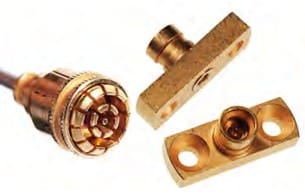
Another unique connector by Smiths Interconnect is the SMPM Mini-Lock connector for harsh vibration and shock applications up to 110 GHz.
An example of new company introductions, Golden Devices GmbH (Erlangen, Germany) founded in 2022 as a university spin-off, utilizes polymer 3D-printing with metallization or 3D-casting, and manufactures waveguide components and antennas for up to 300 GHz.
SV Microwave exhibited in the Amphenol Corridor, presenting the NanoRF VITA 67.3 Connector System, BMB RF Adapters (BMB are high-power push-on adapters to support the testing and calibration of SOSA-Aligned open systems), plus Torque Resistant Edge Launch Connectors, cable assemblies, and connector families. (See SV’s simplified explanation of the difference between MOSA, SOSA, and VITA.)
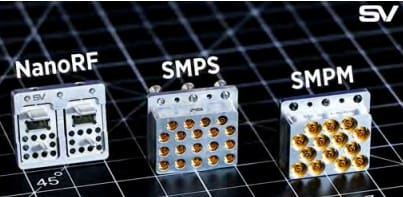
VITA 67.3 connectors offered by SV Microwave (Amphenol)
Companies pushing performance for “extended standard” connectors include 1 mm by SPINNER for 120 GHz and Keysight’s 125 GHz performance for its 1 mm applications.
Hirose offers 2.92 mm for 43.5 GHz as part of its new family of field-replaceable connectors. Southwest Microwave’s thick-wall SuperSMA still seems foremost for higher power 27 GHz applications, while its SuperMini 0.9 mm emphasizes miniaturization and is offered for low VSWR (1.2:1) at 67 GHz.
At higher microwave frequencies and above, connectors become transmission line components and must be treated similar to active devices. Just meeting minimum specifications is not sufficient, as users voiced need for repeatable performance that doesn’t change lot to lot. To be effective, connector/cable specialists need to learn about packaging differences. GaN, with its higher power density and efficiency, uses packaging solutions like embedded 2SPAK and PowerFLAT packages. GaAs uses more traditional packaging like QFN (Quad Flat No-Lead) packages, which affects PCB and connector I/O design and components. With node sizes shrinking to 90 nanometers, GaN is being used at E-band (71-86GHz) and W-band (92-114GHz).
Multi-Port Connectors
Multi-port connectors are high-density ganged coax interconnect assemblies that offer benefits for packaging size, PCB board space, labor, and reliability (consider mating one connector pair versus an array of individual coax lines). Multi-port assemblies were offered by many connector exhibitors. A quick review of exhibitors suggested that almost all suppliers of SMPM type connectors were presenting ganged assemblies, at least in single-row configuration.
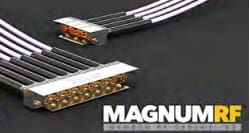
Samtec’s multi-port products included coax assemblies, housings, plus cabled assemblies as shown in picture at right for the MAGNUM RF products.
SV Microwave (Amphenol) has developed a new family of coaxes compatible with the Size 20 contact cavities of MIL-DTL-38999 circular connectors, for Series I, II, III, and IV housings for applications to 40 GHz. This supplements SV’s prior offerings for larger size cavities. Contact cavities for Series II are different, as these connectors are used often for reduced weight applications being “pancake” and not scoop-proof. The same Series II cavities and hence applicable coaxes fit Amphenol’s 2Mconnectors per MIL-DTL-32689. Other connectors such as ITT Cannon’s MKJ and Glenair’s Series 80 (and others) conform to MIL-DTL-32689.
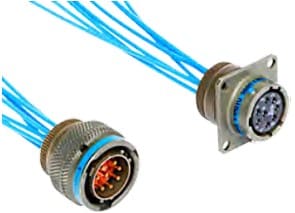
SV Microwave D38999 connectors with SV20 Size 20 Coax Contacts.
Southwest Microwave (SMI) exhibited PCB-mounted MIL-DTL-38999 receptacles with coax assemblies in contact cavities, similar to the cable plug and panel receptacles with size 20, 16, 12, and 8 coax assemblies offered in MIL-DTL-38999 and size 20HD for MIL-DTL-32689 connectors. Southwest Microwave also offers coaxes for size 20HD cavities in standard MIL-DTL-24308 D-Subminiature connectors and custom assemblies using modified Micro-D MIL-DTL-83513 housings. Depending on the cable used, Southwest Microwave’s multi-port coaxes are suitable for 67+ GHz.
Bob Griffin, senior sales manager at Southwest Microwave, said, “Since MIL-DTL-38999 connectors often are used for high vibration/shock applications, we had a full vibration/shock qual test done by Contech Research to the levels of MIL-DTL-38999. The concern is that the contacts for the regular MIL-connectors are very different than the structures used for coax-sized equivalents. For example, the MIL-spec male pins are solid versus the coax equivalents that involve thin wall assemblies.” This report, available online, is a good reference.
“Intermateability is a concern, as they are not like SMAs, where the design is rather simple and standardized; the elongated tines used in coax-replacement assemblies are relatively fragile. But this is how we get performance for ≥ 67 GHz depending upon the cable used. Improper mating or even probing can cause damage. Harness houses working with MIL-spec connectors rarely assemble mmWave coax cables and may not have the specialized VNAs to test at application frequencies to confirm their termination processes. Termination for the Size 20 and 20HD coaxes is via direct solder where the cable central conductor is not soldered (has full-circle compression) while the solder is applied to the outer cable/braid to complete the electrical path. We have had potential customers ask how to crimp using the tools for regular non-coax contacts. Accordingly, we prefer to supply size 20 coax assemblies as factory pre-wired pigtails, while customers can terminate the other size 16, 12 and 8 coax-equivalents.”
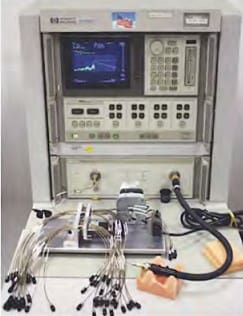
Photo taken from online copy of Southwest Microwave test report No. 91-3057, for electrical and mechanical testing to 5,000 mate/unmate cycles of its size 20 coaxes in 15-position MIL-DTL-24308 D-Sub connectors.
Specialty multi-port coax assemblies are offered by Times Microwave (Amphenol), Glenair, and others, plus cable houses that purchase coax components and MIL-connectors from others. Although the connector housings for MIL-DTL-38999 connectors are interchangeable (if per MIL3899 QPL), coax interface designs and positioning tolerances may be unique for each supplier. Therefore, at this time, intermateability between vendors of coax versions of MIL-DTL-38999 connectors has not been determined.
See information on applicable MIL and commercial standard circular connectors in this article by Bishop & Associates.
Technical Presentations
Presentations at the MicroApps Seminars area included:

Form Factor
Gavin Fisher of Form Factor presented dual band 220 GHz probes that combine coax and waveguide bands for continuous sweep measurement (shown at left). FormFactor provides solutions for mmWave, THz, for load-pull measurements at 67 GHz and beyond.
Marzena Olszewska-Placha of QWED sp. (Warsaw, Poland) presented conductivity of copper foils and copper clad laminates for 5G/6G applications, comparing coax and board laminates.
Krishna Veeram of Anritsu presented satellite testing/measurement options.
Greg Gonzales of Emerson NI, presented “RF Connector Selection Process” reviewing RF connector design, test, and application considerations, including the frequency reference chart below. (Author’s Note: Emerson product reference, not always same as other-supplier results.)

Connector Frequency Ranges (GHz) – Emerson NI
Other MicroAmps talks covered software and EM simulation, IC packaging, Microstrip and Co-Planar Waveguide Implementations, Test & Measurement techniques, plus antenna design, and satellite applications.
Over 200 technical sessions offered 456 peer-reviewed papers that were available for downloading. Topics were all on microwave and covered AI, 6G, machine learning, new standards, phased arrays for LEO SATCOM, radio miniaturization, interconnects for 5G and 6G backhaul, and materials technology.
Next year’s IMS will be June 7-12, 2026, in Boston. I’m anxious to see if anyone offers a 0.5 mm connector.

Additional information on the RF/microwave connectors, cables, and wave guides seen at IMS 2025, as well as other coax connector products, is included in the report World RF Coax Connector Market 2025 by Bishop & Associates.
To learn more about the companies mentioned in this article, visit the Preferred Supplier pages for Hirose Electric, ITT Cannon, Samtec Inc., Smiths Interconnect, SV Microwave, and Times Microwave Systems.
Like this article? Check out our other articles on our Automotive Market Page, and 2025 Article Archives.
Subscribe to our weekly e-newsletters, follow us on LinkedIn, Twitter, and Facebook, and check out our eBook archives for more applicable, expert-informed connectivity content.

- IMS2026: New Connectors Enable Higher Frequency Performance - July 14, 2026
- IMS2025 Brings New RF/Microwave Interconnects - July 22, 2025
- New Microwave and RF Advances Impress at IMS2024 - July 16, 2024