A Faster Future with Linear Pluggable Optics
As data center infrastructures upgrade to transition to higher bandwidths, LPOs are emerging as a promising solution to enable faster, more energy-efficient, and cost-effective optical connectivity.

A few days before the OFC 2025 optical networking conference, the LPO MSA (Linear Pluggable Optics Multi-Source Agreement) Group announced the completion of the 100 Gb/s per lane Linear Pluggable Optics Single-Mode Optical Data Transmission specification, or 100G-DR-LPO. This is a significant milestone that standardizes linear pluggable optics and sets the stage for the next generation of high-speed computing and data center design.
LPOs are a low-power pluggable module interface that eliminates DSP chips, creating a linear signal path. By simplifying the connection, the LPO reduces cost, latency, and power consumption. The energy savings is a significant development: LPOs use about 50% less power compared to traditional pluggable optical modules. Reducing power consumption at both the module and the system level through the use of LPOs will help data centers meet the escalating demand for higher computing speeds while more efficiently managing their enormous power consumption.
100G-DR-LPO targets speeds of up to 800 Gigabit Ethernet, the high-speed connectivity required for AI and machine learning applications, and ca be used in networking and computing equipment such as switches and network interface cards (NICs). It provides a defining framework for the optical cable and connectors and other components used in these systems, and simplifies fiber cabling. LPOs can plug easily into transceivers, enabling upgrades to be implemented as speeds increase.
“In short, with LPO the industry has an energy-efficient interconnect technology capable of supporting the rapid scale-up of AI cluster,” said Hadrien Louchet, receiver test expert with Keysight Technologies.
TE Connectivity is a member of the LPO MSA and has developed several products to serve in 800 G systems, including LPO transceivers. TE Connectivity’s OSFP-XD LPO Transceiver for PCIe Gen 6 Connectivity Over Optics, demonstrated at OFC 2025, is an innovative module is suitable for PCIe Gen 6 (64 GT/s per lane), delivering a total bandwidth of up to 256 GB/s in a 16-lane configuration, while maintaining a low power consumption of 8.5W. It can transmit up to 800G of data, accommodating more density and bandwidth than traditional connectors. Amphenol Communications Solutions also has an LPO product in development.
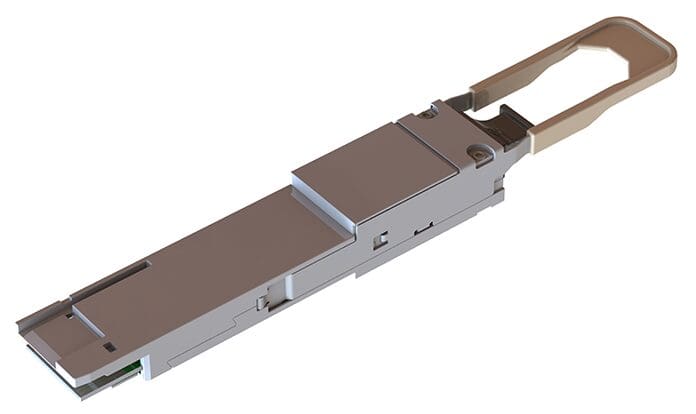
A new specification
The LPO MSA, a group of 50 networking, semiconductor, interconnect, and optics companies, collaborated on interoperability testing for 100G-DR-LPO. The LPO MSA’s goal was to create an open standard that would enable broad market adoption of linear pluggable fiber optic links and define the optical and electrical requirements for LPO-compatible products. The specification covers 100 Gb/s, 200 Gb/s, 400 Gb/s, and 800 Gb/s Ethernet parallel single-mode links, and includes component, module, and system-level interoperability requirements that span both the electrical and optical interfaces operating at 100 Gb/s per lane. This specification can be found on the LPO MSA website: Specifications and White Papers.
The connectors addressed in 100G-DR-LPO include the compact transceiver, which is “form factor agnostic” according to the specification; QSFP, QSFP-DD, and OSFP are possible form factors, with compatibility with SMF connectors. Testing also included LPO and LC connectors. The specification sets requirements for fiber optic cable, including single-mode optical cable and LPO cable.
“It has been exciting to see the growth of the LPO MSA and the broad participation from all parts of the networking ecosystem,” said Ryan Latchman, LPO MSA Marketing Chair. “This clearly demonstrates the benefits of using open standards to drive optimal interconnect solutions.”
An even faster future
Looking ahead, the LPO MSA, in conjunction with organizations such as OIF and IEEE, has set its sights on the next generation of high-speed computing with 200 Gb/s per lane linear implementations.
Read Bob Hult’s OFC 2025 show report to see more high-speed developments.
Like this article? Check out our other High-Speed and Data Center articles, our Wire and Cable Assemblies Market Page, and our 2025 Article Archive.
Subscribe to our weekly e-newsletters, follow us on LinkedIn, Twitter, and Facebook, and check out our eBook archives for more applicable, expert-informed connectivity content.

- Connectivity Is Reshaping Police and Security Vehicle Fleets - September 8, 2026
- Thermal Management Strategies with Liquid Cooling Connectors - August 11, 2026
- Rodent-Resistant Electronics - July 28, 2026