USB-C Serves Industrial Design with Rugged Variants
The USB-C connector has quickly moved from consumer applications into harsh environments. With 20 Gb/s data rates and IP-rated sealed variants, this connector can handle industrial conditions and serve in controllers, robotics, and peripherals for the factory floor. A new class of rugged USB-Cs and cables elevates this ubiquitous interface.

It’s been nearly two years since the EU Radio Equipment Directive went into effect, mandating that all consumer peripherals be equipped with the USB-C universal charging connector. USB-C currently supports up to 240W of power delivery (USB PD 3.1) and 20 Gb/s data rates (USB 3.2/USB4), making it a good choice for a wide range of device connections. But the implementation of this “universal” connector didn’t stop with phones, tablets, headphones, and other small devices. Versatile, fast, and easy to connect, the USB-C is expanding into industrial and harsh environment markets, connecting terminal screens, peripherals or attachments, and charging small equipment on the factory floor. The connector’s reversible form factor makes it easy for a human or robot to plug or unplug it without rotating it. However, while the same basic format used in a consumer USB-C can theoretically connect industrial applications, ideally USB-Cs need specialized features to provide long-term service in these operating conditions.
That’s not to say this is a flimsy commercial connector. High-quality versions of the basic USB-C format are already designed to withstand the considerable rough handling of consumer use, which can include such everyday hazards as thousands of mating cycles, debris ingress, shock and vibration, dropping, and even brief immersion. Even for consumer applications, it is available in sealed designs rated to IP69K. But for industrial conditions, connector suppliers have gone even further with new variants that offer additional protection against the realities of industrial applications. Rugged variants now feature screw flanges, THR reflow mounting posts, ruggedized housings, and other design elements tailored to meet standards for specific markets, such as automotive, military, and aerospace, where reliability is a key consideration.
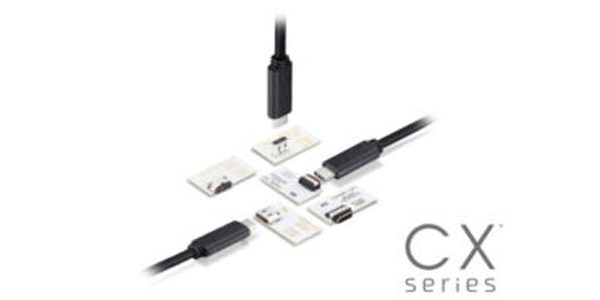
Hirose’s USB-CX for industrial applications features the familiar connector in a ruggedized housing.
“Engineers no longer want bulky proprietary connectors or multiple ports for data and power—they want a single, streamlined interface that saves space and simplifies integration,” according to Hirose. The company has been innovating variations to the USB-C format that can be used in industrial equipment like handheld diagnostics tools, edge devices, and small rechargeable robotics that operate in warehouses and factories. These applications need a small form factor connector, but still need to handle high power and data rates for tasks such as machine vision, analytics, and digital twin functions. In some situations, they could also be used for non-USB-C protocols, like UART.
Two main considerations determine whether a USB-C has the mechanical robustness needed for industrial applications: how the connector’s port end is secured to the PCB and how the cable attached the connector’s plug end is supported with strain relief. In other words, the structural integrity of the parts that surround the connector are as important as the connector itself.
Hirose’s engineers designed the industrial USB-C CX Series with mechanical robustness to support its enhanced voltages and the currents. To secure it to the port, screw flanges and THR mounting can double its peel strength (ability to resist loosening or peeling off the PCB) compared to SMT-only.
Pairing the connector with a suitable cable is also critical. An overly rigid cable causes stress or torque that can loosen a USB-C port when connector equipment moves. “Industrial IP67 USB-C cables and connectors are heavy-duty and can withstand heat, solvents, and liquids commonly found in harsh industrial facilities. USB-C industrial cables are also built to minimize power and signal loss and are more tolerant of the abuses of bending and twisting forces,” said electrical engineer Bill Giovino for DigiKey. DigiKey identified several features that make cables suitably ruggedized to support USB-C connections for industrial environments.
Broad temperature ranges enable operations in a variety of facilities and outdoors conditions. Look for cables rated over -20 °C to +85 °C, appropriate for most harsh industrial environments. Ruggedized cable jacketing, such as polyvinylchloride (PVC) resin, which has excellent water resistance and ultraviolet (UV) ray tolerance, serves outdoor applications or facilities that require wash downs. Materials must be specified for the application environment. “Commercial jackets can crack or discolor under prolonged exposure to sunlight,” notes Giovino.
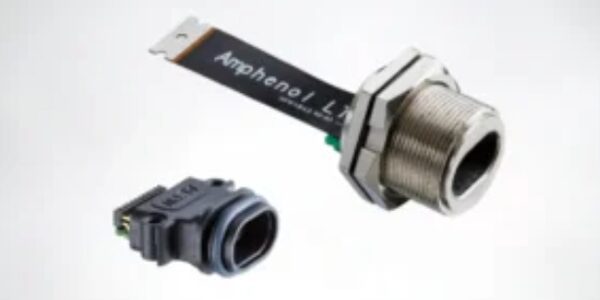
Amphenol LTW’s waterproof USB connectors are ruggedized for use in harsh or demanding environments. Also available from DigiKey.
In extreme harsh environments, DigiKey offers Amphenol LTW’s ruggedized USB-C products, such as the UC30FL-NCML-SC01. This cable is surrounded by a polypropylene plastic (PP) conduit that resists shock, extreme vibration, cutting, and strain from bending around corners. This cable is fire resistant to UL94V-0, and resistant to oil, gasoline, and most solvents. Able to withstand higher temperatures (from -40°C to +115°C), the cable can be used for industrial sensors and actuators in industrial environments where gasoline, engines, or generators are active.
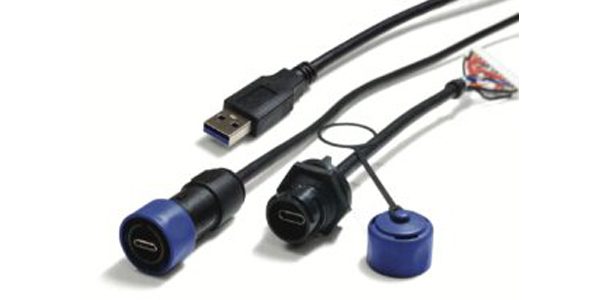
Bulgin’s USB 4000 Series Type C combines the ruggedness of the Buccaneer lines with the USB-C interface. Available in C to A, C to C. and various IP ratings.
In some industrial environments, water is the chief hazard, and specifying a suitable cable assembly for USB-C connections is an essential part of preventing water ingress and system failure. Bulgin’s PXP4040/C/A/2M00 USB-A to USB-C assembly can operate when submerged under 10 m of water for two weeks. This one can be used in marine environments and resists salt water, making it a good choice for equipment used on oil platforms, tankers, and cargo ships.
To learn more about the companies mentioned in this article, visit the Preferred Supplier pages for Amphenol LTW, Bulgin, DigiKey, Hirose Electric.
Like this article? Check out our other Harsh Environment articles, our Industrial Market Page, and our 2026 Article Archives.
Subscribe to our weekly e-newsletters, follow us on LinkedIn, Twitter, and Facebook, and check out our eBook archives for more applicable, expert-informed connectivity content.

- USB-C Serves Industrial Design with Rugged Variants - September 22, 2026
- What is a Solid-State Lighting Connector? - September 22, 2026
- What is an Ultrasound Cable Assembly? - September 15, 2026