Connectivity Is Reshaping Police and Security Vehicle Fleets
Police and security patrol vehicles are adopting new and emerging technologies from both the military and automotive worlds. This unique market combines defense-grade signal integrity demands with automotive-grade ruggedization requirements, often in the same harness.

Police and security patrol cars have become mobile electronics platforms, with huge investments in recent years outfitting these fleet vehicles with the most advanced surveillance, communications, and weaponry capabilities outside of the military. They are now essentially a rolling node on multiple networks, carrying sensors, cameras, encrypted communication devices, and weaponry. Body-worn integration connects the patrol officer to the vehicle, outside information gathering equipment, and command centers. This expansion of connectivity is leading to a specialized group of equipment. Components used in police and security vehicles come directly from the automotive worlds, although recent adoption of military-grade equipment is underway. Interconnect selection for police fleets is not restricted to MIL-Spec components, giving designers more leeway in specifying newer and low-cost components. The use conditions for police work are similar to military environments; interconnects need to support connectivity amid shock and vibration, thermal cycling, road salt, and long duty cycles.
Waytek has exhibited at the Police Fleet Expo for several years, giving the distributor an inside perspective on the police and security market. “Generally there is a drive for smaller products. More circuits are being used for accessories, so there is a need for high density connectors, compact designs, low profiles for ease of implementation and routing,” said Steve Green, corporate communications manager at Waytek. “One thing we’ve noticed is the need for standardization. Every upfitter organization builds something in a particular way. Connectors may look the same, but they are not all built the same.”
The company exhibited connector and wire and cable solutions that prioritize reliability under conditions such as water ingress and high temperatures, while advancing design goals centered on miniaturization. “We displayed our entire range of wire and DC electrical components at this show, not just connectors. For connectors, we focused on Amphenol products. Again, not a specific connector, but Amphenol’s many families within their A series, which covers a lot of the bases for automotive wiring.”
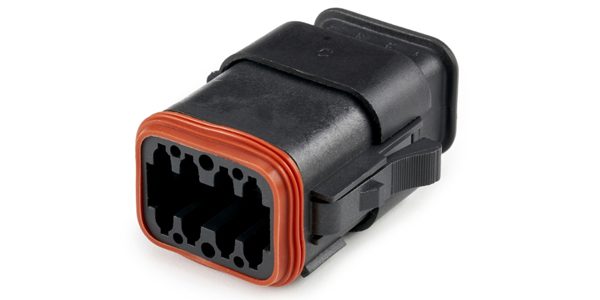
Amphenol AT and ATM series support Waytek’s police and fleet vehicle customer designs. These connectors include built-in diodes or resistors.communication.
Waytek’s customers are focused on fleet vehicle technologies. “They draw mostly on standard automotive electrical products. These components are compliant with SAE and other industry guidelines, which are quite rigorous,” said Green. “One trend we are seeing is a need for connectors that lock securely so they stay in place despite motion, jostling, vibration. A good example is Aptiv OCS connectors which have connector position assurance (CPA). It is the red tab you see on the male side of the connector.”
The company is attentive to changes within the police and security market, including the potential for integration of AI technology. “On an electrical components level, we aren’t hearing much about AI. Connector technology is fairly standardized and reliable. But data handling is becoming more important for this market, as it is for every market, and we’ll probably be hearing more about that in the future,” Green said. Right now, however, AI is a largely used by Waytek’s customers as a tool for specifying components. “AI gives buyers more ability to analyze products, compare them, learn about life cycle and other specs, to synthesize the product information that’s out there.”
Surveillance and sensing
While many police technologies operate outside of the public eye, small-unit surveillance and sensing technologies are becoming a visible part of the environment. In many communities, license plate recognition cameras (LRPs) and gunfire-detection microphone mobile stations are being installed in public spaces, with connectivity features that send data to police and security fleets. These systems transfer on-site video or data over Ethernet to patrol vehicles, where officers can view it onscreen.
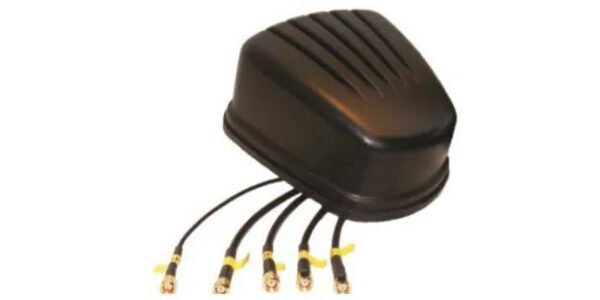
Mouser’s mobile fleet management resources include Advantech’s TREK-668 in-vehicle screen technology, a system that presents onscreen information to police and first responders. Specialized telematics are provided through vehicle-mounted antenna solutions.
A network of antennas, cameras, and sensors provides surveillance and fleet management data via Bluetooth, GPS, and WLAN connectivity. These vehicle-mounted technologies must be designed to resist outdoor environments and extreme driving conditions. M12 X-coded connectors are a good choice for exterior camera runs because their locking collar and IP67/IP69K ratings hold up against road spray and frequent pressure washing (patrol vehicles receive more frequent washing than most private vehicles). In patrol vehicles, FAKRA and HSD (High-Speed Data) connectors from the automotive world are used for shorter analog and Ethernet-over-coax runs.
Additionally, so many different RF systems within the confines of a vehicle chassis generate EMI and RFI, so shielding is an important consideration. Distribution to in-car video recorders and mobile data terminals can use shielded Cat6A M12 or ix Industrial connectors to keep EMI down. Deutsch DT/DTM series connectors are commonly specified for applications throughout police and fleet vehicles because their benefits include positive keying, vibration-resistance, and field-serviceability.
Communications
5G modems, mesh radio, and P25 land-mobile radio now coexist in the same patrol vehicle. This requires multi-port antenna connector arrays with combined GPS/cellular/Wi-Fi, typically terminated in SMA, TNC, or FAKRA-C. Backhaul between the vehicle router and roof-mounted MIMO cellular antennas can use low-loss coax with connectors rated for 5G-band frequencies, such as N-type or 4.3-10 connectors. Encrypted radio equipment requires connectors with guaranteed shielding effectiveness (typically 60 dB+) to prevent leakage, such as MIL-DTL-38999 Series III circular connectors with backshell EMI banding.
“Another trend is power splitters for J1939 CAN-Bus applications (data signals). We are seeing more demand for J1939 type products,” said Green. These products include Amphenol’s AT series of black connectors, which are more affordable than MIL-spec connectors but offer similar performance and reliability features, including IP68 and IP69K sealing and an integrated latching system with over-sized detents to ensure an electrical and mechanical connection under rigorous conditions. (Waytek’s blog includes a recent interview on trends in emergency vehicle upfitting.)
Shielding and EMI management
With RF transmitters, receivers, and high-current switching (light bars, sirens, winches), within a limited space, EMI/EMC compliance is a significant design concern. Overbraided cable assemblies with 360° shield termination at the connector backshell, rather than pigtail grounding, is a common strategy that helps mitigate interference, plus hybrid connectors that combine power, signal, and shielding in a single ruggedized shell. The advantage of using shielded components and wiring strategies is a reduction in the number of EMI ingress points.
Body-worn technology
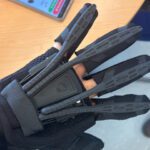
Body-worn cameras, TASER telemetry, and duty-belt biometric sensors are used in the field by police officers and then dock inside the vehicle for charging and data uploads. These interfaces need connectors rated for tens of thousands of insertion cycles under one-handed, non-visual operation so an officer can dock a camera or device quickly and without visual confirmation. OEMs are moving towards pogo-pin and magnetic connectors alongside ruggedized USB-C variants, which support the fast-paced handing of real-world conditions.
These smaller devices draw less upon the automotive world than the medical and military worlds, where small equipment must deliver extreme reliability under duress. ODU’s products for body-worn military applications transfer easily to police communications and security equipment. These connectors have been designed for high-reliability performance in high-density applications operating in equipment-dense environments. ODU perfected these capabilities in medical environments, where small and portable devices must perform amid larger equipment without generating interference or experiencing its impact.
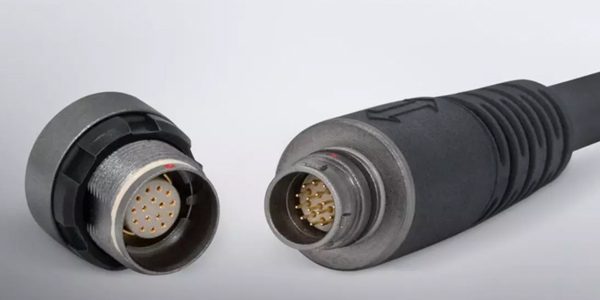
ODU AMC HIGH‐DENSITY connector is flexible, reliable, and compact, making it ideal for body-worn military and security applications. This high-speed data connector features IP68/IP6K9K protection, an operating temperature range from −51 °C to +125 °C, and more than 5,000 mating cycles.
Weaponry and less-lethal systems
Weapons technology is changing quickly, giving police and security personnel access to emerging and less-lethal military-grade weapons that integrate with the vehicle. These technologies include electronic weapon mounts, gun-lock/rack sensors tied to CAD dispatch, and less-lethal launcher telemetry for bean-bag and 40mm systems that can report round-count. Connectivity for this equipment draws more upon MIL-Spec components, with an emphasis on ease-of-use in the field. While most municipalities are not yet using this equipment, an excess of equipment and changing needs in the military are making these technologies more available for police departments. The years to come will see more adoption by the police and security market, in terms of original designs as well as retrofitted fleet vehicles. Engineers focused on this market must balance cost and fleet vehicle design traditions with the high-tech and mission-critical reliability expectations of military electronics. This is creating a hybridized connector landscape in which automotive-derived form factors and MIL-spec circular connectors operate in tandem.
For more inforamation on the companies mentioned in this article, visit the Preferred Supplier pages for Amphenol Communications Solutions, Mouser Electronics, ODU, TE Connectivity, and Waytek,
Like this article? Check out our Military and Aerospace Market Page and our 2026 Article Archives.
Subscribe to our weekly e-newsletters, follow us on LinkedIn, Twitter, and Facebook, and check out our eBook archives for more applicable, expert-informed connectivity content.

- Connectivity Is Reshaping Police and Security Vehicle Fleets - September 8, 2026
- Thermal Management Strategies with Liquid Cooling Connectors - August 11, 2026
- Rodent-Resistant Electronics - July 28, 2026