The Key to Preventing Connectivity Failures in Harsh-Environment Vehicles
There’s a frustrating pattern familiar for anyone who has operated or worked on commercial trucks, agricultural machinery, or construction equipment: a fault appears, the vehicle goes into the shop, technicians run diagnostics and find nothing. The fault code is gone, and the connection looks fine. The vehicle goes back into service, and within days or weeks, the problem returns.
By Jean-Paul Gervais, Global Product Manager, Industrial and Commercial Transportation, TE Connectivity
This isn’t just bad luck. It’s engineering.
Electrical connectivity failures in harsh-environment transportation platforms are rarely the result of a single defective part. In fact, post-mortem analysis consistently traces them back to system-level design oversights. Those decisions that were made early in the design process reveal their consequences months or years into a vehicle’s service life. To prevent these failures, it’s important to understand why they happen and why they’re so difficult to diagnose.
The top four engineering failure modes in harsh environments
Connectors in wiring harnesses don’t operate in isolation, but rather sit at the intersection of mechanical stress, environmental exposure, electrical loading, manufacturing variability, and service lifecycle events. Failure occurs when any one of these domains is weakly controlled and, in harsh environments, the margin for weakness is essentially zero.
The four failure modes that dominate industrial and commercial transportation tell the story.
Vibration-induced intermittency is perhaps the most frustrating. Continuous vibration creates micromotion between contact interfaces, which gradually erodes normal force, promotes fretting corrosion, and produces temporary open circuits that fall below ECU fault thresholds. The vehicle’s own diagnostic system can’t see the problem. The fault disappears the moment the vehicle stops moving and a technician plugs in their equipment. These failures trace back to contact performance, contact retention systems, crimp relaxation, and the absence of secondary contact locking, and not to any obvious defect a visual inspection would catch.
Thermal cycling and crimp degradation follows a similarly slow and deceptive path. Differential thermal expansion between the conductor, terminal, and housing degrades crimp tightness over repeated heating and cooling cycles. Contact resistance increases, and localized heating accelerates further degradation. This is why connectors that pass rigorous validation can fail 18 to 24 months into field service. The validation captured performance at assembly, not performance after thousands of thermal cycles.
Moisture and contaminant ingress compound these effects. Capillary action draws water into wire seals and interface seals. Agricultural equipment faces fertilizers and pressure washdown. Heavy trucks accumulate road fluids and grime across long service lives. The result is progressive corrosion and rising contact resistance as a result of common design oversights such as sealing performance evaluated only at initial assembly, elastomer compounds not selected for the actual fluid exposure the connector will face, or mismatches between wire outer diameter and seal compression. These are all problems that won’t show up until the vehicle has been in service for a significant period.
Assembly variability closes the loop. Mis-seated contacts, partial insertion, and connector mis-mating often go undetected without mechanical confirmation. When harness builds vary between plants or between operators, performance varies too, which introduces a source of unreliability that exists before the vehicle ever leaves the factory floor.
Robust connectivity directly influences system and vehicle reliability
What makes connectivity failure particularly costly in commercial and industrial applications is how one failed connection propagates through a system. A single harness or connector failure can disable multiple sensors or actuators simultaneously, collapse a communication bus, or trigger partial or complete vehicle shutdown.
In agricultural equipment, that translates directly to lost revenue during a narrow planting or harvest window that won’t come around again for months. In commercial trucking, it means a vehicle off the road and a load that isn’t moving. The connector is no longer just a component, it’s a business continuity risk.
The diagnostic dimension makes this worse. Intermittent electrical behavior caused by connection instability often doesn’t set trouble codes. It disappears during service inspection and reappears only under specific vibration or thermal conditions. Engineers and technicians spend hours troubleshooting a problem that isn’t visible when they’re looking for it. Connectors, in this sense, become a diagnostic multiplier increasing mean time to repair even when the underlying physical issue is small.
Engineering intelligent design from the start
The answer to these failure modes isn’t incremental correction after problems appear. This means selecting contact geometries that maintain spring force over thermal and mechanical aging, not just at initial assembly. It means validating crimp systems for conductor tolerance and plating consistency, and choosing housing and seal materials for dimensional stability across the temperature range and fluid exposure the application actually demands. What’s more, mechanical assembly confirmation, such as secondary locks, keyed housings, and processes designed to fail fast when something isn’t right, reduces variability between harness builds and lowers dependence on operator skill.
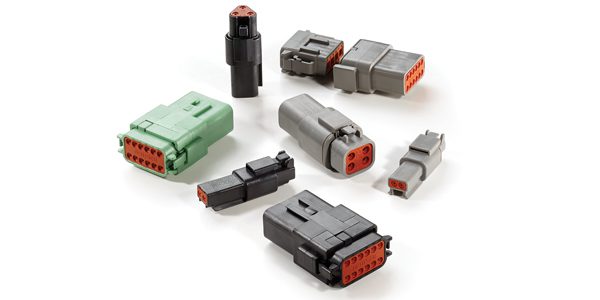
The bottom line is failure mechanisms in harsh environments may be application-specific, but they are also predictable, which means they are preventable. Engineers working on long-life platforms sometimes treat connector selection as a procurement decision and that can be a costly mistake. The difference between specifying correctly at the design stage and diagnosing failures in the field is substantial. Because intermittent connectivity failures are so difficult to isolate, diagnostic/service in the field and engineering fixes are always more costly than they first appear. TE Connectivity’s DEUTSCH connectors address these realities through reliable design at the architecture level, not incremental correction.

Jean-Paul Gervais, Global Product Manager, Industrial and Commercial Transportation, TE Connectivity
Learn more at TE Connectivity.
Like this article? Check out our other Harsh Environment articles, our Military and Aerospace Market Page and our 2026 Article Archives.
Subscribe to our weekly e-newsletters, follow us on LinkedIn, Twitter, and Facebook, and check out our eBook archives for more applicable, expert-informed connectivity content.

- Robots at the Limit: How Intelligent Connectors Enable Industrial and Medical Applications - September 15, 2026
- Designed to Survive: The Critical Role of Connectors in Harsh Environments - September 8, 2026
- Protecting Every Connection: Securing the Critical “Doors” of Solar Inverters - September 1, 2026