Extreme Temperature Innovations for Aerospace and Defense
One of the greatest engineering challenges facing military and aerospace systems is extreme temperature. Connectors must withstand severe heat and cold, as well as sudden temperature changes and other harsh conditions, while maintaining electrical integrity throughout the mission.

Extreme temperature remains one of the greatest engineering challenges facing military and aerospace systems. Connectors must withstand severe thermal gradients, vibration, shock, humidity, corrosion, and long-term storage while maintaining electrical integrity throughout the mission. Whether exposed to intense aerodynamic heating during hypersonic flight or freezing conditions during storage and deployment, mission-critical interconnects must deliver power and data with absolute reliability.
“A hypersonic missile can travel at Mach 5, 10, or even 15. Depending on the vehicle geometry, mission profile, and whether it exits and re-enters the atmosphere, localized temperatures at the nose can exceed 2,000 °C and may approach 2,500 °C,” explained Hecham Elkhatib, Director of Research & Development and Head of New Product Development at Bel Fuse, for their Cinch product line. “Peripheral regions can experience temperatures of approximately 1,200°C ~ 1,500°C, while other hypersonic configurations may expose portions of the airframe to approximately 700°C ~ 800°C. Missiles, propulsion systems, and future space vehicles all require interconnect solutions capable of surviving these extreme environments.”
Mouser supplies Cinch interconnects for space, military and defense applications, including harsh environment Technical Readiness Level (TRL) 9 connectors and Qualified Parts for Space (QPS) components.
The Bel Fuse Cinch team was tasked with developing a launch-trigger connector capable of surviving these demanding conditions. The resulting patented extreme-temperature connector was engineered to withstand virtually every military-specified environmental condition while maintaining electrical and mechanical integrity. “The contacts cannot shift relative to the insert because of thermal expansion. The insert must remain highly stable. We selected a precision-machined glass-ceramic dielectric with exceptional dimensional stability and press-fit pure copper contacts reinforced by stainless steel. The ceramic withstands temperatures above 900°C ~1,000°C, while the overall structure maintains the required mechanical integrity,” said Elkhatib. “Shock, vibration, and temperature had to be considered simultaneously. We incorporated magnets to stabilize connector mating and unmating instead of conventional alignment posts, eliminating components that could fracture during launch. The result was a coplanar poka-yoke design that enables reliable engagement before launch and smooth disengagement during liftoff.”
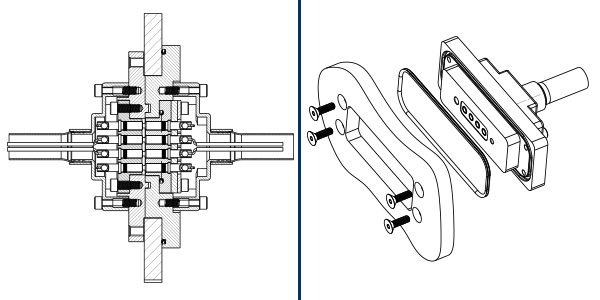
Patent diagrams of the extreme temperature launch trigger. On the left, a partial exploded view of once concept hypersonic receptacle. On the right, a mated cross section pair.
Throughout development, the connector underwent numerous design iterations as additional electronics reduced the available installation space. Ultimately, the connector footprint was reduced to approximately half of its original size without compromising performance or reliability.
“The system requires no human interaction during launch,” Elkhatib said. “An umbilical cable from the launch system engages our connector and transmits the signal that initiates launch.” During liftoff, the connector experiences shock and vibration associated with 65,000 to 75,000 pounds of thrust before being exposed to aerodynamic heating and temperatures approaching 700 °C for approximately one hour. “Once the launch sequence is complete, the connector no longer has an electrical function, but it must remain structurally intact,” Elkhatib noted. “Any degradation could interfere with the missile’s operation.”
Looking ahead, Elkhatib sees broader applications for the technology. “Reusable launch vehicles, spacecraft, and next-generation aerospace platforms will require similar material technologies,” he added. “Advanced dielectric materials, ceramic-reinforced polymers, and engineered composites represent the future of rugged, mission-critical, high-temperature interconnect systems.”
Extreme temperature hermetic connectors
Tim McCoy, Vice President of Sales and Marketing for the Engineered Interconnected Packaging Business Unit within AMETEK, understands the challenge of extreme temperatures. “Ninety-nine percent of what we do is a hermetic product, and it’s either in the connector space where we make standard and custom connectors, or it’s in the electronics packaging business where we make highly custom metallic or ceramic hermetic packages. And 85% of our business is defense and aerospace,” he said.
The company’s line of extreme temperature connectors provide a solution for these environments when standard hermetic connectors fall short. “Originally, we were working with some of the engine manufacturers in aerospace who wanted to have their sensors (measurement instruments for temperature, pressure, fuel flow, etc.) as close to the engines as possible. This meant less cabling, which removes weight and reduces the potential for inaccuracies, but required connectors that were significantly more resistant to heat than the ones used in the past,” said McCoy. The extreme temperature line addresses temperatures from -197 °C up to 440 °C. “In addition to traditional aerospace and defense applications, this makes our extreme temperature connectors very good for space applications where they’re going to see very wide shifts in temperature,” McCoy added.
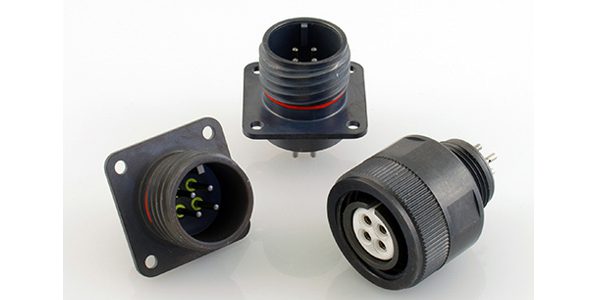
Extreme temperature connectors from AMETEK are available fully custom or according to MIL standards (including 38999, 26482, and 83723), and European standards EN2997 and ESC 10 YE.
AMETEK typically makes only the connector, however, for its extreme temperature product line, the company also makes the backshells. “Backshells that are capable of the same temperature range are not readily available,” said McCoy. For this reason, the company provides a full solution that works, the connector as well as the backshell that connects to the cable and functions reliably in extreme temperatures.
A key feature of AMETEK’s extreme temperature connectors is the proprietary custom glass formulation. “A lot of the glass in the industry that’s normally used would not maintain hermeticity at these temperature ranges,” McCoy said. The backshells are made of Inconel, a family of nickel-chromium-based superalloys that perform well under extreme thermal, mechanical, and corrosive conditions, including temperatures exceeding 1,000 °C. “It’s very difficult to machine, but we have significant capability in-house for machining Inconel.”
To learn more about the companies mentioned in this article, visit the Preferred Supplier pages for AMETEK, Cinch Connectivity, and Mouser.
.
Like this article? Check out our Military and Aerospace Market Page and our 2026 Article Archives.
Subscribe to our weekly e-newsletters, follow us on LinkedIn, Twitter, and Facebook, and check out our eBook archives for more applicable, expert-informed connectivity content.

- Safety First: Preventing EMI in Medical Devices - September 15, 2026
- Plastic Circular Connectors Product Roundup - September 15, 2026
- Micro, Mini, and Nano Product Roundup - September 8, 2026