What is an Elastomeric Connector?
Elastomeric connectors are used wherever a solder-free, zero-insertion-force interface is needed between a PCB and a flat or fragile substrate.
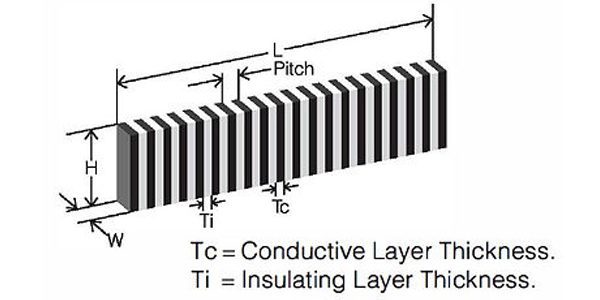
Elastomeric Connectors (also known as ZEBRA connectors) feature alternating, parallel layers of electrically conductive and non-conductive silicone elastomer. The elastomeric connector was invented by Joseph Asscher in the early 1970s by Elastomeric Technologies Inc. (ETI) to address a persistent problem in electronics: how to make reliable, low-force electrical connections to flat surfaces such as glass LCD panels, membrane switches, and PCB pads without soldering, crimping, or mechanical contacts that could fracture fragile substrates. ETI registered the connector under the trademarked name ZEBRA, an acronym for Zero-insertion-force Elastomeric Bonded Ribbon Assembly.
ETI’s technology was rapidly adopted by Japanese consumer electronics manufacturers in the mid-1970s for handheld calculators and digital watches. These applications required low-cost assembly, minimal height, and direct glass-to-PCB connections. The product line changed hands several times before being acquired by Fujipoly, the current trademark holder and primary manufacturer. By the 1990s, elastomeric connectors had become the de facto standard interface for LCD modules in medical devices, instrumentation, and automotive dashboards. Fujipoly subsequently introduced the XGP (gold-particle) grade for applications requiring lower contact resistance, such as precision analog, audio, and high-cycle-life medical diagnostics. Today the connector type is fully commoditized, with multiple manufacturers offering equivalent products, though “ZEBRA connector” remains the generic engineering term universally recognized in the display and embedded electronics industries.
From Fujipoly, a cross section of a ZEBRA elastomeric connector showing alternating conductive (carbon-loaded) and insulating silicone layers compressed between PCB pad and LCD glass.
Defining design feature
The elastomeric connector features a laminated silicone matrix of alternating conductive and non-conductive layers, formed by co-curing carbon-black-loaded (or gold-plated particle-loaded) silicone strips with pure insulating silicone in a tightly controlled pitch. When the connector is compressed between two mating surfaces, such as a PCB land pattern and a glass LCD segment electrode, each conductive layer bridges the opposing pads while the insulating layers prevent crosstalk between adjacent circuits.
Connection is made entirely by compression, with no solder, no mechanical latch, and no insertion force beyond the clamping load applied by a bezel, frame, or housing. This zero-insertion-force (ZIF) mechanism is critical for mating with fragile glass substrates that cannot tolerate lateral stress, and it allows blind-mate assembly. Contact resistance is determined by the cross-sectional area of the conductive layer and the applied compressive stress, typically 0.5–2.0 N/mm²; over-compression degrades performance, making housing design the key system-level variable. Pitch can be specified independently of the mating pad layout because any pad that falls within a conductive band makes contact, giving designers significant layout flexibility without custom tooling.
Sealing & Environmental performance
Elastomeric connectors do not carry an IP rating as discrete components; sealing is a system-level function achieved by the housing that clamps them. However, the silicone matrix itself is moisture-resistant, chemically inert, and performs across a wide thermal range (typically –55 °C to +150 °C). Because there are no metal contacts exposed to the environment, corrosion and contact oxidation are eliminated, which is a significant advantage in humid or salty environments. Elastomeric connector systems are widely used in small medical devices like glucometers and hearing aids, and outdoor meters where the housing provides IP65 sealing. Gold-particle-loaded variants (XGP and GXGP grades from Fujipoly and equivalents) offer lower and more stable contact resistance than carbon grades, making them suitable for precision analog interfaces.
Interoperability
ZEBRA is a registered trademark of Fujipoly. Generic equivalents conforming to the same laminated silicone principle are manufactured by Shin-Etsu Polymer Co., Ltd., Yokowo Co. Ltd., and Würth Elektronik. Because the technology is material- and geometry-based rather than pin-form-based, interoperability between suppliers is achieved by matching pitch (layer period), connector height (compressed and uncompressed), and bulk conductivity grade. They compete with FPC-to-board ZIF connectors in applications where a separable, solderfree interface is preferred.
Connector configurations
Elastomeric connectors are offered in three material grades: (1) Carbon-loaded silicone, the original ZEBRA formulation, economical, suited for low-speed digital and display applications; (2) Gold-particle-loaded silicone (XGP/GXGP) silver-coated gold or pure gold particles dispersed in silicone, offering contact resistance below 100 mΩ per layer, suitable for precision analog, audio, and high-reliability circuits; and (3) Metal-plated wire mesh woven metallic cloth embedded in silicone for very high current or RF shielding applications. Custom heights (compressed) from approximately 0.5 mm to 10 mm and pitches from 0.2 mm to 2.0 mm are available to order. Connectors are supplied in cut lengths or on reels for automated placement.
TECHNICAL SPECIFICATIONS
| IDENTIFICATION | |
| Product / Series Name | Elastomeric Connector; ZEBRA® Connector (registered trademark of Fujipoly). Grades: Standard Carbon (C), XGP (gold-particle), GXGP, Mesh ZEBRA |
| Manufacturer(s) | Fujipoly (USA/Japan; ZEBRA® brand); Shin-Etsu Polymer Co., Ltd. (Japan); Yokowo Co., Ltd. (Japan); Würth Elektronik (DE). Multi-sourced; no exclusive IP lock-in. |
| Industry Category | Elastomeric / Pressure-Contact; Board-to-Board (B2B); Display Interface; Compression Connector |
| Relevant Standards | No dedicated IEC/EIA standard. Material testing per ASTM D2240 (Shore A hardness); silicone per UL 94 HB or V-0 depending on formulation. RoHS 2011/65/EU compliant (most grades). |
| MECHANICAL SPECIFICATIONS | |
| Shell / Housing Shape | Rectangular strip (no shell). The connector body is a solid elastomeric block; housing/clamping frame is supplied by the OEM assembly. |
| Shell Material & Finish | No metallic shell. Body: silicone elastomer (Shore A 30–60 typical). Conductive layers: carbon-black-filled silicone (C grade) or gold/silver-coated particle-filled silicone (XGP/GXGP). No surface plating. |
| Overall Dimensions | Custom to application. Width (contact length): 1 mm to 200 mm+. Height (uncompressed): 0.6 mm to 12 mm typical. Layer pitch: 0.2 mm to 2.0 mm. Supplied in cut lengths or continuous reels. |
| Mounting Type(s) | Compression mount (clamped between two surfaces by OEM housing, bezel, or screw frame). No PCB through-hole or SMT attachment. ZIF (Zero Insertion Force). |
| Plug Types | Not applicable (no plug/receptacle pair). Single-piece strip compressed between two flat mating surfaces. |
| Receptacle Mounting Styles | Not applicable. Mating surfaces are bare PCB pads, glass ITO electrodes, membrane switch traces, or FPC pads. No dedicated receptacle component. |
| Mating Cycles (rated) | Effectively unlimited under constant compression (no wear mechanism). For intermittent mate/demate applications: typically rated to 10,000–100,000 cycles depending on grade and contact force. Carbon grades wear faster than gold-particle grades. |
| Locking Mechanism | None inherent to connector. Retention entirely by OEM housing/frame clamping load. Target compression: 15–25% of uncompressed height. |
| CONTACT SPECIFICATIONS | |
| Contact Count (range) | Determined by connector length ÷ layer pitch. A 10 mm connector at 0.5 mm pitch provides 20 conductive layers (20 circuits). Practical range: 2 to 500+ circuits on a single strip. |
| Contact Material & Plating | C grade: carbon-black particles in silicone matrix (bulk resistivity 0.5–5 Ω⋅cm). XGP grade: silver-plated gold particles in silicone (bulk resistivity <0.05 Ω⋅cm). GXGP: pure gold particles. No electroplated surface finish. |
| Termination Method(s) | Pressure contact only (no solder, crimp, IDC, or SMT). Mating pads may be bare copper, ENIG, OSP, or ITO on glass. |
| Current Rating (per contact) | C grade: 0.5–2 A per layer (contact area and compression dependent). XGP/GXGP grade: 1–5 A per layer. Mesh grade: up to 10 A+ per layer. Derate at elevated temperature. |
| Voltage Rating | Working voltage: up to 50 V DC typical (C and XGP grades for display/signal use). Dielectric withstand between adjacent layers (insulating silicone): 500 V AC per 0.1 mm insulating layer thickness (approximate). |
| SEALING & ENVIRONMENTAL | |
| IP Rating | Not rated as a discrete component. System IP rating depends on OEM housing. |
| Sealing Type & Material | Inherent silicone gasket effect when compressed. No separate sealing element required for the connector body. Silicone grades available on request. |
| Operating Temperature Range | –55 °C to +150 °C (standard silicone grades). High-temp grades available to +200 °C. Note: contact resistance increases at low temperature as silicone stiffens; housing clamp load must be verified over full range. |
| Environmental Testing | Thermal cycling: –40 °C to +85 °C, 1000 cycles (typical OEM qualification). Humidity: 85 °C / 85% RH, 1000 h (JESD22-A101). Vibration and shock: per OEM system spec; connector itself has no rigid interfaces to fail. |
| EMI / RFI Shielding | Standard C and XGP grades: unshielded. Mesh ZEBRA (woven metallic mesh in silicone): provides EMI gasket / shielding function in addition to electrical connection; shielding effectiveness up to 60 dB at 1 GHz (geometry-dependent). |
| MATERIALS & COMPLIANCE | |
| Insulator Material | Pure polydimethylsiloxane (PDMS) silicone elastomer (insulating layers). Durometer Shore A 30–60. No separate housing insulator; the insulating silicone layers are co-cured integral to the connector body. |
| RoHS / REACH / Halogen Free | RoHS 2011/65/EU: compliant (standard grades). REACH SVHC: compliant. Halogen-free: yes (silicone-based; no chlorine or bromine flame retardants). Confirm with supplier data sheet for specific grade. |
| UL Flammability / Certifications | Silicone body: UL 94 HB (standard grades); UL 94 V-0 available in select formulations. |
| ELECTRICAL PERFORMANCE | |
| Impedance (if controlled) | Not impedance-controlled. Contact resistance (per conductive layer, per unit area): C grade 0.1–2 Ω (compression-dependent); XGP grade <100 mΩ; GXGP grade <50 mΩ. |
| Data Rate / Bandwidth | Suitable for low-speed parallel buses and segment LCD data (DC to ~1 MHz typical). |
| TESTING & COMPLIANCE | |
| Testing Standards Referenced | EIA-364 (electrical connector test procedures); ASTM D2240 (durometer hardness); IEC 60068-2 series (environmental testing); JESD22-A101 (humidity). No connector-specific IEC standard; OEMs typically qualify against their own test plans. |
| Qualification / Approvals | No industry-wide standard. |
MARKETS & APPLICATIONS
Automotive, Medical, Consumer, Military and Aerospace
Elastomeric connectors are used wherever a solder-free, zero-insertion-force interface is needed between a PCB and a flat or fragile substrate. Primary markets include consumer electronics (calculators, digital watches, clocks, handheld games), industrial instrumentation, medical devices (glucometers, pulse oximeters, hearing aids, infusion pumps), automotive dashboard and HVAC displays, point-of-sale terminals, and white goods (appliance control panels).
Application milestones include early Casio and Texas Instruments calculators (1970s–1980s), LCD watch modules, Garmin GPS display modules, and glucometers. The connectors are also used for telecom and defense electronics (Mesh ZEBRA grade).
SUPPLIERS
Fujipoly (ZEBRA® brand; XGP, GXGP, Mesh grades); Shin-Etsu Polymer Co., Yokowo Co. Ltd, Würth Elektronik (elastomeric connector strips)
Like this article? Check out our other Meet the Connector and Connector Basics articles, our Military and Aerospace Market Page, and our 2026 Article Archives.
Subscribe to our weekly e-newsletters, follow us on LinkedIn, Twitter, and Facebook, and check out our eBook archives for more applicable, expert-informed connectivity content.

- Connectivity Is Reshaping Police and Security Vehicle Fleets - September 8, 2026
- Thermal Management Strategies with Liquid Cooling Connectors - August 11, 2026
- Rodent-Resistant Electronics - July 28, 2026