Data Centers Under Pressure: Designing infrastructure for an AI-driven future
Data center growth is reshaping how infrastructure is designed and scaled, placing new demands on the connectors that underpin power and data transmission.
By Greg MacDonald, global business development manager – Amphenol CS Products, PEI Genesis
Data centers are foundational to the global digital economy, supporting everything from cloud services and financial systems to AI, healthcare, and national security. The industry is expanding at unprecedented speed, with global data-center investment projected to reach $1 trillion by 2027, driven largely by AI and other compute-intensive technologies. This growth is reshaping how infrastructure is designed and scaled, placing new demands on the connectors that underpin power and data transmission. These shifts are changing connector requirements inside modern data centers.
AI workloads are fundamentally different from traditional enterprise computing. Training and inference tasks require vast volumes of data to be moved rapidly between processors, accelerators, memory, and storage, often within tightly packed racks operating at extreme power densities. Between 2020 and 2024, data-center bandwidth usage surged by nearly 330%, driven largely by AI-related demand, reflecting the unprecedented strain these workloads place on connector infrastructure.
Where data centers were once optimized around predictable, relatively modest loads, AI-driven environments demand connectors capable of supporting higher currents, faster data rates, and tighter signal integrity margins. At the rack and board level, even small losses or inconsistencies can translate into performance bottlenecks, increased heat generation, or reduced system efficiency. Connector reliability has become a critical enabler of AI scalability.
This shift is occurring alongside rapid architectural change. High-speed copper, optical connectors, and hybrid solutions must coexist in the same facility, often in the same rack. The challenge for designers is not simply achieving peak performance but ensuring that connectors can maintain that performance consistently over time, despite thermal cycling, vibration, repeated mating cycles, and evolving system configurations.
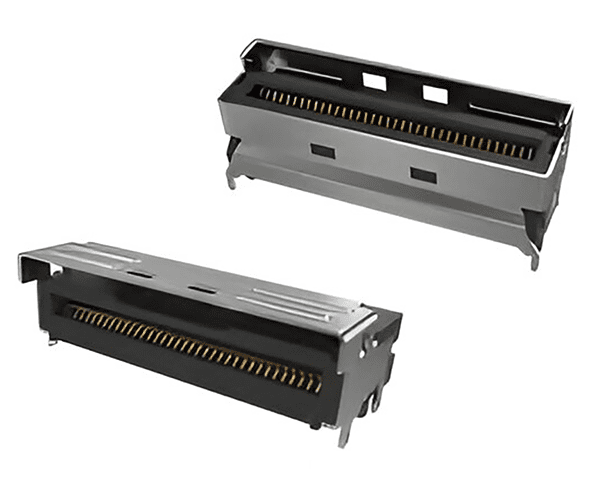
High-speed interconnect technology, such as Amphenol Communications Solutions PCIe Gen 7 Mini Cool Edge IO, illustrates how next-generation connector designs are evolving to support bandwidth demands while improving thermal efficiency in dense AI compute systems.
Power density raises the stakes
One of the most significant consequences of AI adoption is the sharp rise in rack power density. In hyperscale data centers, where most large-scale AI workloads run, power density has increased to around 36 kW per rack, significantly above traditional enterprise figures.
In AI-optimized facilities, racks are now commonly engineered to deliver 60 kW or more, reflecting the demands of dense GPU clusters and next-generation AI hardware. These escalating power profiles have profound implications for power distribution and the connectors that support it.
High-current connectors, busbars, and cable assemblies must operate reliably under sustained electrical load, often in confined spaces with limited airflow. Elevated temperatures accelerate material ageing, increase contact resistance ,and heighten the risk of failure if components are not designed with sufficient margin. Over time, this can contribute to gradual degradation mechanisms such as increased contact resistance and loss of contact normal force, rather than immediate, catastrophic failure. In this context, data centers increasingly resemble industrial environments rather than traditional IT spaces.
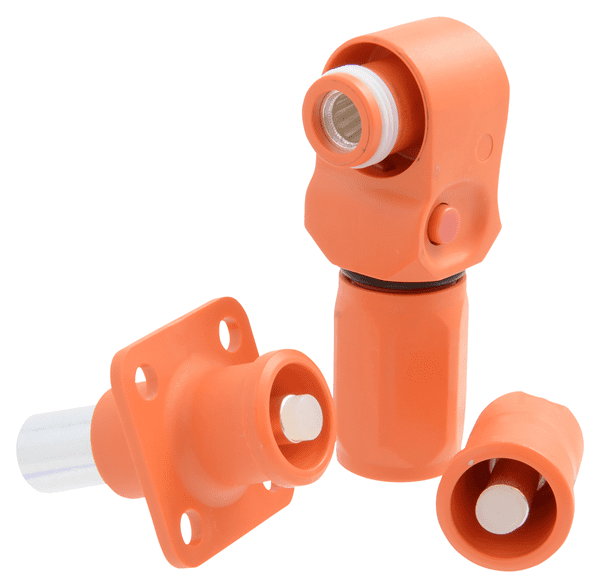
High-current interconnects such as Amphenol SurLok Plus, designed to support dense power distribution architectures in modern data-center environments.
At the same time, operational requirements have become increasingly stringent. Continuous uptime remains critical, while maintenance and upgrade activities are often conducted under constrained timeframes. Connectors must, therefore, deliver both electrical performance and mechanical robustness, maintaining stable contact integrity despite handling, vibration, and repeated mating cycles over extended service lives. As a result, the distinction between conventional and ruggedized connectivity is becoming progressively less defined within the modern data-center environment.
Liquid cooling constraints
As rack power densities continue to rise, thermal management becomes a limiting factor in data-center design. With air cooling approaching its practical limits in high-density AI environments, liquid and immersion cooling are increasingly deployed to manage sustained heat loads more effectively. While these approaches improve thermal efficiency, they also expand the operating envelope for connectors, introducing new environmental and mechanical constraints that must be addressed at the interface level.
In liquid-cooled systems, connectors may be subjected to condensation, dielectric fluids, or cleaning agents during both normal operation and maintenance. These conditions elevate the importance of sealing strategies, corrosion-resistant contact materials, and polymer stability under prolonged thermal and chemical exposure. Repeated thermal cycling, driven by fluctuating coolant temperatures, can also affect contact, normal force, and interface resistance over time, increasing the risk of gradual performance degradation rather than abrupt failure.
For connector selection and system design, this shifts emphasis beyond nominal electrical ratings towards long-term interface stability and environmental tolerance. Connectors must accommodate evolving cooling architectures while supporting frequent reconfiguration, higher mating cycles, and accelerated hardware refresh schedules common in AI-driven data centers. In this context, adaptability and lifecycle resilience become as critical as initial performance specifications.
Reliability at scale
The scale of modern data centers significantly amplifies the impact of minor component failures. A hyperscale facility can contain millions of individual connectors across power, data and control systems, meaning overall reliability depends not on any single interface, but on consistent performance across all of them. As system density increases, small variations in contact resistance, mechanical stability, or installation quality can have disproportionate consequences.
Research by the Uptime Institute shows that more than half of impactful data-center outages are caused by on-site power distribution failures, showcasing how electrical issues remain the most common root cause of operational disruption even as data-center systems grow more complex.
In high-density, AI-enabled environments, where thermal and electrical margins are tighter, a single underperforming connector can contribute to localized overheating, signal degradation or unexpected shutdowns, with cascading effects across racks or entire systems. This has driven a shift away from viewing connectors as interchangeable commodities towards a more lifecycle-oriented approach that considers durability, repeatability, and performance under real operating conditions.
These challenges are further intensified as AI workloads extend beyond hyperscale campuses into edge and modular data centers. Such facilities are frequently deployed in locations subject to wider temperature variation, vibration, airborne contaminants, or inconsistent power quality. Modular designs also introduce additional mechanical stress during transport, installation, and reconfiguration, increasing the demands placed on connectors to maintain contact integrity over repeated mating cycles.
With data processing moving closer to the point of generation, from industrial environments to healthcare and transport infrastructure, connectors are increasingly required to deliver high-speed data and high-current power under less controlled conditions. In these contexts, reliability is defined not only by initial performance, but by long-term stability across scale, environment, and operational change.
As AI-driven data centers increase in density and architectural complexity, connector portfolios illustrate how connectivity is being engineered across the full power and cooling chain. The solutions mapped across next-generation data-center architectures include high-current power connectors, rigid and flexible busbars, cable assemblies, terminal blocks, and connectors designed for liquid and immersion-cooled zones, supporting applications from switchgear and busway systems to rack PDUs and server interfaces.
This reflects a system-aware approach in which connectors are designed in context, maintaining electrical and mechanical integrity as loads shift, cooling strategies evolve, and infrastructure is modularly expanded.
AI-driven growth is forcing data center operators to reevaluate how physical infrastructure is specified, deployed, and maintained over time. Beyond processors and software, long-term performance increasingly depends on the consistency and durability of connectors operating at higher currents, tighter tolerances, and under more variable environmental conditions.
In this landscape, connector performance directly influences uptime and the ability to scale AI workloads without introducing new points of risk. Connector choices made early in the design process can either enable future AI scaling or introduce latent constraints that limit performance and resilience over time.
To learn more about connector selection, sourcing, and supply strategies for demanding data-center environments, visit PEI-Genesis at www.peigenesis.com.
Like this article? Check out our other Data Centers, Artificial Intelligence and High-Speed articles, our Datacom-Telecom Market Page, and our 2025 and 2026 Article Archive.
Subscribe to our weekly e-newsletters, follow us on LinkedIn, Twitter, and Facebook, and check out our eBook archives for more applicable, expert-informed connectivity content.

PEI Genesis.
- Data Centers Under Pressure: Designing infrastructure for an AI-driven future - February 24, 2026