Taking the Plunge: Underwater Connections
By Lynda Nolen, Bishop & Associates Inc.

For many of us, August is the hottest month of the year. Temperatures soar into the 90s, and even the 100s. In an effort to escape the oppressive heat, we head to the water. Whether it is the ocean, the sea, a lake, or a swimming pool, we appreciate the cooling and hydrating effect water has on us. But for interconnects, repeated exposure or total submersion in water creates one of the harshest environments an electrical or electronic connector can encounter. Water, in any of it various forms—vapor, liquid or solid—exposes these connections to a variety of environmental obstacles that can affect the mechanical, electrical, and dimensional properties of the part. To compound the problem, the type of water and level of exposure each mandate a different level of protection, meaning there is no one approach to protecting valuable electronic or electrical connectors exposed or submerged in water.

Because each level of exposure dictates it own unique set of environmental obstacles, connectors designed for use in or around water are generally broken down into three categories:
 

  1. Connectors designed for use in surface or shallow water

  2. Connectors designed for use in deep water

  3. Connectors designed for full ocean depth or sub-sea use

In addition to the level or approach to protection, and of course the power or signal-carrying capabilities of the connector, the category a connector falls within can also dictate other conditions, such as resistance to pressure, extreme temperatures, ergonomics, method of coupling, ability and ease of installation, repair, and cost-effectiveness.

As in any application that carries signal or power, the ability to mate or couple the connectors easily is vital. When dealing with connectors designed for applications involving exposure or submersion in water, this becomes even more significant. There are two basic methods of coupling a connector that is exposed to water. With the dry-mate approach, interconnects—either electrical, optical, or a combination of the two—are mated or unmated in the air or in a dry environment prior to being exposed to water. This type of coupling is common in applications such as shipboard connections, oil or gas platform installations, and meteorological measurement or broadcast systems. This type of coupling is used frequently when equipment and cables can be brought to the surface for repair. Interconnects that are actually mated or unmated under water, at up to full ocean depths, are referred to as wet-mate connectors. These types of connectors are used in sub-sea systems for the oceanography, oil and gas, and defense industries. This choice of coupling is chosen when surface retrieval is virtually impossible or extremely cost prohibitive. Wet-mate connections generally on two aspects of the connection—the front face of the connector, where the active electrical or optical signals are joined, and the backend of the connector, where the wires are terminated and the connector is sealed to the cable.


Environmental Obstacles


Corrosion
Probably the most crucial environmental obstacle a connector—used around or submerged in water—must overcome, is based on the type of water to which it is exposed. This is particularly important when discussing connectors exposed to salt water or seawater. Salt water or seawater, which represents 97 percent of all water on the earth, is made up of water (H2O) with salt in it. These salts, which are composed of over 70 different dissolved elements, decompose into electrically-charged atoms, or groups of atoms, when placed in water. Of these 70 different elements, more than 90 percent of the content is from these six elements: sodium (Na+), chloride (Cl−), magnesium (Mg+), potassium (K+), sulfate (SO4−), and calcium (Ca). These six elements, in the presence of water, allow ions on dissimilar metals to form, which slowly leach from the material in a galvanic reaction and dissolve the plating. This galvanic corrosion can cause weakening of the material and its properties, which can lead to reduced current-carrying capacity and result in intermittent, and ultimately, permanent failure of the connector. To overcome this, connector manufacturers offer a variety of shell materials specifically designed to withstand the corroding effects of exposure to these elements. These materials include:

  • Titanium
  • Thermoplastic  
  • Nickel-Aluminum-Bronze
  • Nitronic 50
  • Stainless Steel 316 & 316
  • Inconel

The choice of material is normally based on the level of exposure, length of expected service, operating temperature, composition of other components within the system, and of course, cost.

Recognized for its excellent resistance to a wide range of organic and inorganic liquids, high temperature rating, excellent tribological and electrical properties and reasonable price, high-performance thermoplastics, like PEEK, make a great choice for shallow or surface water exposure. Connectors and backshells manufactured with high-performance thermoplastics, such as Souriau’s UTS series, offer discrete wire sealing with IP68/IP69K sealing when mated, optional sealing caps for protection when not mated, and UV-and salt-spray-resistance—ensuring rapid, secure mating. Available in three shell sizes and nine contact arrangements, Souriau’s UTS series also offers a variety of contact sizes and styles, including machined, stamped, coaxial, and fiber optic. Because the contacts are crimped, all four contact styles can be combined within the same connector. Also, the connector can be field-terminated and easily repaired. The grommet, which uses the backshell to maintain the pressure seal, is capable of handling cable insulation diameters from 1.7 to 3mm. Each grommet cavity has a membrane that is pierced only when a terminated wire is loaded, therefore, no filler plugs are needed unless a cabling error or modification has occurred.

Shells used on connectors designed for full ocean depth or sub-sea environments are generally manufactured of high-grade metal alloy such as nickel-aluminum-bronze, or one of the other metals previously mentioned. These metals and metal alloys, which are used in a variety of marine applications, are all recognized for their high strength and excellent corrosion- and wear-resistance.

In addition to the corroding effects of saltwater or seawater, shear stress must also be taken into consideration. As seawater moves over the surface of a connector—particularly salt water that is heavily mixed with sand—parallel stress is placed on any object perpendicular to the movement of the water. Over time, metal shell connectors plated with a protective coating can experience a shearing or a breaking down of this coating as the velocity of the water increases. Overcoming this, especially in applications where the connector will be placed in a particular area for a lengthy period of time, proper selection of the shell material at the onset of the connector selection is required.

Pressure
Pressure plays an important role in connectors used in applications where water is involved. Pressure is particularly relevant for connectors used in full ocean depth or sub-sea environments. Pressure, which is defined as “force per unit area,” is all around us. When a connector is used in a normal application, such as in a laptop or printer, there is approximately 14.7 psi of air pressure also being placed on the connector, in addition to any pressure placed on the connector by the enclosure, PCB boards, or other components. This same 14.7 psi of air pressure is applied to a person standing in a room, but humans are so accustomed to this pressure that they don’t actually feel it. Water, being much heavier than air, adds approximately .445 psi per foot of water, or approximately 1.46 psi per meter of water for a total approximate pressure of 16.2 psi. This means that a connector used in a sub-sea environment at approximately 2,000 meters, must be able to handle an additional 2,920 psi. Considering that the average depth of the Atlantic Ocean is 3,926 meters and the Pacific Ocean 4,280 meters, pressure becomes especially relevant. Of course, none of these calculations address other issues that can affect pressure, such as water temperature and salinity.

To tackle the extreme pressure that these connectors must endure, rugged connectors, such as Souriau’s 8810 series, have been developed. Manufactured with shells of high-grade metal alloys, like nickel aluminum bronze, these connectors are designed to be submerged to depths of 3,000 meters. Rated at 500 mating/unmating cycles, these connectors offer body shells with rugged, square-cut coupling threads to enhance the suitability for repeated coupling and uncoupling in severe environmental conditions, and make the connectors ergonomically easy to mate. 


Another way to tackle the extreme high pressures of underwater wet-mate applications is to use glass-to-metal sealing, as seen in the Teledyne D.G. O’Brien 107 series. These parts, manufactured using 316/316L stainless steel shells, are available in three to 48 contacts, and provide a glass-to-metal seal pressure barrier in the receptacles for maximum protection of equipment. Designed to be molded to cables, the 14-pin and above layouts operate to 6,500 pounds per square inch gauge (psig) mated. Based on wire gauge and contact size, these rugged metal shell connectors can handle both instrumentation and power requirements.


Temperature

Our oceans and seas are separated into three layers. Temperature ranges within these three layers can fluctuate drastically. The surface layer, which accounts for only about 10 percent of the total water, has an average temperature of 17°C (62.6°F) and varies mainly with latitude. Ocean water in high latitude areas, like polar seas, can be minus 2°C (29.4°F) and in a low-latitude area, like the Persian Gulf, water temperatures can be 36°C (96.8°F). The second layer, called the thermocline, acts as a boundary between the surface water and the sub-sea or deep ocean water. In the thermocline layer, water temperatures drop drastically, as both depth and density increases. Temperatures in sub-sea water range between zero and 3°C (32 to 32.5°F). This wide change in temperature makes the selection of materials used in connectors for sub-sea applications extremely critical.

At first glance, sub-sea temperature ratings do not appear to be drastic, especially when realizing that the temperature rating of a connector designed to be used in backplane applications is approximately minus 55°C to 105°C. A connector in a backplane application, though, does not have to accommodate for other environmental factors, such as pressure- and corrosion-resistance, which a connector used in a sub-sea environment does. It is these factors, along with the required temperature ranges, that restrict or limit material selection.

To accommodate for these other factors, manufacturers of connectors used in sub-sea applications provide both an ambient temperature rating and a working temperature rating. Ambient temperature ratings will be significantly different than working temperature ratings. An example of this is seen in the previously mentioned Souriau 8810 series. Although this connector possesses an ambient temperature rating of minus 30°C to 70°C, the working temperature is appreciably different at minus 3°C to 40°C.


Types of Wet-Mate Connectors

There are three types of wet-mate connectors used in deep sea applications. The first type is designed to be mated using a remote operated vehicle (ROV). The second is for manual diver mating, and the third is intended for stab-plate mating.


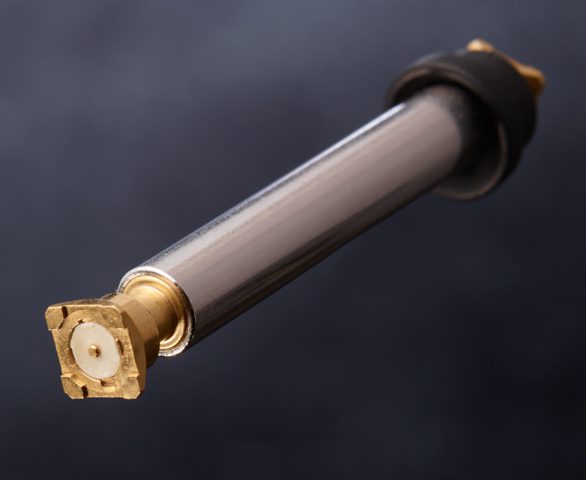
Connectors used with ROVs incorporate backshells with specially designed handles to allow the arm of the ROV to grab the connector and cable securely, and mate it to its fixed mount mate. The handle design is determined by the manufacturer. As illustrated in the side photos, these titanium CP Grade 2 metal shell connectors, part of Ocean Design Inc.’s Nautilus series, are pressure-compensated for full ocean depth of 3,000 psi. Underwater mating is accomplished by using two redundant mechanical barriers at all mechanical interfaces. During the mating action of the two halves of the connector, the pin contact enters the socket chamber by displacing the stopper. At the same time, its surface is wiped clean of any seawater or contamination by a series of wiping seals at the front of the chamber. The electrical connection is made up within the benign fluid environment. During disconnection, the plug retracts from the receptacle chamber and the insulating stopper fills the vacated space and seals off the chamber to prevent any oil leakage or water ingress.

To accommodate the loss of dexterity created by the use of diver’s gloves, wet-mate connectors designed for manual diver mating incorporate longer backshells with easy-to-grip-and-turn coupling mechanisms. Stab plates, which allow multiple connectors to be mated at one time, are commonly used in underwater junction and control boxes. Wet-mate connectors designed for stab plates incorporate retaining rings to hold connectors securely in place once mounted and to assist in mating. Generally, along with the electrical or electronic connections, are also hydraulic couplers that are connected to a variety of valves. Connectors and hydraulic connectors on a stab plate are generally mated using an ROV.


Additional Requirements
In addition to the many connector attributes discussed above, many sub-sea connectors must also be certified to specific navy or industry specifications. These specifications include connectors built to military specifications Mil-C-24217, Mil-C-24231, Mil-S-901C (navy), HI, Det Norske Veritas specifications (DNV), and connectors built to the American Petroleum Institute Standards (API-16D).

Mil-C-24217 covers deep submergence electrical connectors for submarine applications. Connectors built to this specification must be capable of handling a hydrostatic pressure range from zero psi to 10,000 psi, with a maximum recommended operating pressure of 6,500 psi. Mil-C-24231 includes pressure-proof single and multiple cable connectors, plugs, receptacles, adapters, hull inserts, and hull insert plugs. Connectors designed to comply with Mil-S-901D must have the ability to withstand shock loading, which incur during wartime service due to the effects of nuclear or conventional weapons. Connectors, like Souriau’s 8810 series, carry an “A” grade and “I” classification, indicating they are essential to the safety and continued combat capability of the ship and must meet these shock requirements without the use of resilient mounting installed between the equipment and the ship structure or foundation.

Connectors, like Teledyne D.G. O’Brien’s API-16D, have pressure test ports to verify the seal integrity prior to deployment of sub-sea drilling or production equipment as required by API-16D. These robust underwater connectors are pressure-rated to 10,000 psi, have redundant seals in all interfaces, and have an operating temperature of minus 40 to 75°C.

Taking the Plunge
When selecting a connector to be used in a wet or submerged environment, the answer to obtaining long life, highly reliable underwater electrical or electronic connections is to look beyond standard price and delivery. This is particularly true in underwater applications, where failure is most often associated with the inability of the connector to withstand the extreme operating and handling conditions associated with sub-sea installations. Unlike more traditional interconnects found in computer peripheral equipment or consumer goods, connector failure in an underwater application not only creates a major inconvenience, product downtime, repair charges, and the cost of a replacement connector, but it can also include total system downtime as well as replacement and repair charges. These charges can run into the thousands of dollars, when the cost of bringing up the cable and repositioning it is included.


Summary

There is nothing new about using connectors in underwater or surface water applications; in fact, underwater mateable or wet-mate connectors have been around for almost 45 years. What is new is the variety of available to connectors and the depths and environmental obstacles these connectors can now accommodate. This is especially evident when one realizes the impact in production and production costs sub-sea control systems, incorporating wet-mate connectors, have had on the offshore oil industry. What is also new is the extent to which fiber optics is being used and the advantages fiber optic underwater wet-mateable connectors can offer, including weight and size reduction. In fact, sub-sea telecommunications networks have already been deployed in a number of areas. With more than 90 percent of the earth’s surface covered in water, the applications for reliable, long-life and cost-effective dry-mate or wet-mate connections are only limited by where humans or machines can go.


Lynda Nolen
Product Specialist, Bishop & Associates Inc.

Lynda Nolen has been in the interconnect industry for over 28 years. She has worked in sales, sales management, marketing, and product management for such companies as TRW Electronics Components Group, Sunbelt Components, Cinch Connectors, Arrow Electronics, PEI Genesis, and Delphi Interconnect. Nolen has extensive experience in competitive cross-referencing, drawing, web and catalog review, new product introduction programs, harness and connector assembly programs, account management, and customer service programs. Lynda received her Bachelor of Arts degree from Roger Williams University in Rhode Island in 1979, and has completed various electrical engineering courses.


Bishop & Associates, Inc. © 2007