IMS2026: New Connectors Enable Higher Frequency Performance
5G & 6G, SATCOM, UAVs, quantum computers, and test equipment all push for higher performance. David Shaff’s review of this year’s premier microwave industry event finds new RF interconnects are ready for the next advancements.

The IMS2026 symposium had more than 8,000 attendees from 55 countries.
All sections of the RF/microwave industry came together at the IEEE International MTT Symposia (IMS) in Boston the week of June 7-12. IMS is the world’s premier RF and microwave technical conference and industry exhibition. IMS2026 combined the IEEE MTT-S RF Integrated Circuits (RFIC) Symposium with two new symposia formed out of traditional IMS technical content, the IEEE MTT-S RF Systems & Applications (RFSA) and the IEEE MTT-S RF Technology & Techniques (RFTT) Symposium, with the ARFTG Microwave Measurement Conference on Friday. Hosting these four conferences together is important, as all facets of design and technology at higher frequencies interact to achieve results, as illustrated by many IMS technical presentations on THz, cryogenics, transmission, special components, and test equipment.
While development of newer VITA standards was prompted by MIL systems’ requirements for cross-vendor interoperability per SOSA (Sensor Open Systems Architecture), the multi-sourced assemblies now available are expected to provide benefits for larger commercial test and communications applications.
Both the VITA 67.2 and VITA 67.3 standards are important interconnects for the Open VPX embedded computing architecture used in aerospace and defense applications. VITA 67.3 put the floating contacts on the backplane, which allows the contacts on the plug-in card to stay stationary, enabling designers to have direct RF edge-launch connections to the PCB. This reduces internal cabling, simplifies design, and improves electrical performance. Whereas VITA 67.2 offers predefined 2×4 (8 positions), VITA 67.3 covers up to 14 positions using smaller SMPM, or 19+ positions using SMPS, NanoRF, and even optical lines.
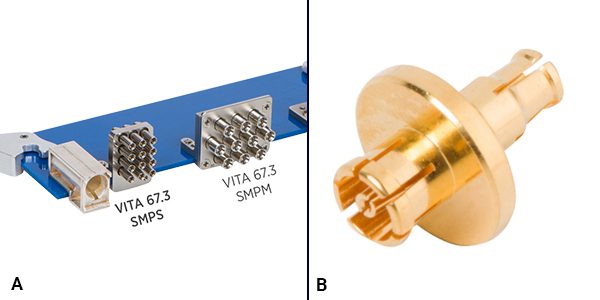
VITA connectors by SV Microwave Amphenol. B. Commercial hardware prompted by SOSA, SV’s SMPM to SMPS/SMP3 adapter for DC to 65 GHz.
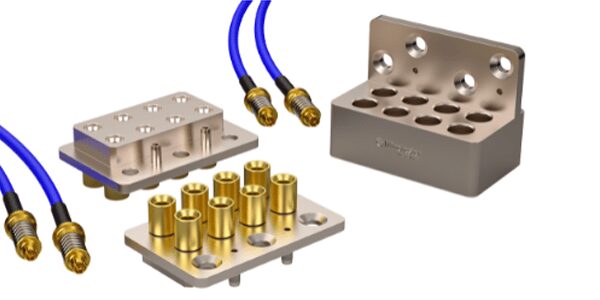
Winchester Interconnect (a subsidiary of Aptiv) recently released a VITA 67.2 8-position connector with SMP3/SMPS interface.
Newest precision coax connectors for 250 GHz
Many suppliers exhibited 1.0 mm precision coax connectors, including Anoison, Cinch Connectivity, Frontlynk, Hirose, HUBER+SUHNER, Rosenberger, Samtec, San-tron, Southwest Microwave, Spinner, SV Microwave (Amphenol), Waka, and WithWave, plus Chinese companies SomeFly, Lanjian Electronics, and Shanghai XinXun Microwave Technology. Many of these manufacturers also offered the 1.35 mm (for 90+ GHz) and 0.8 mm (for 145 GHz) connectors that were included in the lEEE 287.1-2021 standard.
For reference, the 1.0 mm connector was introduced as an open standard back around 1989 with design based upon manufacturing capabilities at that time. It was adopted and defined by IEEE Standard 287-2007 (now IEEE 287.1-2021). Although the 1 mm was standardized for 110 GHz, exhibitors use it at higher frequencies, including Keysight at 125 GHz and SPINNER for 134 GHz.
The 1.35 mm connector with operation DC to 90 GHz (E-band) is considered more rugged than the older 1 mm and initially was priced considerably lower. Many suppliers (and this writer) felt that the 1.35 mm connector would take business away from the 1 mm connector, but due to the many years of market acceptance, this did not happen. Essentially, the 1.35 mm has dropped through the cracks and was not seen applied at IMS, except minimally by Rohde & Schwarz, its initial sponsor.
The IEEE Working Group P287.1 chaired by Jon Martens (Anritsu) and vice-chair Rusty Myers (Keysight) met during IMS to consider adding the 0.5 mm and both the flange-backed and coaxial-threaded versions of the 0.6 mm connector for both Metrology and Instrument Grade test applications. While the flange-mount 0.6 mm was seen at last year’s IMS, the threaded coaxial coupling is new. (Bishop & Associates participates in the P287.1 WG to stay abreast of the latest interconnect technology for its readership.)
SomeFly Technologies displayed samples of both 0.5 and 0.6 mm plus 0.8, 1.0, and other mm Wave coax connectors, showing international support. SomeFly also participated in the P287.1 working group meeting.
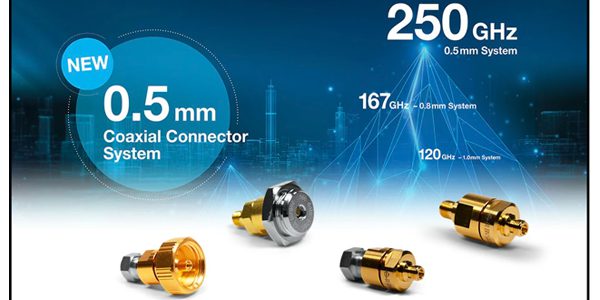
The 0.5 mm coax connectors were developed by SPINNER (shown above) with Keysight Technologies and Junkosha (cables). Broadband wafer probes by FormFactor use the 0.5 mm to achieve 250 GHz performance. Keysight advised that its precision cal kit provides calibration and confirmation to 260 GHz to support 6G and wafer measurements for 250 GHz.
Other exhibitors including MPI Corp. (Taiwan) announced equipment using 0.5 mm interconnects for sub-THz performance. Manufacturers, including WithWave and Southwest Microwave, said they were looking at 0.5 mm (and even the 0.6 mm) connectors but were waiting for standardization by IEEE.
Sub-THz probes were presented by GBB (Picoprobe), and T Plus Co. Signal Microwave had announced new PCB probes but didn’t exhibit this year. Laminate suppliers including Rogers Corporation and Isola Group, alongside specialized PCB manufacturers American Standard Circuits and GreenSource Fabrication, focused on next-generation 77-81 GHz automotive radar, 5G/6G infrastructure, and aerospace applications, plus environmental compliance and specialized dielectric structures. Virginia Diodes exhibited standard component and extension test systems operating up to 1.5 THz with custom-engineered systems scaling to 3 THz, primarily using waveguides to achieve max frequencies.
VITA 67 prompted by SOSA offers commercial benefits
Many exhibitors offered connectors per VITA 67.2 and VITA 67.3, including Amphenol SV Microwave, Molex, Rosenberger, Radiall, Samtec, Teledyne Storm Microwave, and Winchester Interconnect, plus distributors Mouser Electronics and HASCO.
Waveguides and coax connectors overlap
Most of IMS’s Silver Sponsors were component suppliers offering both coax and waveguides, illustrating how today’s designers need to evaluate both interconnect approaches to meet application requirements for power, frequency, and packaging. Eravant (formerly SAGE Millimeter) exhibited millimeter wave and sub-THz (18 to 330 GHz) components, subassemblies, and test equipment. Shown are F-Band right-angle coax-to-WG adapters for 90 to 140 GHz with 0.8 mm connectors.
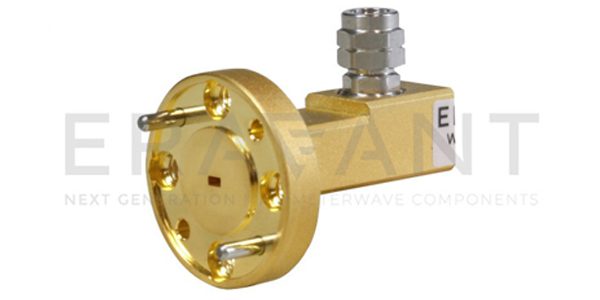
ERAVANT waveguide to coax with 0.8 mm coax connector.
Samtec demonstrated RF interconnect solutions with vertical and angled compression-connect launches to 110 GHz, alongside field replaceable connectors for SMA though 1 mm. Samtec’s board-mounted receptacles have unique alignment features to help assure proper PCB placement. The company’s Nitrowave® high-performance microwave cable assemblies are optimized for 18, 32, 43.5, 71, 95, 110, and 130 GHz, in a distinctive Samtec orange-colored FEP jacket (armoring available).
Samtec presented the Glass Core Technology (GCT) circuits operating up to >170 GHz, which enable system-level miniaturization for significant SWaP advantages over standard solutions. Samtec also exhibited WF15 V-Band Flexible Waveguide Assemblies with flexible WG cable plus panel/box receptacles and adapters.
HUBER+SUHNER ‘s paper, “Metallized 3D Printed THz Hollow Waveguide Components,” presented 3D metallized plastic technology, illustrated by new WR-1 (750-1100 GHz) waveguide components. To update WG technology, IEEE WG standards committees P3136 (Rectangular Metallic WG and Interfaces for 110 GHz and above) and P1785 (for 60 GHz and above) met during IMS, with participation by Bishop & Associates. See more information about waveguides.
IMS Covers a Broad Range of RF Components
Smiths Interconnect, a Molex company, presented its ceramic RF and microwave filtering solutions (including filtered D-Sub connectors) plus Thermopad temperature variable attenuators for DC to K-band. Its new ReadyStack interposers are a versatile, standard platform that is available in various pin-counts, layouts, and heights, using proprietary H-Pin technology, a low cost, stamped spring probe solution for heights 3.75 mm to 20 mm with a molded Top-Hat insulator. The interconnect components include a broad range of RF/microwave connectors and cables. Smiths’ optical interconnect family includes plug-in and backplane module connectors compliant with the forthcoming VITA 66.5 standard.
Teledyne offered a range of products from high frequency switches to GaN-based application solutions. Teledyne Storm’s interconnects include SMP connectors, phase stable cable, multi-port assemblies, and VITA 67 harnesses.
Hirose Electric featured field replaceable connectors, from 2.92 mm (supporting 43.5 GHz for evaluation boards) to 1.85 mm (for 71 GHz), and 1 mm (110 GHz), standardized for .009 inch diameter accessories with optional pre-threaded mounting holes, plus solderless compression mount jacks, terminations and attenuators. The U.FL and smaller X.FL are considered standards for single-line, shielded SMT connectors. Hirose’s DF Series of ultra-miniature flat coax cable to PCB are on 0.3 mm (0.012 in.) and 0.4 mm (0.016 in.) centers for use with micro-coax cable, supplied in tape-and-reel format, which also were presented by Mouser Electronics.
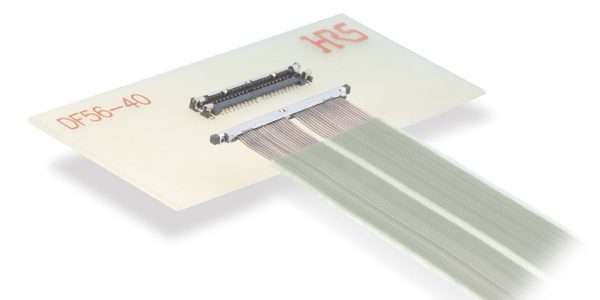
Hirose DF-56 Series on staggered 0.3mm pitch for vertical connections with ultra-miniature coax ribbon cable.
Radiall engineers explained how each terminal in their electromechanical RF switches is a separate coax connector with jack-output for cabling. Unique design, tolerancing, and materials/plating provide 10 million switching cycles. Exhibitor staff compared their switches to those by Keysight, although Keysight did not have a stand-alone display for RF switches at IMS. Other electromechanical multi-pole RF switches were shown by Logus Microwave, RF Lambda, and RelComm Technologies.
Southwest Microwave (SMI) exhibited its families of high-performance connectors, adapters, and cable assemblies, from SuperSMA (27 GHz) to 0.8 mm (145 GHz), and 1 mm. SMI also showed its recently released right-angle board-mount and cable connectors currently available for 0.047 in. and 0.085 in. cable types in SMA and 2.92 mm series.
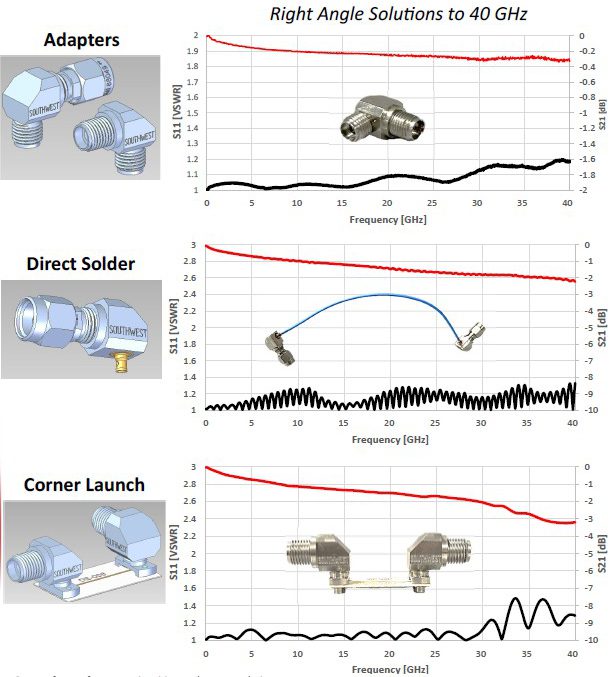
90° 2.92 mm connector performance by Southwest Microwave. Measurement is for complete assembly with multiple interfaces for both connectors and PCB as shown.
The Amphenol Microwave exhibition island featured six of Amphenol business units together: Times Microwave Systems, SV Microwave, Micro-Coax, Q Microwave, XMA Corp., and Amphenol Printed Circuits. While not shown per se, Amphenol Aerospace MIL-DTL-38999 connectors were used by SV Microwave for their multi-port assemblies including Size 20HD coaxes for the lighter-weight Series II connectors. When asked at IMS, SV exhibitors stated that their multi-port coaxes, when used in the same MIL-contact arrangements, were intermateable with those by Southwest Microwave, even though coax interfaces may be different. However, test reports were not publicly available.
Due to packaging and RF/microwave SWaP-C benefits offered, most interconnect manufacturers and cable houses showed high-density, multi-port coaxial assemblies and cluster connectors tailored for high-speed datacom, aerospace, and automated test equipment (ATE) testing. Cables used and termination methods affect results and, at this time, there are no industry end-product standards. Suppliers of standard and ruggedized multi-port and mission-critical hi-rel equivalents were offered by several exhibitors, including ConductRF, Glenair, Radiall, Rosenberger (MPX series), SV Microwave, Southwest Microwave, Times Microwave, and MIcable. For additional information on multi-port connectors, readers are referred to online article with more information about multi-port connectors.
Single-line high power and test cables for MIL-aero and communications were exhibited by Flexco Microwave, whose booth was staffed by third-generation family leadership Jeremy Medina, VP Operations. Other cable suppliers included Amphenol RF and SV Microwave, Anritsu, Cinch Connectivity Solutions, Times Microwave Systems, MIcable, ConductRF, Custom Cable Assemblies, Delta Electronics Manufacturing, Glenair, Micro-Coax, and others.
Both standard/original and mini-FAKRA connectors were exhibited by Rosenberger, with the newer mini-FAKRA operational to 20 GHz. Several firms, including Amphenol and Radiall, included FAKRA/mini-FAKRA in their lists of cable types offered.
Non-magnetic flex cables with nickel-free construction for cryogenic environments for quantum computing, MRI systems, and more are critical elements for sensitive system connections. These were offered by several exhibitors including Amphenol, Mini-Circuits, Radiall, Rosenberger, San-tron, Times Microwave, and WithWave. IMS had several technology sessions involving design for superconducting qubits and emerging low-temperature microwave applications.
The pace of high frequency advancement was seen everywhere at IMS 2026. This will continue at next year’s IEEE/MTT-S International Microwave Symposium in San Antonio, Texas, May 23-28, 2027, marking the 75th anniversary of the IEEE Microwave Theory and Technology Society. We look forward to seeing what new products and technology will be presented.
See Bishop & Associates’ World RF Coax Connector Market 2025 research report for more information about RF, coax, and microwave interconnects.
Like this article? Check out our other Trade Shows and RF and Coax articles, our Connector & Cable Special Topics Market Page and our 2026 Article Archives.
Subscribe to our weekly e-newsletters, follow us on LinkedIn, Twitter, and Facebook, and check out our eBook archives for more applicable, expert-informed connectivity content.

- IMS2026: New Connectors Enable Higher Frequency Performance - July 14, 2026
- IMS2025 Brings New RF/Microwave Interconnects - July 22, 2025
- New Microwave and RF Advances Impress at IMS2024 - July 16, 2024