Connecting the Next Generation of EV Batteries
Falling battery prices, improving battery chemistries, smarter pack architectures, faster charging speeds, and better battery connectors are bringing continuing advancements to e-mobility.
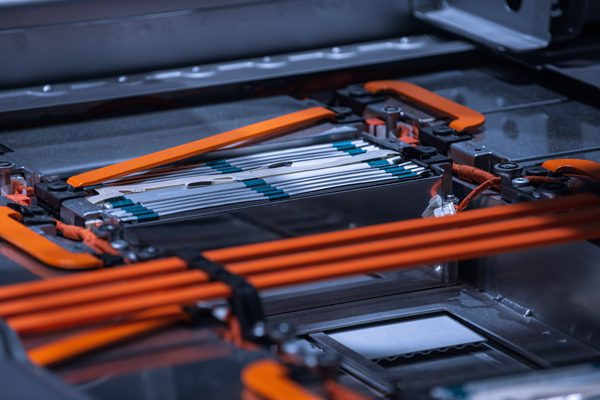
In many parts of the world, advanced components and engineering are solving the range anxieties that have held back e-mobility. Large-scale adoption in many European and Asian countries, and affordable new EV brands from China, are demonstrating that the e-mobility transition is underway. Electrification of the small engine, motorsports equipment, and warehouse vehicles markets has been widely successful. However, from a design perspective, this market remains largely fragmented. While the NACS charging connector is now a standard charging interface, many of the other components and architectures used in EVs are still in a state of active exploration and change, with EVs, hybrids, and internal combustion engines all competing. Automotive OEMs still haven’t settled on a single battery technology, making it necessary for component suppliers to offer new solutions for many different versions of this market. That may be about to change, however. Honda recently announced that it is now manufacturing a proprietary solid-state battery.
Many automakers, notably Toyota, Mercedes-Benz, and Renault, have been working towards solid-state batteries as a goal. Vehicles with SSBs can charge ultra fast with ranges up to 700-900 miles per charge, well beyond that of a tank of gas. Price has been a roadblock, but new manufacturing processes are bringing that down and Honda says it can now produce these batteries for a consumer market. SSBs could transform the EV market, and drive new developments for energy storage and device design as well. Honda says it will implement its batteries in the next two years, although its 2027 lineup still uses lithium-ion, along with most of the global EV industry.
Range per charge by battery type
Miles on one full charge. Bars with hatching are estimates or manufacturer claims.
Reported for a specific vehicle
Estimate or manufacturer claim
Cost and durability
Price per kWh matters as much as range for mass-market cars.
| Type | Pack $/kWh | 75 kWh pack | Cycle life |
|---|---|---|---|
| LFP | $81 | ≈ $6,075 | 3,000+ |
| NMC | $128 | ≈ $9,600 | ~1,500 |
| Sodium-ion | ~$85cells only | n/a | n/a |
LFP and NMC prices are BloombergNEF 2025 pack averages. The 75 kWh column is price per kWh times 75. Solid-state has no published price yet, so it is left out. The sodium-ion figure is a cell price and a target of about $40/kWh is projected at scale.
In the U.S., most subsidies for consumers in the EV market have ended, but an unstable energy market, growing climate change impacts, along with the example of the small engine equipment market, have helped to sustain interest in e-mobility. “Outside of marine and long-haul trucking, virtually all of our customers are at least conducting studies on electrification,” said Henrique Ferrari, Applications Engineer at Chief Enterprises. “Unlike earlier expectations that internal combustion engines would be completely replaced overnight, the transition is more nuanced, but EV development continues to progress steadily across multiple markets.
“My personal take is that while EV development has slowed overall, attributing that purely to reduced government support doesn’t tell the whole story. Consumer adoption is also impacted by practical challenges like charging speeds, infrastructure gaps, and battery longevity compared to ICE vehicles. Guiding customers through this landscape comes down to aligning with their specific product strategies rather than offering a one-size-fits-all roadmap.”
Chief’s engineering team works with customers across the various vehicle markets. The company watches new developments closely to help customers access components that will enable them to move past the experimentation stage. Chief offers off-the-shelf components for battery systems, such as contactors and connectors, and has the engineering capability to integrate these products, said Ferrari.
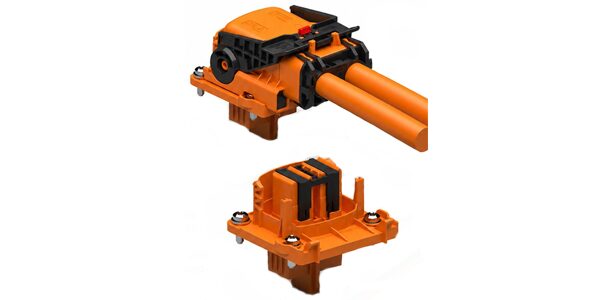
Chief Enterprises is a Bosch distributor. EV solutions include high-voltage interconnects that help facilitate fast charging.
“Integration and standardization are the primary hurdles. While off-the-shelf EV components are widely available, integrating them into units like a Power Distribution Module (PDM) or Battery Disconnect Module remains complex. Customers are constantly weighing ROI questions: Will this unit carry over to next-generation platforms? Is volume high enough to justify a custom solution? On the technical side, the biggest engineering challenge is managing heat dissipation and temperature rise, which directly drives decisions around material selection (copper vs. aluminum) and the influence of raw material costs. So it’s partly technical and partly economical,” he said. “However, battery system architecture and pack development remain deeply integrated with individual OEM requirements at the moment.”
Battery technology and system impacts
At the Battery Show North America, running October 12-15 at Huntington Place in Detroit, the diversity of battery technologies and their corresponding architectures will be on display. Connector suppliers including Ametek, Amphenol, Bel Connectivity Solutions, Heilind, Hirose, ITT Cannon, Lumberg, Rosenberger, Samtec, and TTI will exhibit new connectivity products and TE Connectivity will present at the conference.
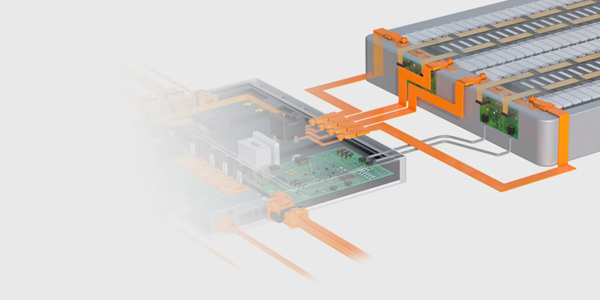
New battery architectures. TE Connectivity
TE’s sessions will explore how the fragmented battery market is impacting design architectures, components, and the global supply chain. Global OEMs are dealing with different regulations, technologies, and levels of investment around the world. These differences impact vehicle design, including higher system voltages and charging currents, increased thermal demands, and more integrated power architectures. TE is also presenting on Software Defined Vehicles. Across vehicle types, SDVs are driving fundamental changes in vehicle networks, zonal architectures, and the design of wiring harnesses, connectors, and electronic systems. The shift to 800-volt (and future higher) platforms is another topic of conversation, with attendant changes to faster charging and lighter-weight cabling, which raise performance requirements for connectors in the system.
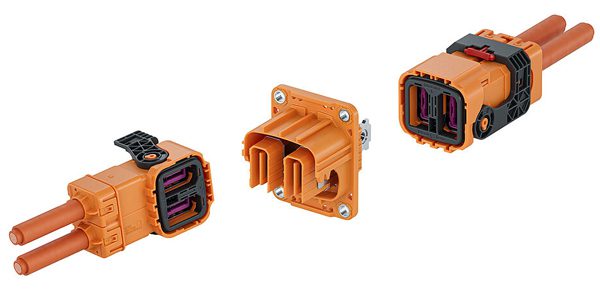
Rosenberger’s HVR 210 is a compact, cost-effective connector solution that helps enable 800-V systems with future-proofing for 1,200-V architectures. Copper and aluminum conductors available for all cross-sections.
Rosenberger will exhibit its solutions for higher voltage systems. The company has released connectors for 800-V vehicle architectures that are designed to facilitate the next transition to higher voltage levels of 1,000 V and 1,200 V. These higher voltages will make it possible to transmit the same amount of power at lower currents. The lower currents require new cables that allow for smaller cable cross-sections, with a continuing move towards greater compactness and weight reduction.
Connectors and the push for faster charging
Connectors help facilitate faster EV charging. In China, automakers like Geely and BYD have unveiled new fast-charging systems that can charge a car in under five minutes, rivaling a gas station visit, and less than half the time it takes to charge at a Tesla Supercharger. These companies have combined hardware strategies such as liquid cooled cables with blade-type batteries and AI temperature management in the vehicle, and on the station side, battery storage systems and solar power.
EV battery types compared
Range, charge time and price side by side, ordered from most to least mature.
| Battery type | Range per charge | Charge time and conditions | Pack price | Also worth knowing |
|---|---|---|---|---|
|
NMC
Most EVs today
|
~330 mi
530 km, Model Y NMC
|
~30–40 min EST.
10–80% on a typical DC fast charger
|
$128/kWh
BloombergNEF 2025 average
|
Highest energy density (150–250 Wh/kg), but only 1,000–2,000 cycles. |
|
LFP
Standard
|
~300 mi
480 km, Model Y LFP
|
~30–40 min EST.
Similar to NMC on a typical DC fast charger
|
$81/kWh
BloombergNEF 2025 average
|
3,000+ cycles and safer, but loses more range in deep cold. |
|
LFP Blade 2.0
BYD
|
~400 mi EST.
Real-world; 621 mi on the optimistic CLTC cycle
|
5 min
10–70%, or 10–97% in 9 min. Needs BYD’s 1,500 kW Flash Charger.
|
About LFP average
$81/kWh, no separate price
|
190–210 Wh/kg, about 5% above the first-generation Blade. |
|
Sodium-ion
CATL, first cars 2026
|
~250 mi EST.
From a 400 km pack design
|
Not reported
|
~$85/kWh
Cells only; about $40 targeted at scale
|
175 Wh/kg, so heavier for the same range. Best suited to city cars. |
|
Solid-state
Honda, Toyota and others
|
700–900 mi CLAIM
Honda’s own target is 620 mi by about 2030
|
“Ultra fast” CLAIM
Honda estimates 80–90% in minutes; not yet demonstrated
|
No published price
Cost is the roadblock
|
Not yet at scale. Safer and more compact, if production costs fall. |
As DC fast-charging systems push past 350 kW, the connectors and cables carrying that current have had to manage more heat. Liquid-cooled cable and connector assemblies are now standard on the highest-power charging equipment, since passive designs can’t dissipate the heat load adequately. Contact material and plating choices, such as silver versus tin, can make a big difference in current density, but cost considerations must be weighed against conductivity and wear life. And because a charging connector gets mated and unmated thousands of times over its life, often outdoors and in all weather, durability and sealing are as much a design problem as raw current-carrying capacity.
Higher-voltage architectures mean busbars and high-voltage interconnects have to manage greater electrical stress in a smaller footprint, with less room for error on creepage and clearance. Blind-mate and modular connector designs are easing pack assembly on the manufacturing line and making service and second-life repurposing more practical — an increasingly important consideration as the first wave of EV batteries starts reaching end-of-life. And as battery management systems get more sophisticated, tracking voltage and temperature at the individual cell level, the signal and data connectors carrying that information have become as critical to pack safety as the high-current power connections themselves.
To learn more about the companies mentioned in this article, visit the Preferred Supplier pages for Chief Enterprises and Rosenberger.
Like this article? Check out our other Automotive articles, our Connector & Cable Special Topics Market Page and our 2026 Article Archives.
Subscribe to our weekly e-newsletters, follow us on LinkedIn, Twitter, and Facebook, and check out our eBook archives for more applicable, expert-informed connectivity content.

- How We’re Creating Connections for Life - October 16, 2026
- What Is an RFID Antenna? - October 13, 2026
- Connecting the Next Generation of EV Batteries - October 6, 2026