Single Pair Ethernet Association is the New Face of SPE
The organization is now well-positioned to build momentum and accelerate the development, standardization, and global market adoption and implementation of Single Pair Ethernet (SPE) technology for industrial communication, automation, and IIoT.
Single Pair Ethernet System Alliance and SPE Industrial Partner Network have merged to create the Single Pair Ethernet (SPE) Association, representing members from more than 130 leading manufacturing and technology companies worldwide. The leadership of both networks unanimously approved the decision to combine the two previously independent organizations, consolidating their expertise, activities, and memberships into one unified entity.
Rather than continuing to pitch their own views of what SPE should be, the two groups saw the value in coming together to figure out what is best for customers, said Nick Sandoval, President of SPE Association’s North American Marketing Council. “We came to realize that our current structure was keeping a lot of companies from joining the SPE conversation. They saw a ‘VHS versus Beta battle’ and wanted to see which won before they started investing. The SPE Association merger happened because we wanted to create a single voice to proliferate this technology, which we believe strongly in. It is really a game-changing technology. It’s not just going to change this one small part of factory automation. Frankly, it is going to change all factory automation, in my view.”
The result was not one technology winning out over the over, but rather one that all the parties could get behind: IEC 63171-7 (the seventh variant of the SPE standard). “This one combines legacy technologies into a single standard for a whole family of connectors — a new IP20, M8, M12, and M12 hybrid. All of us are going forward in this technology,” Sandoval said. “Because this technology was ratified so recently, there aren’t a lot of devices yet in the market, but we expect that to change early next year. We already have a lot of prototypes due to go to this new standard. For customers, this means their choices are a lot clearer. They don’t have to worry about something else coming down the line.”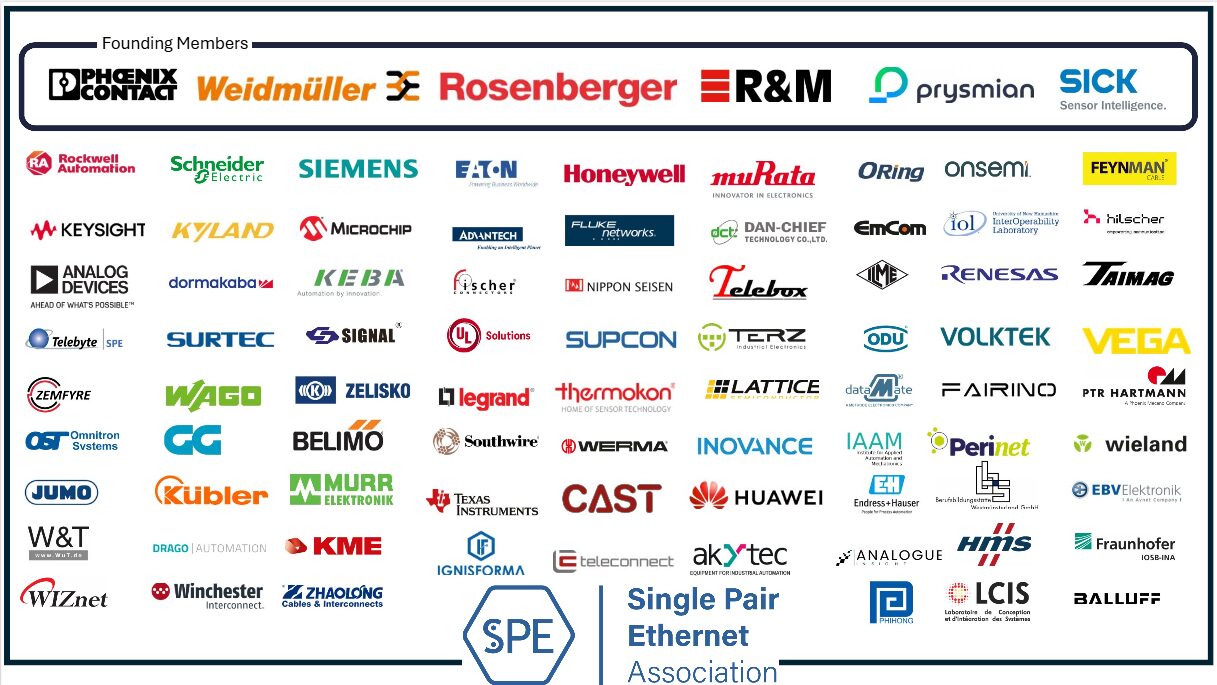
What does this mean for customers with legacy connectors?
Prior to this development, multiple companies were pursuing five different standards, mainly based on the L-standards for communication (10Base-T1L and 100Base-T1L).
“The communication standard did not change. The only thing that changed was the connector. In a worst-case scenario, a customer may have to put in a new connector to go with a new device. For now, while it depends on the company, these legacy connectors are not likely to be phased out, especially if they have good demand. The standard is still there, and nowhere in the standard does it say not to use IEC 63171-1 through -6. It’s just saying -7 is the newest flavor. And we all agree that, moving forward, -7 is where we can focus. So, it makes sense for customers to focus on -7 as well. That’s going to be the future,” said Sandoval, adding that another advantage is the products from different companies are compatible with one another. “I could grab a connector from one company and a second connector from another company, and they are going to snap in and work.”
SPE offers clear advantages over fast Ethernet, fiber, and serial communications. “One of the clearest benefits is that SPE is the only standard out there that offers long-distance data and power. I’ve been talking to robotics manufacturers who are super interested in this, because now a robot can be powered up to 1,000 meters out, and with a hybrid cable they can power up to 1,000 watts or use the built in SPE power capability of 50W, called PoDL (Power over Data Line). No other technology could even do it at five meters with a single cable assembly,” Sandoval said. “But not every customer cares about long distance. Some care about reliability and the ability to handle interference and noise, for example, EMI. In terms of ability to handle EMI, fast Ethernet was like a pickup and SPE is like a big rig. At 100 meters, which is the maximum you can do with fast Ethernet, that’s only one tenth SPE’s capability. You are going to start seeing issues perhaps much sooner with Fast Ethernet, but again with SPE, you are far beyond its capability and thus will have a much more reliable connection. And now, it is a unified technology that replaces all communications in industrial factories. I think that’s a powerful message.”
SPE Alliance premiered in September at IMTS (International Manufacturing Technology Show) in Chicago, and then in October at IAS (Industry Automation Show) in Shanghai. SPE Association will next be at SPS (Smart Productions Solutions) in Nuremberg, Germany, Nov. 24-26.
Like this article? Check out our other articles on our Wire and Cable Assemblies Market Page, and our 2026 Article Archive.
Subscribe to our weekly e-newsletters, follow us on LinkedIn, Twitter, and Facebook, and check out our eBook archives for more applicable, expert-informed connectivity content.

- Single Pair Ethernet Association is the New Face of SPE - October 27, 2026
- High-Speed Copper Assemblies Product Roundup - October 27, 2026
- Ceramics in Space: BME X7R MLCC - October 20, 2026