The Challenges of Electric Flight: How Engineers Are Rethinking Power
Aviation innovation has followed a predictable trajectory: incremental efficiency gains layered onto combustion-based propulsion. Now, electric and hybrid-electric aircraft are becoming central to aviation’s future.

Article Contributed By Stuart Steadman, Senior Principal Engineer at TE Connectivity
For more than a century, aviation innovation has followed a predictable trajectory: incremental efficiency gains layered onto combustion-based propulsion. But today, electric and hybrid-electric aircraft are no longer speculative concepts or distant ambitions, they are becoming central to aviation’s future.
Public discussion of electric flight often highlights its promise: lower emissions, quieter operation, and new forms of air mobility. These advantages are important, but a deeper transformation is happening. Electric aviation is forcing the industry to rethink aircraft design and engineering, with electricity serving not just as a support system, but as the primary source of propulsion.
A new power reality
Traditional commercial aircraft operate on electrical architectures built around relatively low voltages. Even the most electrified aircraft flying today were designed for systems measured in hundreds, not thousands, of volts. Electric and hybrid-electric aircraft change that equation entirely.
As propulsion systems electrify, onboard power requirements increase dramatically. Voltage levels rise accordingly, pushing aircraft electrical systems into ranges that were once rare in aviation. This introduces new challenges that cannot be solved by simply scaling up existing designs.
High-voltage environments behave differently. Materials are stressed in new ways. Electrical clearances that once seemed conservative have become marginal. Failure mechanisms that were once theoretical have moved into the realm of operational risk.
One of the most consequential of these phenomena is partial discharge.
When small failures become systemic risks
Partial discharge refers to localized electrical breakdowns within insulation systems that do not cause an immediate short circuit. These micro-events are difficult to detect; however, over time, they degrade materials, accelerate aging, and dramatically increase the likelihood of failure.
In terrestrial power systems, partial discharge is well understood and carefully managed. In aircraft, it presents a more complex challenge. Weight constraints limit insulation thickness. Tight packaging increases proximity between conductors. And perhaps most critically, aircraft operate across extreme altitude ranges. To understand this further, we need to consider Paschen’s Law.
How altitude changes the rules
As altitude increases, air pressure decreases and electrical behavior changes with it. According to Paschen’s Law, the voltage required to initiate an electrical discharge depends on the relationship between pressure and distance. In practice, this creates non-linear effects that can surprise even experienced engineers.
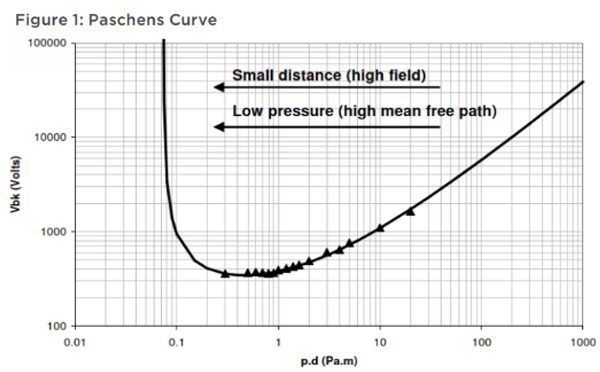
A system that is perfectly stable on the ground may behave very differently at altitude. Partial discharge inception voltages can drop, or insulation margins can shrink. What was once a comfortable design window can narrow quickly.
For electric aircraft designers, this creates a multidimensional problem. Voltage levels, insulation materials, geometry, temperature, frequency, and altitude are all interdependent. Optimizing one variable in isolation is no longer sufficient. Electrical architecture must be treated as a system rather than a collection of components.
The weight–reliability tradeoff intensifies
Aviation has long faced a central tension: reducing weight without compromising safety. Electric aircraft intensify this trade-off.
Heavier insulation can improve electrical robustness, but it comes at the expense of range, payload, and efficiency. Lighter systems demand far greater precision in materials, manufacturing, and installation to maintain reliability under high-voltage stress.
This balance is especially critical for emerging platforms such as electric vertical take-off and landing (eVTOL) aircraft. These vehicles combine compact packaging, extreme flexibility requirements, high vibration, and demanding electrical loads, often within architectures that have little historical precedent.
In this environment, electrical systems are no longer passive infrastructure. They actively shape what aircraft designs are viable.
Case study: designing for higher voltage and altitude
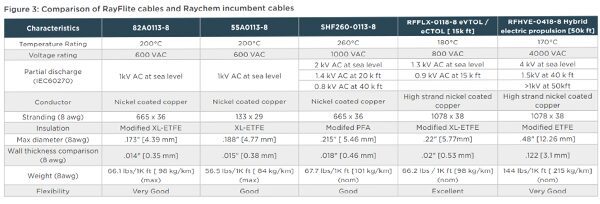
Many legacy cables and connectors, when used at altitude, do not meet the partial discharge free voltage requirements needed in higher voltage (>800V AC) networks (see Figure 3). So, in real cases, how do we tackle the problem of partial discharge in cables that need to operate at these higher voltages? Fortunately, there are International AeroSpace Standards such as SAE AS50881 which provide guidance on all aspects of electrical wire interconnection systems (EWIS). This document also gives guidance on partial discharge prevention. International cable committees (SAE and ASD) address the issue by recommending specific design rules within new standards. For now, to prevent ionization between the outside of an unshielded wire covering and grounded structural elements over which the wire passes, or between the insulation and a braided shield, the wire covering should have an adequate “equivalent insulation thickness” for the conditions of operation. The designer selects the required operating pressure and temperature which then determines the insulation wall thickness, dependent on the dielectric constant of the insulation material. This will then give an estimate of the partial discharge inception voltage (kV) for the required operating pressure and temperature.
One question often raised is “how accurate and reliable are these ‘guidelines’?” As engineers, we know that theory does not always reflect reality. In the case of cables, any imperfections such as voids, high conductor strands or even cables being bent will reduce the partial discharge inception voltage. Experience has shown that the theoretical values produced by these methods are a good guide and typically within about +10% of reality. When designing cables for a particular partial discharge inception voltage, a good guide is therefore to apply a +20% safety factor.
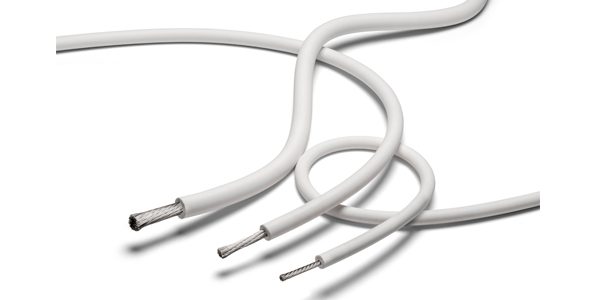
There are alternative cable designs that use insulation systems based on high temperature, low dielectric constant insulations, such as ETFE, PFA and PTFE. Using the design rules prescribed above, TE Connectivity has launched a new family of partial-discharge-free cables under the RAYCHEM brand known as RayFlite High Voltage cables, engineered to handle the unique challenges of electric aviation. RayFlite RHFVE-0418 is a flexible ETFE cable that is designed with optimized partial discharge performance (Figure 2).
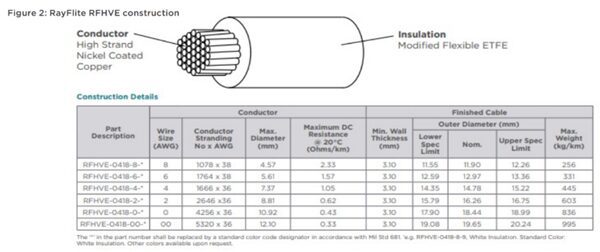
Figure 3 below shows partial discharge (PDIV) data for a range of alternative cable designs, from traditional legacy cables such as Spec 82A, 55A and SHF260 wire, which are widely used in aircraft with network voltages of 115V AC and/or 270V DC, to the new higher voltage RayFlite cables that can operate above 800V AC, at altitude. Where customers have required a cable to operate at a higher voltage and altitude, cables such as those within the RayFlite range are free of partial discharge above 1kV AC at 50kft, 1.5kV AC at 40kft, and 2kV at 30kft, in both stand-alone and connectorized versions with TE Connectivity’s 987 connector family. This has been achieved by following the design rules described above, by optimizing wall thickness and insulation material dielectric constant for the desired operating voltage, temperature and altitude.
Engineering the next era of flight

Stuart Steadman, Senior Principal Engineer at TE Connectivity
As electric aviation matures, progress depends on how effectively multiple technologies are integrated into coherent, reliable systems. Cables, connectors, power electronics, thermal management, and control systems are now strategic enablers of aircraft performance. Their interactions—and their failure modes—directly influence certification pathways, maintenance strategies, and operational economics.
With the rise of hybrid regional aircraft, urban air mobility platforms, and specialized electric systems, electrical architecture is a core design discipline that must be addressed early and holistically.
To learn more about solutions for flight applications, visit TE Connectivity.
Like this article? Check out our other Innovation and EVs and HEVs articles, our Military and Aerospace Market Page and our 2026 Article Archives.
Subscribe to our weekly e-newsletters, follow us on LinkedIn, Twitter, and Facebook, and check out our eBook archives for more applicable, expert-informed connectivity content.

- The Challenges of Electric Flight: How Engineers Are Rethinking Power - October 20, 2026
- Printing at the Edge of Possibility: How TE Connectivity Leverages Micro-3D Printing - October 13, 2026
- A Five-Layer Clad Solution for High-Performance Battery Interconnects - October 6, 2026