A Five-Layer Clad Solution for High-Performance Battery Interconnects
Battery connector design gets super-charged in a case study that demonstrates the power of materials science to solve new connectivity challenges.

Article Contributed by Alyssa Koch, Materion Corporation
Battery interconnect materials must satisfy a demanding combination of electrical, mechanical, joining, and environmental requirements, properties that are difficult to achieve with a single metal. When nickel strip could no longer provide the conductivity and electrolytic corrosion resistance required for a cylindrical lithium-ion battery pack, Materion engineered a five-layer clad metal solution that increased electrical conductivity from 18% to 60% IACS while maintaining strength, weldability, solderability, and corrosion protection.
The project started when a customer working with cylindrical lithium ion batteries in the outdoor tool market approached Materion to design a material that would improve their battery interconnect design. They had been using nickel strip as a current collector connecting each individual cell but found that the nickel did not have high enough electrical conductivity (18% IACS) to efficiently handle the charging and discharging rates required. They also found that while nickel provided good environmental corrosion protection, it was lacking in electrolytic corrosion, which is a larger issue they faced when accounting for failures in the field.
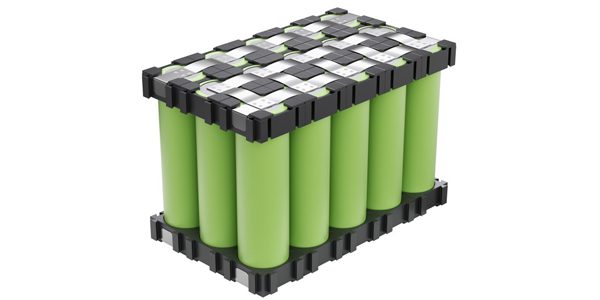
Cylindrical cell lithium ion battery pack configuration.
The task for Materion was then to design a metallic laminate that had good electrical and thermal conductivity while maintaining strength, weldability, solderability, and electrolytic corrosion protection that could be used as a battery interconnect.
Cladding is a great method to address challenges where a metal may be strong in one category, but weak in another. For example, copper has excellent electrical conductivity but lacks strength. And stainless steel has good mechanical strength properties, but it lacks electrical conductivity. Cladding can bring these two metals together to make a metallic laminate material with increased stiffness and electrical conductivity relative to the input materials.
Cladding is a non-alloying method of joining multiple metals together into discrete layers combining the best properties of each metal to make a cohesive package. This is achieved by sending 2 to 3 strips of metal through a bonding mill (similar to a rolling mill) where the metals undergo severe plastic deformation as they are reduced by 70% in a single pass. At the roll bite, the material is being stretched linearly, exposing unoxidized metal. This allows the metal to stick together forming a green bond. The clad is then sintered to drive diffusion between the metal layers creating a metallurgical bond while maintaining discrete layers. At this point, the clad can be processed like any other metal strip.
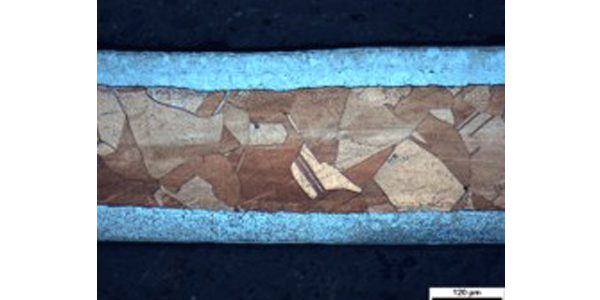
Micrograph of a cross section of clad showing discrete layers.
To address our customer’s design challenge, Materion designed a clad metal (ConnectiClad strip) with five distinct layers consisting of copper, stainless steel, and a CuNi alloy to answer each of the specific design requirements.
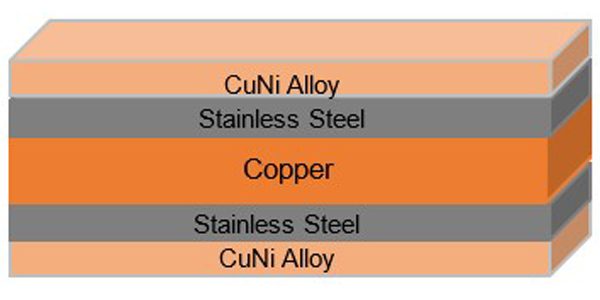
Cross section of the five layers in ConnectiClad material.
Copper (C102) is the center and primary metal in the clad because it has the best thermal and electrical conductivity of any commercially available alloy except silver. In clad metals, the overall electrical conductivity is proportional to the volume of metals in the clad. Since C102 has an electrical conductivity of 101% IACS and the other metal layers have insignificant conductivity, the bulk conductivity of the clad is easy to approximate; a clad consisting of 60% C102 will have approximately 60% IACS, a clad with 80% C102 will have 80% IACS, etc. For our customer’s case, a clad that achieves 60% IACS was sufficient and exceeded that of nickel, which is only 18% IACS, providing them with an efficient way to conduct electricity during charge and discharge.
The layers on either side of the copper need to be stainless steel. S304 was chosen by the customer because it has improved formability over other stainless steels, but for the cladding process any stainless steel can be used interchangeably. The stainless steel provides two benefits to the clad: strength and weldability.
Putting the stainless steel on the outside of the copper gives the metal the strength and durability it needs to be used as a battery interconnect material. Tensile strength is determined the same as electrical conductivity; the more volume a metal has in the clad, the more influence it has on the property.
However, in bending, the outer layers of the clad disproportionately influence the strength and stiffness (in this case, the very outer layers of CuNi are so thin they are negligible). The outer fibers of the clad are being compressed or put under tension relative to the center so having the stronger material on the outside will improve the overall bending performance.
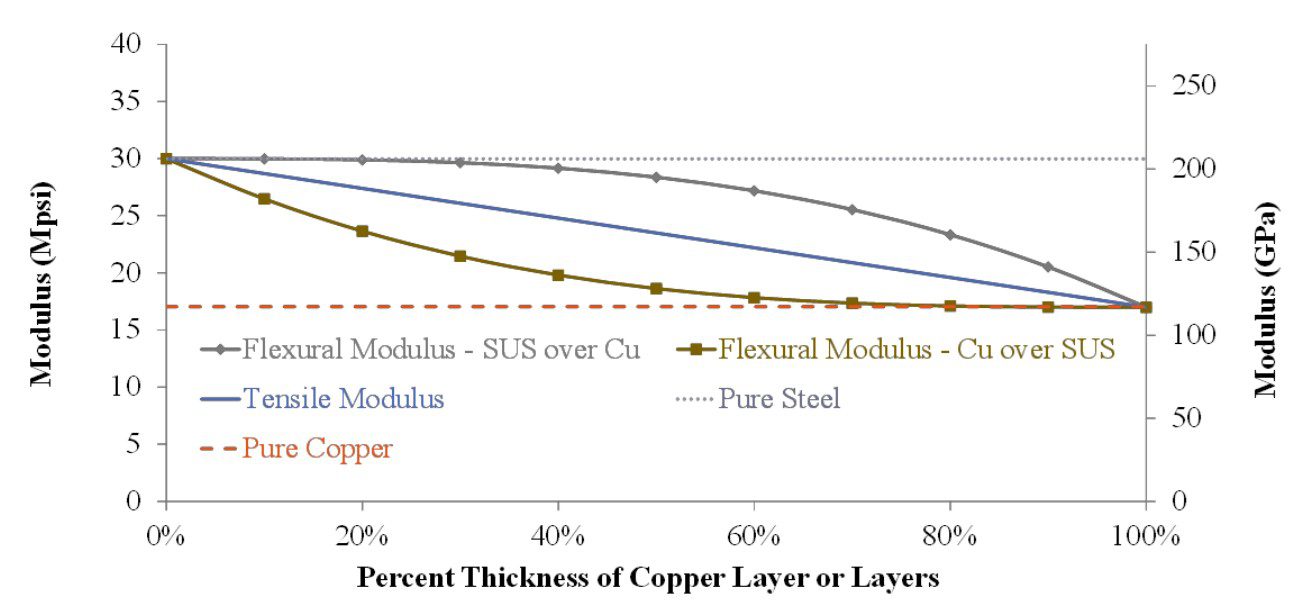
Flexural stiffness differences change based on the outer skin of the clad.
The stainless steel also makes the clad resistance weldable as required by our customer. Resistance welding passes a high electrical current through the metal and relies on the resistance generated at that spot to heat and melt the material to form the weld. Copper alone would be too electrically and thermally conductive and would dissipate the electricity and heat generated, preventing the metal from melting. The stainless steel layers on the outside of the copper provide sufficient electrical resistance for heat to build and a weld to form.
Finally, C706, a copper nickel alloy, was chosen as the outermost skin layer. It was chosen because the customer wanted a material that had good electrolytic corrosion properties. When a battery connection is exposed to water, it becomes an electrolytic cell due to the voltage potential across the electrodes. The anode material will corrode and be deposited onto the cathode. Over multiple wet-dry cycles a conductive dendrite will form between the two electrodes leading to shorts in the battery which can cause thermal runaway and fire.
Metals that typically perform well in environmental corrosion may not be able to passivate under electrolytic conditions. Testing was required to determine which metals could provide the electrolytic corrosion protection requested by our customer. Tests were run by inserting two strips of metal into a NaCl solution and electrifying the metal at 5 V and 10 V while measuring the amperage of the circuit. If a metal cannot passivate under voltage, it will corrode and shed ions into the solution increasing the amperage. Metals that exhibit a higher amperage will perform worse in electrolytic corrosion. Metals tested were Ni201, C706, C17410, and C510.
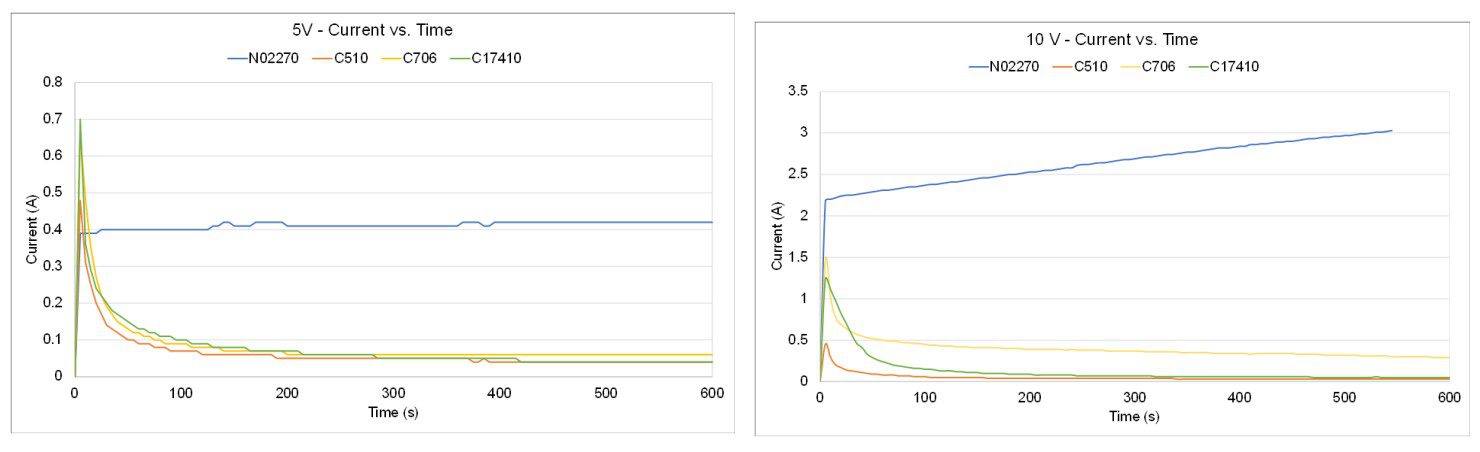
5 V and 10 V electrolytic corrosion test results.
At 5 V, the copper-based alloys all have an initial spike in amperage then stabilize at a low amperage. This indicates that the metal has passivated and is no longer releasing ions into the solution so it will not electrolytically corrode. The nickel spikes and holds constant at a higher amperage indicating that the metal never passivates. At 10 V, the copper-based alloys spiked then stabilized, indicating the metals all passivate at a higher voltage. The nickel’s amperage continued to rise steadily showing that the metal never passivated and corroded under an application of 10 V.
Of the three copper-based alloys tested for electrolytic corrosion protection, C706 was chosen as the outer layer of the clad. C17410 was not chosen due to beryllium considerations. Between C706 and C510, C706 performed better in environmental corrosion tests (Table 1). The C706 also passed solder tests to ensure the customer’s battery management system (BMS) could attach to the battery.
Table 1. Environmental corrosion results of C706 and C510.

With cladding, Materion was able to design a compact and efficient metal strip for battery interconnects that met customer requirements and exceeded the performance of nickel. The five-layer clad design maintains a high electrical conductivity without sacrificing weldability, strength, and corrosion protection.
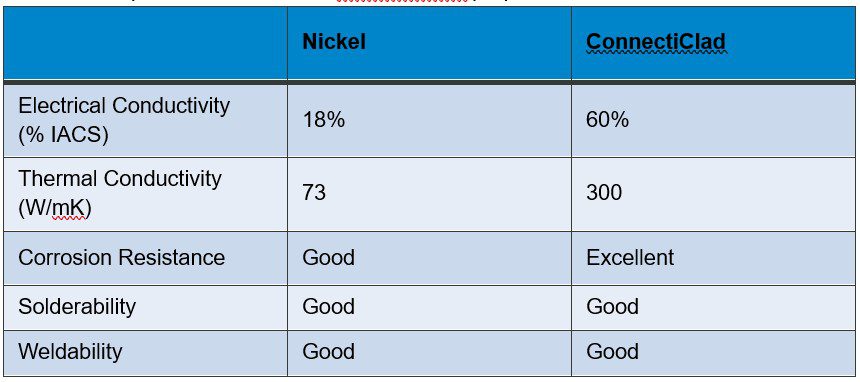
Table 2. Comparison of nickel and ConnectiClad properties.
Learn more about battery interconnect systems and other clad materials at Materion.
Like this article? Check out our other Materials and Power articles, our Connector & Cable Special Topics Market Page and our 2026 Article Archives.
Subscribe to our weekly e-newsletters, follow us on LinkedIn, Twitter, and Facebook, and check out our eBook archives for more applicable, expert-informed connectivity content.

- A Five-Layer Clad Solution for High-Performance Battery Interconnects - October 6, 2026
- High Voltage Interlock for Commercial Vehicles: A Must-Have or a Nice to Have? - September 29, 2026
- Case Study: A Partnership to Improve Rail Health - September 29, 2026