Taking the Complexity out of Power Distribution
One solution is higher voltage systems that reduce wire size and require less copper.
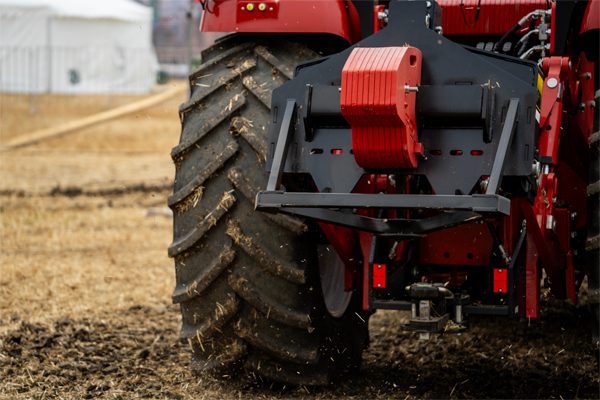
Off-road transportation, such as work trucks, construction vehicles, and agricultural equipment, rely on battery systems that power everything in the vehicle. This includes the sensors sending signals back and forth to monitor all parts of the vehicle, as well as the lights, cameras, and air conditioning. Tractors, for example, pull implements that also need power. All these functions require a way to distribute higher power and lower power as necessary.
“You need a distribution point or points to distribute the current to the various components, and also address circuit protection. Power distribution modules or centers typically house components that allow power to switch from one direction to another, and to flow to the rear, the front, and the sides of the vehicle,” said Robert Herzog, Senior Account Manager at Chief Enterprises. “OEMs are looking at different ways to do that. A classic 12 V or 24 V system runs basic components — lights, and the main controllers and sensors — but also components that require a lot more power. OEM’s want to reduce the complexity of 12 V and 24 V systems, which use lots of wiring. These wire bundles and cables can get pretty big and heavy, and use a lot of copper, which is expensive.”
Higher voltage systems are an option for reducing complexity and lessening the amount of copper required. “One way to accomplish that is to have a separate system, like a 48 V or a 60 V system on top of a 12 V overlay,” said Herzog. However, because higher voltage systems use smaller currents and smaller wires, this creates the new challenge of ensuring that all the devices can accommodate the higher voltage. For now, he says, customers are approaching this in different ways to meet their different needs.
“Customization is a word I really like. We understand that not everyone can utilize a product off the shelf, so there’s a lot of customization that’s typically involved to design power distribution systems for these types of customers,” Herzog said. “Another thing our customers are doing is localizing components in more strategic places, to allow shorter wire harnesses, more like a plug-and-play type harness. They localize controllers and different aspects so not all the wiring has to go from the front of the vehicle, where the battery is, to the back. They’re able to redistribute some of those components to optimize the efficiency of the wire harnesses. Again, the challenge with smaller and smaller wire is being able to connect to these devices. Our new generation of power distribution modules is rated up to 48 V to be able to support the customers that want to move in this direction.”
BRIC (Breathable Robust Interconnect Center) is the name of Chief’s durable power distribution modules. “Like a brick, it can’t break if you drop it. It’s got to be able to withstand the harsh environments of farms and anywhere off-road,” said Herzog. They are also watertight and IP67 sealed.
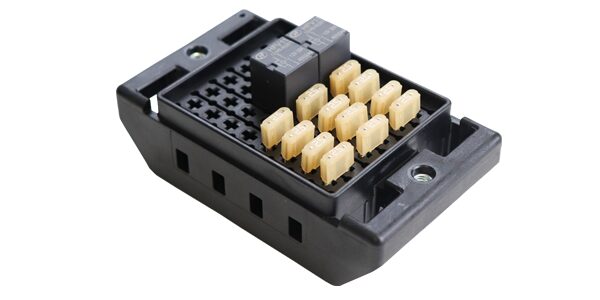
Chief’s standard BRIC, a 280 footprint, where all the terminals that go into it are 2.8 mm. It can house mini fuses and plug-in relays that all have a common footprint.
Most of those relays have a continuous current max of about 35 A.
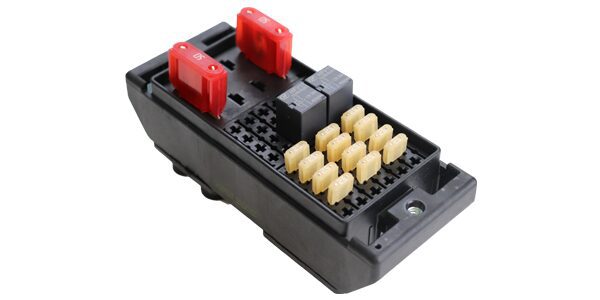
BRIC Fusion series are a little more high-powered for customers that require options like a mini ISO relay and ATL fuses. These are in the 35 to 40 A range continuous rating. The BRIC Fusion series can accommodate approximately 20 different configurations of inserts that house these higher powered components.
Chief introduced BRIC products about 10 years ago. Each BRIC houses electro-mechanical plug-in relays, fuses and breakers for circuit protection, and diodes for electrical protection. “The initial generation one design is all hardwired. The block itself is plastic. The wire harness maker plugs in all the wires in the circuit layout that is needed and then plugs in the fuses and the relays accordingly. The power is distributed within the block, but all the interconnections of the splices in the wire harnesses, the jumper wires, and anything that’s distributed inside the layout of the fusion relays, is done in the wire harness bundle,” said Herzog. “Our next-generation BRIC, showcased at Work Truck Week this year, is our bused BRIC. This product helps reduce the complexity of those wire harnesses and take out some of that copper by integrating the copper busing into the BRIC itself. An integrated bused fuse and relay center is not a new concept, but what I really like about our product is the flexibility it allows our customers. Our bused BRIC doesn’t come in a standard off-the-shelf configuration. The customer can designate how those copper buses lay out inside the BRIC.”
The busing layout can be configured inside the bused BRIC’s designated main busbar, capable of 150 A. This gives customers the same design flexibility as the hardwired BRICs while eliminating the need for jumper wires and splices and reducing the number of wires overall.
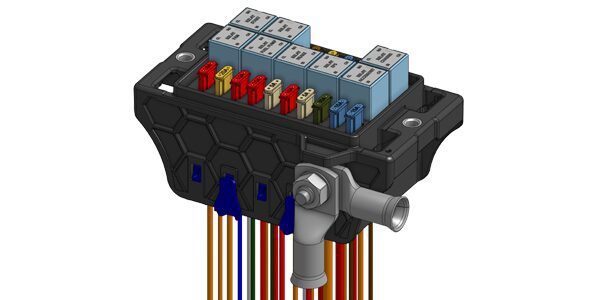
In designing these products, Herzog explained the need to keep three categories of people in mind. First, for the end users, who need accessibility to service these fusion relay centers, there are removable covers that make it easy to find the components, take them out, and replace them. Customer-designed overlays and laser etching that make it easier for end users to service, if needed.
Secondly, for OEMs, Chief offers a lot of options that allow the power distribution system to be installed in the location they choose and mounted appropriately so it is accessible to their customers, the end users.
Lastly, the wire harness suppliers must be considered. “We initially work with the OEM, the vehicle maker, but ultimately we provide these modules to the wire harness makers, and they’re the ones who crimp the wires, assemble them, and put the wires and components inside the block. Ease of assembly is a main consideration for them,” Herzog said.
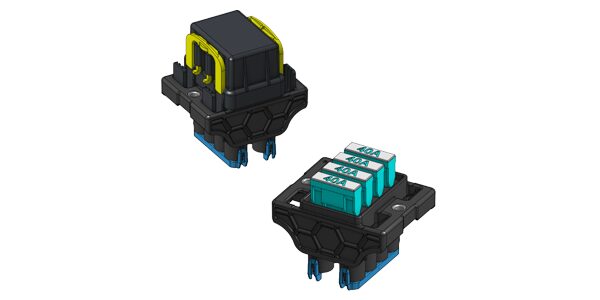
The Mini Mod series has a very small footprint and has the option of taking any of those single insert configurations and putting it into its own sealed module.
What’s next?
Typically, advances made in the automotive and EV startup world eventually trickle down to the off-road space. “The EV guys are going to 48 volts and, as I mentioned, we’re working on going up in voltage now. Beyond that, we are looking at full EV solutions,” Herzog said.
He shared that customers today want good partners that provide local support and, if possible, local manufacturing — someone they can work with and grow with long term. Perhaps more important than price, he said, “customers are looking deeper in light of current challenges, but they are excited to really pick up in the market again and start building.”
Visit the Preferred Supplier page for Chief Enterprises to learn more about the company and its products.
Like this article? Check out our other Wire articles, our Transportation Market Page, and our 2026 Article Archives.
Subscribe to our weekly e-newsletters, follow us on LinkedIn, Twitter, and Facebook, and check out our eBook archives for more applicable, expert-informed connectivity content.

- Taking the Complexity out of Power Distribution - September 29, 2026
- I/O Connectors Product Roundup - September 29, 2026
- ODVA Embraces ix Industrial - September 22, 2026