The Hidden Risks of Low-Quality Connectors in High-Power Applications
Connectors are among the smallest components in a larger electrical system, but they hold significant responsibility to carry current repeatedly, maintain stable electrical performance, withstand harsh environments, and support safe operation over thousands of mating cycles. When that connector is specified correctly and manufactured to the appropriate quality standards, it can perform reliably for years. When it is not, the consequences can extend far beyond the connector.
Article Contributed By: Sam Jaros, Product Manager at Anderson Power
A connector failure is rarely isolated. It can lead to overheating, arcing, intermittent power loss, voltage drop, equipment downtime, battery damage, and operator safety concerns. In severe cases, poor connection performance can contribute to fire risk, equipment damage, or broader facility hazards.
As more counterfeit, look-alike, and low-quality alternatives enter the market, it’s imperative that engineers, quality teams, supply chain professionals, and installers understand the risks of choosing low-quality options and understand how to source reliable, genuine connectors. The connector is one of the highest-stress electromechanical elements in an entire system and should never be treated as an interchangeable commodity. Quality connectors should be sourced from credible manufacturers. This isn’t the component to deprioritize for cost savings — and that’s why it is one area that has been vulnerable to counterfeiting. Here’s how to specify with confidence.
The difference between quality connectors and low-cost alternatives
In high-power systems, current-carrying capability depends on more than connector size or an advertised amp rating. Contact material, plating quality, spring force, contact geometry, and mating surface area all influence resistance and heat generation. Housing materials, retention features, and dimensional consistency affect durability, mating integrity, and safety. In applications where connectors are connected and disconnected frequently, mating cycle performance also matters. Genuine connectors from reliable manufacturers offer the proper testing and certification to verify these requirements, whereas low-cost alternatives could pose a risk to the entire system’s integrity.
The risk with non-genuine connectors is not always immediate failure. In many cases, the more concerning scenario is that the connector appears to work at first, enters service, and then degrades unpredictably and catastrophically.
A connector that is underrated for the actual current may experience increased contact resistance, which over time leads to arcing, housing damage, carbonization, and fire risk. Nearly half (46%) of non-home fires due to electrical failure or malfunction involve some form of arcing.
This is why third-party testing and certification, like UL Certification, matter. Reputable manufacturers typically validate connectors for performance factors such as continuous current ratings, temperature rise limits, mechanical cycling and material flammability requirements. A non-certified or poorly documented alternative may perform adequately in some cases, but without validated test data, there is no reliable way to know whether it will survive the actual demands of the application. This is especially crucial in harsh environments where connectors could be exposed to moisture, dust and debris, and extreme temperatures.
The cost difference can also be misleading. Procurement may save a few dollars on a lower-cost connector, but one field failure can create ongoing costs tied to service calls, downtime, warranty claims, damaged equipment, or liability exposure. Because the connector is often a small fraction of the total system cost, the long-term economics usually favor selecting a component that is properly rated, tested, and supported.
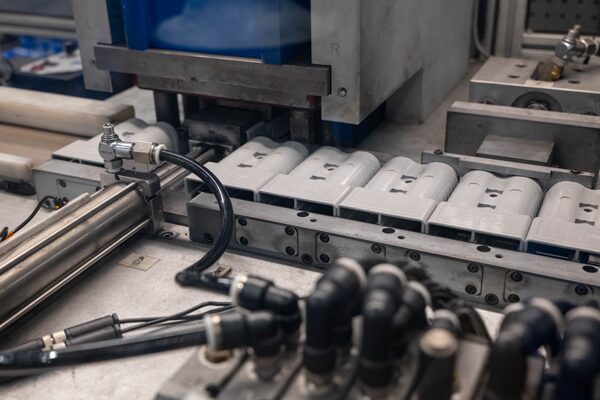
SB Connectors are constructed in Anderson Power’s manufacturing facility.
How to identify counterfeit or lookalike connectors
In recent years, cost pressures have pushed buyers to search for inexpensive alternatives, which has created an opening for aftermarket distributors to visually clone reputable connectors. For example, longstanding connector families like the Anderson Power SB Connector Series and Anderson Power Powerpole Series are commonly replicated because of their trusted reputation and field reliability. Buyers recognize the form factor and may assume similar appearance means similar performance.

Powerpole Connectors from Anderson Power are offered in four housing sizes and stack together to support a wide range of amperages up to 350A.
Because counterfeit and look-alike connectors are designed to resemble trusted products, they can be difficult to identify at first glance. However, there are practical warning signs that should prompt closer inspection.
- Visual indicators: Missing or inconsistent branding, markings, part numbers, or agency certification marks can help buyers distinguish a counterfeit. Inconsistencies in contact plating, housing color, molding quality, or overall finish should be questioned. Poor fit, loose mating, unusual insertion or removal force, and unclear source of origin can also indicate risk.
- Documentation: A trusted component manufacturer should be able to provide ratings, drawings, data sheets, test information, certifications, and application guidance. If a product listing provides only a voltage and amperage claim without details on temperature range, wire size compatibility, mating cycle expectations, material ratings, or testing information, the buyer should question a connector’s validity.
- Sourcing channel: Many manufacturers maintain lists of authorized distributors and sales partners. Purchasing through those channels helps ensure the component is genuine, traceable, and supported. It also gives the customer a path for replacement, investigation, or technical assistance if an issue occurs. By contrast, products purchased through gray-market or non-traditional channels may leave the customer with limited recourse if the component fails or does not meet expectations.
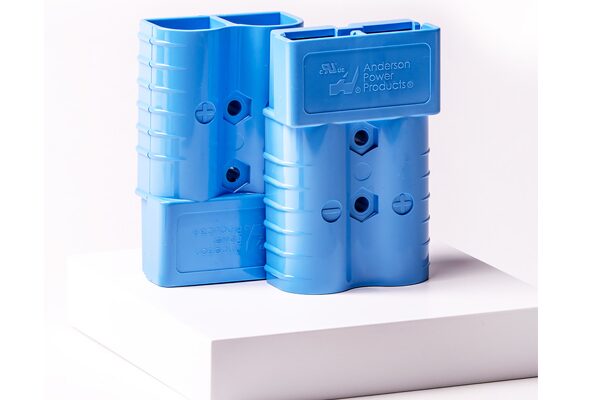
SB Connectors from Anderson Power feature a convenient genderless design and multiple housing sizes to support 50 to 500A applications.
Manufacturer support is part of the connector’s value
Selecting the right connector requires careful consideration, which is why manufacturer expertise should be weighed alongside cost, availability, and performance requirements. A knowledgeable connector manufacturer like Anderson Power can help avoid under-specification, misapplication, and installation issues.
For example, a connector may be electrically rated for an application but still be the wrong choice. Experienced manufacturers can help determine continuous versus intermittent current requirements, wire size compatibility, environmental exposure, mating cycle requirements, vibration and shock conditions, and future scalability to ensure long-term connector reliability.
They can also provide guidance on tooling, accessories, documentation, and maintenance practices to avoid connector failure. When there is a suspected issue, manufacturers can investigate to determine root-cause analysis, share future design recommendations, and provide training and documentation to avoid future, expensive field issues or safety concerns.
Before selecting a connector, the following questions should be asked of the manufacturer:
- Can long-term performance be proven?
- What level of traceability and quality control exist?
- What support is available if something goes wrong?
Evaluate quality before failure occurs
In demanding power applications, the safest connector is not simply the one that fits. It is the one designed, tested and supported for the way the system actually operates.
Connector quality should be evaluated before overheating, downtime, or premature wear reveals a problem. A low-cost component may seem like a small decision at the time of purchase, but connection reliability has system-level consequences. Choosing quality components from trusted sources helps protect the entire operation over the full lifecycle of the application.
Visit Anderson Power online to learn more about quality connectors for high-power applications.
Like this article? Check out our other Quality articles, our Industrial Market Page, and our 2026 Article Archives.
Subscribe to our weekly e-newsletters, follow us on LinkedIn, Twitter, and Facebook, and check out our eBook archives for more applicable, expert-informed connectivity content.

- The Hidden Risks of Low-Quality Connectors in High-Power Applications - September 22, 2026
- Robots at the Limit: How Intelligent Connectors Enable Industrial and Medical Applications - September 15, 2026
- Designed to Survive: The Critical Role of Connectors in Harsh Environments - September 8, 2026