What Is a Photovoltaic (PV) Connector?
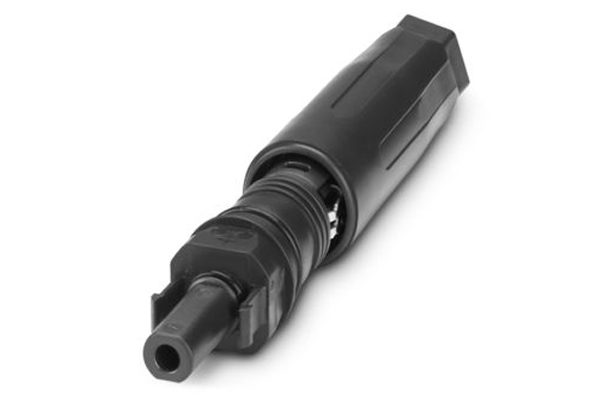
A photovoltaic (PV) connector is a single-pole, weatherproof, quick-connect DC electrical connector used to join solar modules into strings and link those strings to combiner boxes, inverters, and other balance-of-system equipment. PV connectors are built to survive decades of outdoor exposure at up to 1500 V DC with ruggedized, IP67/IP68 sealing. They are used on nearly every crystalline-silicon solar installation. There is not a single interface used in this market, and a variety of interconnects are used for PV installations, including combiner box, converter receptacle, end cap, female coupler, male coupler, junction box, and socket.
The MC4 connector, originated by Multi-Contact (now Stäubli), is the dominant type, but several other families, including Amphenol H4 and TE Connectivity SOLARLOK, are also in use, alongside many MC4-compatible alternatives.
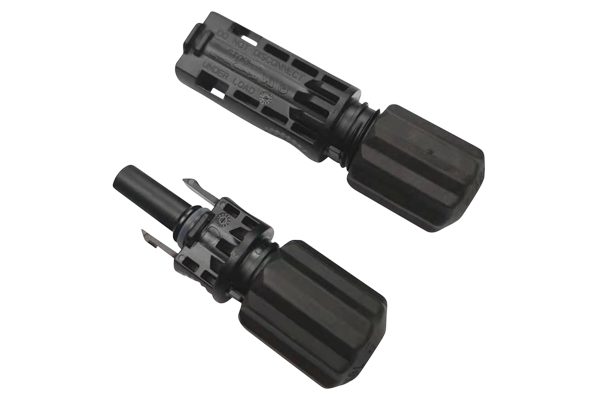
Amphenol’s H4 PV Connector supports photovoltaic systems with system voltages up to 1500 V DC
Origin & Development
Photovoltaic connectors emerged in the early-to-mid 2000s in response to the expanding solar market’s need for a field-attachable, tool-free way to wire modules in series without soldering. Multi-Contact (Switzerland) introduced the MC4 in 2004 with a positive locking mechanism that earlier connectors lacked; Tyco Electronics (now TE Connectivity) answered with its own Solarlok system, and the two competed for market leadership through the late 2000s. By around 2011 the MC4 form factor had become the de facto global standard for rooftop and utility-scale solar arrays, and with the patent now expired, MC4-style connectors are now commercially available.
Design Highlights
Engineers choose PV connectors for field-friendly assembly (crimp or IDC termination with no soldering), IP67/IP68 sealing, and a locking mechanism that requires a tool to disconnect, a safety requirement under NEC 690.33 and IEC 62548. Because the basic MC4 shape is produced by dozens of manufacturers, engineers must also weigh true intermatability: qualification standards UL 6703 and IEC 62852 test a connector only against its own mated pair, so mixing brands, even when they physically click together, is discouraged by code and by connector makers. Looking ahead, the category is trending toward higher voltage and current ratings (1500 V DC, larger AWG), tool-free IDC termination for faster field assembly, and connector variants purpose-built for microinverters, DC optimizers, and combiner boxes. Second sources are extensive — Amphenol, TE Connectivity, Weidmüller, and many others compete directly with Stäubli’s Original MC4, though Stäubli disclaims responsibility for cross-brand mating of third-party “MC4-compatible” parts.
Markets & Applications
PV connectors are used wherever DC power is carried on the array side of a solar installation: residential and commercial rooftop systems, ground-mount and utility-scale solar farms, floating PV, building-integrated photovoltaics (BIPV), and solar-plus-storage systems. Within an installation they appear at module junction-box leads, module-to-module string jumpers, home-run cables to combiner boxes, and the DC input side of string inverters, central inverters, microinverters, and DC optimizers.
Specific applications include factory-terminated module leads (standard on nearly all modules produced since roughly 2011), field-assembled extension and branch cables, and connector-equipped harnesses for module-level power electronics such as microinverters and rapid-shutdown devices. Utility-scale EPC contractors also specify PV connectors in embedded balance-of-system (eBOS) trunk-cable assemblies that reduce on-site termination labor across large solar farms.
Technical Specifications
Because “PV connector” covers several distinct connector families rather than one product, full mechanical, contact, and environmental specifications for each type are covered in that type’s own Meet the Connector entry (linked under Related Products, below). The table below compares the connector types currently in production and what each is typically used for.
| Connector Type | Originator / Manufacturer(s) | Standards & Rating | Termination & Locking | Typical Use |
| MC4 (Original & compatible) | Originated by Multi-Contact, now Stäubli; MC4-style connectors also made by Amphenol, TE Connectivity, Weidmüller, Renhotec, and many others | UL 6703; IEC 62852; up to 1500 V DC; IP67/IP68 | Crimp; positive tool-release locking collar | The default connector on nearly all crystalline-silicon modules since ~2011 — module leads, string jumpers, and combiner-box home runs across residential, commercial, and utility-scale solar |
| Amphenol H4 (Helios H4) | Amphenol Industrial | UL 6703; IEC 62852; up to 1500 V DC; IP68 | Crimp; self-locking, tool-release design | Direct MC4-form-factor alternative; module-lead and field-assembled cable connections where an Amphenol-sourced, single-brand mated pair is specified |
| TE SOLARLOK PV4-S / PV5 | TE Connectivity (formerly Tyco Electronics) | UL 6703; IEC 62852; up to 1500 V DC; IP68 | Crimp; Standard Solar Interface housing | Module junction boxes, harnesses, and field cables on modules and inverters specified with TE’s SOLARLOK interface |
| TE SOLARLOK SLK 2.0 | TE Connectivity | UL 6703; IEC 62852 (TUV); up to 1500 V DC | Insulation-displacement contact (IDC); no stripping or crimp tool needed | Fast field termination on new installations and repairs where installers want sub-30-second, tool-light connections |
| Legacy types: MC3; Tyco Solarlok (first generation) | MC3: Multi-Contact; first-gen Solarlok: Tyco Electronics | Pre-dates current UL 6703/IEC 62852 editions; MC3 rated 600 V UL / 1000 V IEC | MC3: crimp, friction-fit (no positive lock); early Solarlok used a two-cable system | Found only on older installations (pre-~2011); both were superseded by locking, single-cable designs and are not used in new construction |
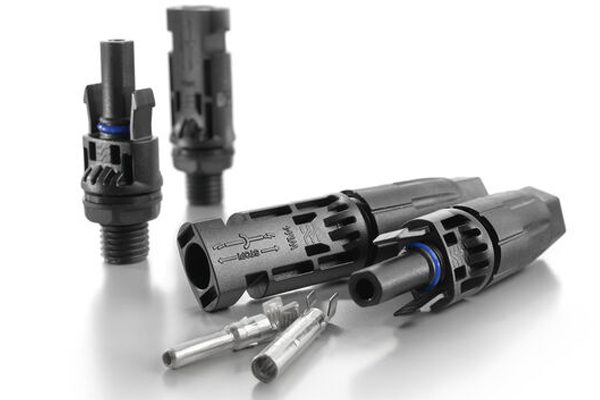
WM4 C PV Connectors for industrial solar applications
SUPPLIERS
Amphenol Industrial Operations, Bel Magnetic Solutions, Phoenix Contact, TE Connectivity, Weidmüller, LAPP, Stäubli
Distributors
DigiKey, Heilind Electronics, Kensington Electronics, Mouser Electronics, Sager Electronics, TTI Inc.,
RELATED PRODUCTS
Like this article? Check out our other Meet the Connector and Connector Basics articles, our Connector & Cable Special Topics Market Page, and our 2026 Article Archives.
Subscribe to our weekly e-newsletters, follow us on LinkedIn, Twitter, and Facebook, and check out our eBook archives for more applicable, expert-informed connectivity content.

- What Is a Photovoltaic (PV) Connector? - September 1, 2026
- What is an FMLB Connector? - August 11, 2026
- What is a Manual Service Disconnect (MSD) Connector? - August 4, 2026