Camera Connectivity for ADAS Systems and Autonomous Driving
The use of cameras in automobiles is booming. To enable these systems, vehicle manufacturers and suppliers need optics with reliable and fast data connectivity, while keeping costs low and quality high. Modular solutions are the answer.

Article Contributed by Harry Jacob, IT journalist, for Rosenberger
Camera connectivity is an increasingly essential part of automotive and transportation systems. To maintain safety, navigation, cruise control, and autonomous systems, vehicle manufacturers and suppliers need optics with fast, reliable data connectivity. Increasing component variation and global supply chain disruptions are making it more difficult to benefit from economies of scale. “A modular system approach combined with comprehensive manufacturing and integration services can help maintain cost efficiency despite tougher global trading conditions,” says Sebastian Mysyk, Director of Product Management Data Connectors at Rosenberger Hochfrequenztechnik.
Camera connectivity plays a crucial role in enabling driver assistance systems to comprehensively perceive a vehicle’s surroundings. These cameras deliver high-resolution images with the detail needed to recognize objects, traffic signs, or road markings, for example. The most important camera and image-based assistance systems include:
- Front camera: Recognizes traffic signs, lane departure warning systems, and collision warnings; or for an emergency brake assist system
- Rear view camera: Provides assistance when reversing and parking
- 360° camera systems: Provide a panoramic view when maneuvering in tight spaces and enable partially autonomous parking assistance
- Night vision cameras: Improves visibility and early pedestrian detection in poor light or weather conditions using infrared technology (IR)
- Adaptive cruise control (ACC): Performs automatic speed adjustment in flowing traffic using combined camera and radar sensors
- Gesture control: Allows the driver to control functions using specific hand movements
- Attention assist: Monitors driver behavior using an interior camera
- Dashcams and surveillance cameras when stationary (sentry mode): Record while driving (e.g., in the event of accidents) or are used for surveillance when the vehicle is parked.
- Interior security cameras: Monitor taxis or cash-in-transit vehicles, or AI-based, autonomously controlled taxis and transport vehicles.
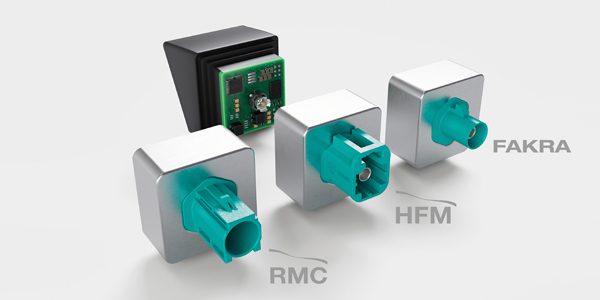
Modular camera connectors in three coaxial interfaces: RMC, HFM, and FAKRA
Robust and reliable camera connectivity
Camera technology is also changing. Image data processing is shifting away from cameras to powerful central control units, where greater computing and storage capacities are available, such as those required by AI applications. This also enables further miniaturization.
Current vehicle cameras are therefore essentially limited to the optical components, i.e., the lens and imager chip, and a compact housing with a network interface. All other technology, such as image processing and evaluation, is outsourced.
Since image recognition is sometimes used for safety functions and information transfer is time-critical, low latencies are essential. Sufficient bandwidth must also be reliably available. The connection is therefore usually established via high-speed data links that can transfer several GB/s.
To achieve this, the connectors must also contribute to ensuring the connectivity of the camera. A robust and fault-resistant fit despite continuous stresses such as temperature changes, humidity, dirt and salt, and vibrations, is crucial for this.
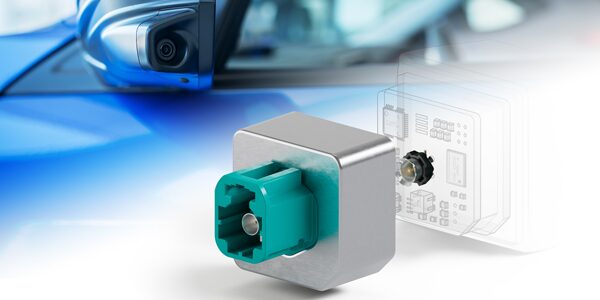
Various material options for camera and interface housings, such as metal and plastic, are robust, cost-optimized and offers excellent EMC shielding
Supply chain challenges impact OEMs and Tier 1
Recent unpredictability is impacting global electronics supply chains. One response is to promote local production for local markets. However, this reduces the cost benefits achieved through scaling. Modularity is one solution.
“Instead of manufacturing huge quantities of different cameras, a modular concept is recommended, which enables production entirely according to customer requirements while still keeping costs low. This is because the individual components – apart from customer-specific housings – are standardized and can therefore be produced cost-efficiently in large numbers,” says Thomas Miedl, Head of Product Management Team Camera Solutions.
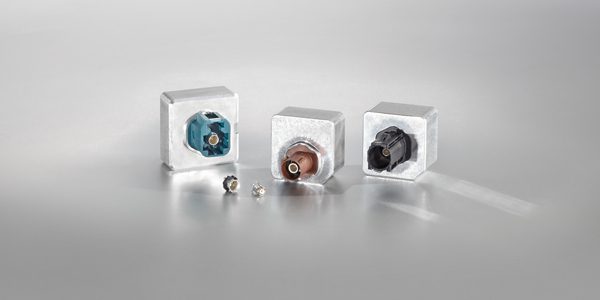
This all-in-one solution, which includes a connector, housing, and PCB connector/bullet, is suitable for all camera applications in vehicles
Modular connector systems offer flexibility
Connectivity for a variety of cameras can be achieved by combining different parts from the “modular system.” The focus is on three components:
Backhousing
Plastics or metal (aluminum) can be used here, and the size and shape can be varied according to customer requirements. Variants with 24 or 26 mm edge lengths and individually defined mounting points, for example, are in demand. For cameras in vehicle interiors, such as driver monitoring, particularly slim housings are also possible. The camera can also be made waterproof in accordance with IPx7 protection class.
The backhousing can be made entirely of metal, entirely of plastic, or in a two-part solution, with the rear cover made of aluminum and the interface housing molded from plastic.
Interfaces
Various coaxial interfaces are available for camera applications:
- FAKRA-Interface (up to 6 GHz)
- HFM-Interface (up to 20 GHz)
- RMC-Interface (up to 9 GHz)
In addition, variants with optional power pins (MQS) and versions with backhousing, flange, or DirectLink pigtail connections are available, including wire-to-board versions with MQS pins.
Tolerance compensation functions
The position of the PCB within the housing can be flexibly realized based on requirements, and different outlet directions for the interfaces and cables are also available. Two mounting variants are on offer as well. One is the “rigid” connection, which requires precise positioning during the plugging process but allows for greater tolerances when gluing or welding the camera head.
The other is the “floating” variant; thanks to tolerance compensation within the plug-in system, the plug is automatically centered and ideally positioned during the camera assembly process. This effectively prevents the components from becoming distorted, which could exert pressure on the connector or cause the circuit board to bend. This ensures long-term reliable operation, as the RF path is always exactly the same. As a result, fewer tolerances are permitted during bonding or welding.
Of particular interest to OEMs and Tier 1 suppliers: both variants are footprint compatible. This means that if, for example, the customer uses one variant in its U.S. plant and the other in its EU plant, only the PCB connector needs to be changed. All other components – including the camera head’s characteristic values – remain the same.
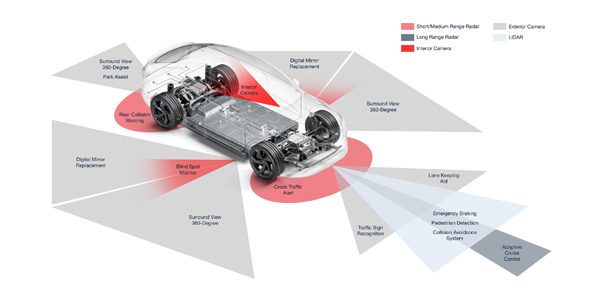
Overview of the various automotive camera applications incl. LiDAR, radar and interior and exterior camera systems, including surround view, front, rear and mirror cameras
DirectLink pigtails or wire-to-board solutions
DirectLink pigtails or wire-to-board solutions demonstrate their advantages particularly in driver monitoring systems, which are often installed in confined spaces, such as behind rear-view mirrors or in the headliner. Their compact designs enable space-saving integration without compromising signal quality or electromagnetic compatibility. Even in complex interior camera systems for analyzing eye behavior or detecting fatigue, the interfaces can be implemented seamlessly and with high transmission reliability.
All elements of this “modular system” are available to customers worldwide. The use of standardized components enables automated production in line with the best-cost approach. This means that production can be carried out cost-efficiently in different markets according to the “local-to-local” principle. At the same time, customers enjoy full flexibility with minimal effort. For example, they can offer a FAKRA variant in one market and a HFM variant in another, with the only difference being the interface, while all other components are standardized.
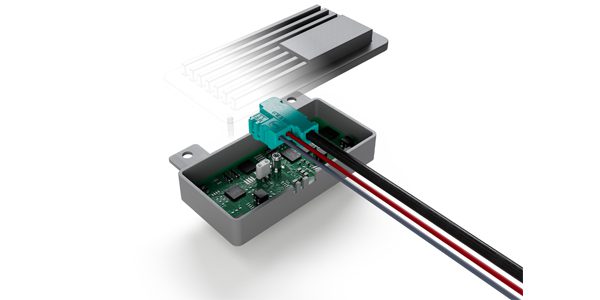
“DirectLink” pigtail connectors in a compact size, enable flexible installation in highly constrained environments
Phy2Phy strategy
Instead of simply supplying components, the focus is increasingly shifting to a holistic system approach in which technical responsibility covers the entire signal path – from capture by the image sensor to further processing in the central control unit (“from Phy to Phy”).
This means that the reliability of the data connection with high bandwidths, low latencies and no interruptions in data transmission is paramount. All components for the camera head are optimized for this purpose, right down to optimized EMC compatibility.
As the number of cameras in vehicles increases, manufacturers and suppliers must manage this growth in vehicle equipment in a cost-efficient manner. Model variance on the one hand and multi-source approaches and risks in supply chains on the other require new strategic responses that go beyond the scaling effects of mass production.
A modular approach provides these answers – on several levels. It offers flexibility in the choice of standardized components such as the interface, combines this with individuality in housing shapes and sizes, and also takes into account the different production processes of the customers. Technical expertise in the field of high-frequency data transmission on the part of an IT service provider is essential to ensure the quality of the data signal across all segments of the data link, from the image sensor to the processing CPU.
Images courtesy of Rosenberger. For further information on vehicle and camera connectivity, visit Rosenberger online.
Like this article? Check out our other High-Reliability and Connected Vehicles articles, our Transportation Market Page, and our 2026 Article Archives.
Subscribe to our weekly e-newsletters, follow us on LinkedIn, Twitter, and Facebook, and check out our eBook archives for more applicable, expert-informed connectivity content.

- High Voltage Interlock for Commercial Vehicles: A Must-Have or a Nice to Have? - September 29, 2026
- Case Study: A Partnership to Improve Rail Health - September 29, 2026
- The Hidden Risks of Low-Quality Connectors in High-Power Applications - September 22, 2026