Connectors Adapt to Changing Battery Regulation
In the EU, one regulation is making it simpler to remove, replace, and recycle batteries in everything from e-bikes and scooters to electric vehicles to walkie-talkies and insulin pumps. Amphenol Communications Solutions explains what that means for connectors.

The EU’s comprehensive regulation on batteries, Regulation (EU) 2023/1542, is set to take full effect February 2027. Connector Supplier spoke with members of the FCI Basics division of Amphenol Communications Solutions, a leading manufacturer of battery connectors, about how their connectors address the new requirements in advance of the deadline.
“The new regulation highlights three areas that impact our connector product lines: the battery passport, the carbon footprint declaration, and the second life/recycling requirements,” said Dorian Moyne, Business Development Manager – Automotive EMEA. The battery passport is required for any battery above 2 kWh. This is especially relevant for replacement and recycling of EV and industrial batteries. The passport contains a great deal of data, including everything related to dismantling, safety, and diagnostics. This information is accessible over the battery’s life. “Meeting traceability and diagnostic requirements may increase the amount of sensing, monitoring electronics, and data communication within battery systems,” Moyne explained.
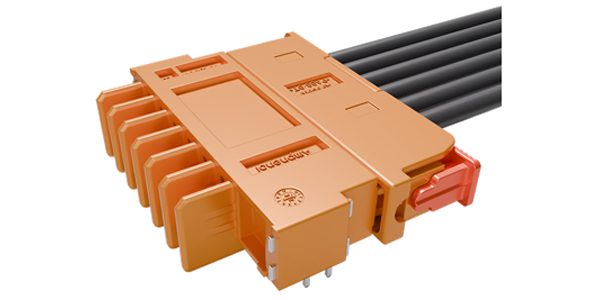
HVLock High-voltage interconnect with touch-safe interfaces
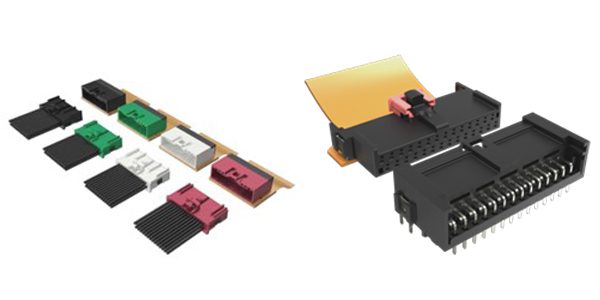
WireLock and FlexLock: Wire-to-board and flex-to-board high pin count signal connectors with robust locking and keying for serviceable in-pack connections
All this connection will need access for repair and diagnostics, especially on the battery management and cell sensing layer. “There will be some design pressure as well — greater emphasis will be placed on electrical performance, including contact resistance, insulation performance, current carrying capabilities, and also, of course, higher mating durability,” said Moyne. “Many applications today have solder joints or screw connectors. Battery replacement and recycling require connectors that can be removed and plugged in again many times, and this requires separable interconnects. Depending on the design, customers may require higher mating-cycle durability than traditional battery interconnects. This may involve enhanced contact plating, lubrication, or alternative contact systems.”
Lastly, there will be requirements for carbon footprint records in the form of a carbon emission declaration. This includes sustainable sourcing and proof of a sound supply chain. It also includes the use of regrind material (plastic resin that is reground and re-injected). “Increasingly, customers are requesting recycled or reprocessed materials where performance requirements can still be met,” Moyne said.
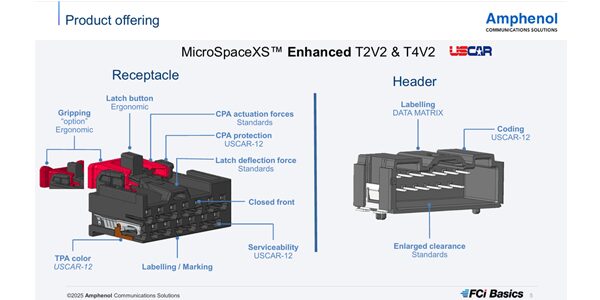
Safey and ease of use
In response to the new rules, OEMs are moving “nice-to-have” features to specification line items, particularly around safety due to the increase in battery disconnection and reconnection.
“One request we are seeing from OEMs is for FMLB (first mate, last break) connectors. These connectors incorporate a designated contact that mates before and disconnects after the primary power contacts, helping reduce arcing risk and improving operator safety during battery connection and removal,” said Moyne. Improved and stricter ergonomic requirements for repairability are also becoming necessary. “Our solution for this is a reworked version of an existing product that meets all the requirements of some European and US OEMs. We applied many small changes to the product to make it more ergonomic. For example, we eliminated the sharp edges to make it easier to handle.”
Mating force is also an issue for operators who mate and unmate connectors all day in the factory. “We are working on some low mating force aspects and lubricant requirements. FCI Basics is also evaluating the addition of a lever for ease of assembly and disassembly,” said Moyne. Other incorporated features that address ease of use are positive locking and connector position assurance (CPA), keying and polarization to prevent mis-mating, touch-safe interfaces, self-alignment and float, and robust contact plating for mating-cycle durability.
“To support the traceability requirements, we have incorporated a QR code on some of our connectors. Basically, it’s a data matrix on the product that shows the date and time the connector was manufactured and the batch number. Our vision inspection systems verify critical dimensions and all this information is available just by scanning the connectors, to verify product quality and manufacturing traceability,” said Moyne.
Portable battery requirements
Batteries for e-bikes and e-scooters, as well as small handheld devices (less than 5 kg) such as insulin pumps, barcode readers, and walkie-talkies, must be readily removable and replaceable by the end user. For this reason, Regulation (EU) 2023/1542 addresses the need for tool-less removal and replacement, or the use of readily available tools, such as a small screwdriver, rather than proprietary service tools.
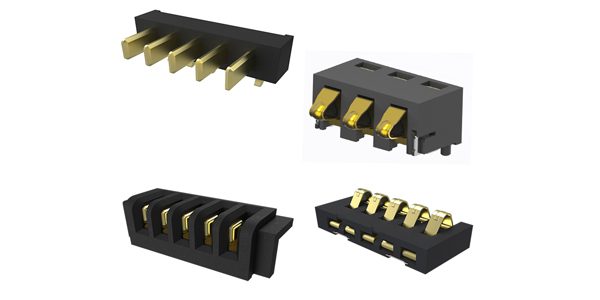
“Spring-type and blade-type connectors are increasingly being used instead of some traditional board-to-board and wire-to-board connector designs in removable battery applications to meet this requirement. With these connectors, the end-user can just open the cover of the small device and easily remove the battery,” said Jimmy Wang, Product Manager of Basics I/O. “In collaboration with customers preparing for the new European battery regulation, we have expanded our portfolio of battery connectors to support evolving design and compliance requirements.”
With this new regulation, the interconnect is taking on a greater strategic role. “It increasingly determines whether a battery design can meet its regulatory obligations, from passport diagnostics to safe field replacement to end-of-life dismantling. This is a good era for connector engineering,” Moyne explained.
Visit the Preferred Supplier page for Amphenol Communications Solutions to learn more about the company and its products.
Like this article? Check out our Transportation Market Page, and our 2026 Article Archives.
Subscribe to our weekly e-newsletters, follow us on LinkedIn, Twitter, and Facebook, and check out our eBook archives for more applicable, expert-informed connectivity content.

- 2026 Push-Pull Connectors Product Roundup - October 6, 2026
- October 2026 New Connectivity Products - October 6, 2026
- Taking the Complexity out of Power Distribution - September 29, 2026