Branch Wiring Simplifies Cabling in Crowded Applications
When there is too much wire and not enough space, branch wiring provides an elegant solution that benefits engineers, designers, manufacturers, and customers.
Branch wiring offers engineers and designers a valuable solution for industrial and other applications that require managing lots of wire and cable. Connector Supplier spoke with Nathan Moskal, product manager, and Zachary Pease, electromechanical engineer, from Hirose Electric to learn more about what it is and how it works.
Connector Supplier: Let’s start with an overview of branch wiring. What is it?
Nathan: Like a tree that has a big branch splitting into smaller branches, branch wiring splits a big current into smaller currents for the purpose of powering multiple devices or components with less wiring. Basically, if you’ve got your power source connecting to, for example, two devices with two wires to each of them (four wires total). Now, instead, you have two wires part of the way going to a branch connector that splits them into the four that are needed. Rather than running all the wires the whole distance, you run the big power wires part of the way and then you split them as needed.
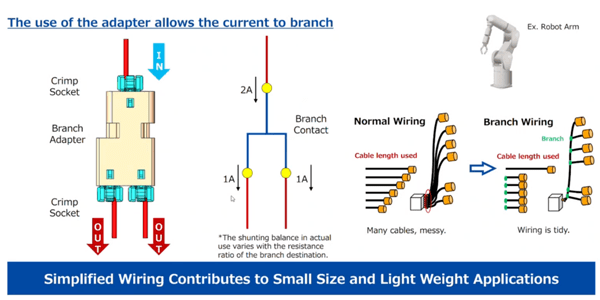
Figure 1. Hirose’s DF51 connector branches from two to one, for more signal, lower power applications.
In the diagram (Figure 1), on the left you can see the wires going in, then they split to the wires going out, in this case 2 amps to 1 amp. This would be a one to two branch. We also offer a one to three branch (Figure 2) that is higher current—30 amps maximum. You can split that into three 10 amp wires. You can also daisy chain the connected devices together. With a third device, if the current was supported by the connector, you could split off again and do another branch.
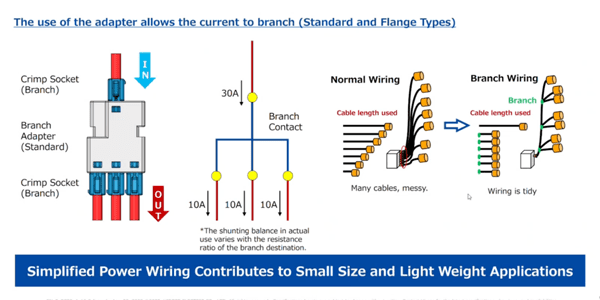
Figure 2. Hirose’s DF22 is a higher current branching connector
What are the benefits of branch wiring?
Nathan: Doing this cuts down on your overall cable usage, which saves on the weight and cost of wires. Another benefit is that you can put the connector in to split the wires wherever you need to. For bigger devices with a lot of wires, you might have an access hatch. Now you can move that harness to be sectioned right at that point making it easier to service. If the wire coming from the branch connector breaks, you can just replace that one section rather than the whole wire, so the maintenance is simpler and cheaper. You can also move things around as needed to make those branches fit into your system.
Zachary: When you have less wiring as a result of savings from the branch connector, you also have less wiring to route. You don’t have to pull as many cables throughout the interior of the device, which simplifies manufacturing.
Nathan: And it helps get through tight spaces where, let’s say, normally you would have to run 6 wires now you can run maybe two or four and branch those downstream to reach whatever they need to power.
What factors need to be considered when designing in branch wiring connectors?
Nathan: The first consideration is whether the connector supports the power and current you need. If not, then you’re going to have to run all those wires. If it does, though, then you can use it to save on wires.
Zachary: Another consideration is that the connector itself is somewhat a passive component that just sort of acts on the forces that are applied to it. If you’re running two amps through it, it will try to naturally split into one amp each (as shown in Figure 1), but that is influenced by the downstream resistive load. For example, if you have one initial wire connecting to three devices with different resistances, and you try to split that evenly, you may not get an equal amount of current to each connector. So you really need to ensure that each branch is placed to split current the way you want it. You can split a two amps into 1.5 amps and half an amp and then split that further downstream or just have one device that uses 1.5 amps and one that uses half an amp, for example.
Nathan: This type of branching can happen on PCBs as well. In a circuit board design, you can have one trace that splits current with downstream traces placed in parallel. One benefit of PCB branching is that you can also have traces that do not split, so you can pass signals instead of power. Hirose also offers a product combining branching with signal contacts in our DF51 composite branch. Using this composite branch can potentially reduce the number of circuit boards that you need in your design to get power and signals where they need to go. However, as Zach said, there is some work needed to check that each branch will get the required power level, as well as ensuring the connector supports the total power requirement.
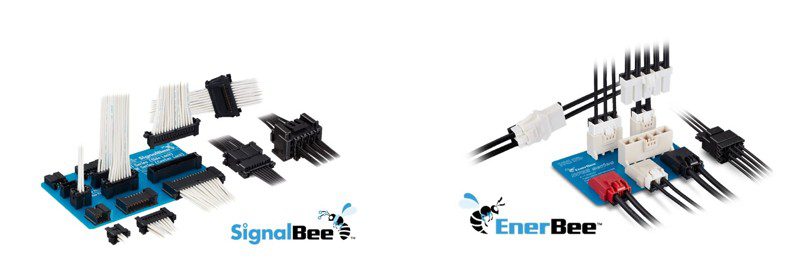
Hirose’s SignalBee (DF51) and EnerBee (DF22) series offer a variety of branch adapter options.
What hardware is required?
Zachary: If you typically have a standard wire-to-wire connection, the plugs themselves are generally going to be the same as what is currently on the market. You’re just adding in what essentially is a jack in between. Only one or two new parts total are added to the bill of materials.
Is this capability something your customers have requested?
Zachary: We’ve had customers looking to do this for a while. They have asked for a way to split a wire into two or have two wires come into one. These connectors offer a way to make it easy and safe to do that.
Nathan: This is a relatively new option that we introduced in the last two years or so and have been expanding and evolving. There are other ways you can do this as I mentioned, such as with a circuit board, or just taking three wires and twisting them together. This will be a more reliable and consistent option than manually connecting wires, and more cost effective than PCB branching. Additionally, in today’s globally distributed world, the parts to build your design might come from multiple different countries or suppliers. This is a way to connect those components safely and consistently. The ease of manufacturing and serviceability are benefits for both the customer and the manufacturer.
Visit the Preferred Supplier page for Hirose Electric to learn more about the company and its products.
Like this article? Check out our other articles on Wire our Wire and Cable Assemblies Market Page, and our 2025 and 2026 Article Archive.
Subscribe to our weekly e-newsletters, follow us on LinkedIn, Twitter, and Facebook, and check out our eBook archives for more applicable, expert-informed connectivity content.

- Electronic Technology is in the Wind - September 1, 2026
- 38999 Connectors Product Roundup - September 1, 2026
- September 2026 New Connectivity Products - September 1, 2026