What are MIL-DTL-38999 Connectors?
What is a 38999 Connector?
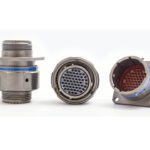
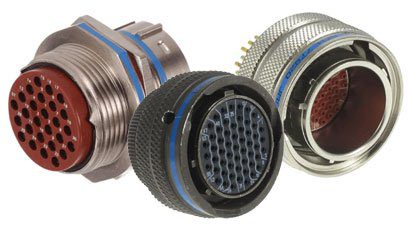
The 38999 connector, also known as also known as MIL-DTL-38999, D38999, or simply the “38-triple-nine” is a subminiature high-speed circular connector used for military, aerospace, and other rugged, high-reliability applications. This connectors are ruggedized and environmentally resistant and feature removable crimp or fixed solder contacts, six keying options per shell size, and environmental sealing. The 38999 is one of the best-selling connector families in history.
In the 1930s, the U.S. Department of Defense identified a need for lightweight connectivity for tactical and aeronautical designs. Between World Wars I and II, the Douglas Aircraft Company, Boeing, and the Vega Company collaborated with the government to develop an electrical connector to support military aircraft. Douglas contracted with Cannon (now ITT Cannon) to create the ANSI 9534 standard circular connector, a precursor to MIL-C-5015 (subsequently MIL-DTL-5015), for use in its Douglas DC transport aircraft. However, limitations with that product, including inefficient use of panel space and only one keying option, led to continued development in the 1950s and 1960s. In the 1970s, the rise of increasingly complex electronic equipment created a need for greater signal capacity. This led to the MIL-C-38999, a smaller, high-density circular connector that enables high-speed data transmission. It includes up to 128 contacts with a variety of keying options and shell sizes. Today, the connector known as the MIL-DTL-38999 has four unique sub-types. They are available in shell sizes ranging from #9 to #25, with up to 128 pins in more than 50 QPL-approved insert arrangements.
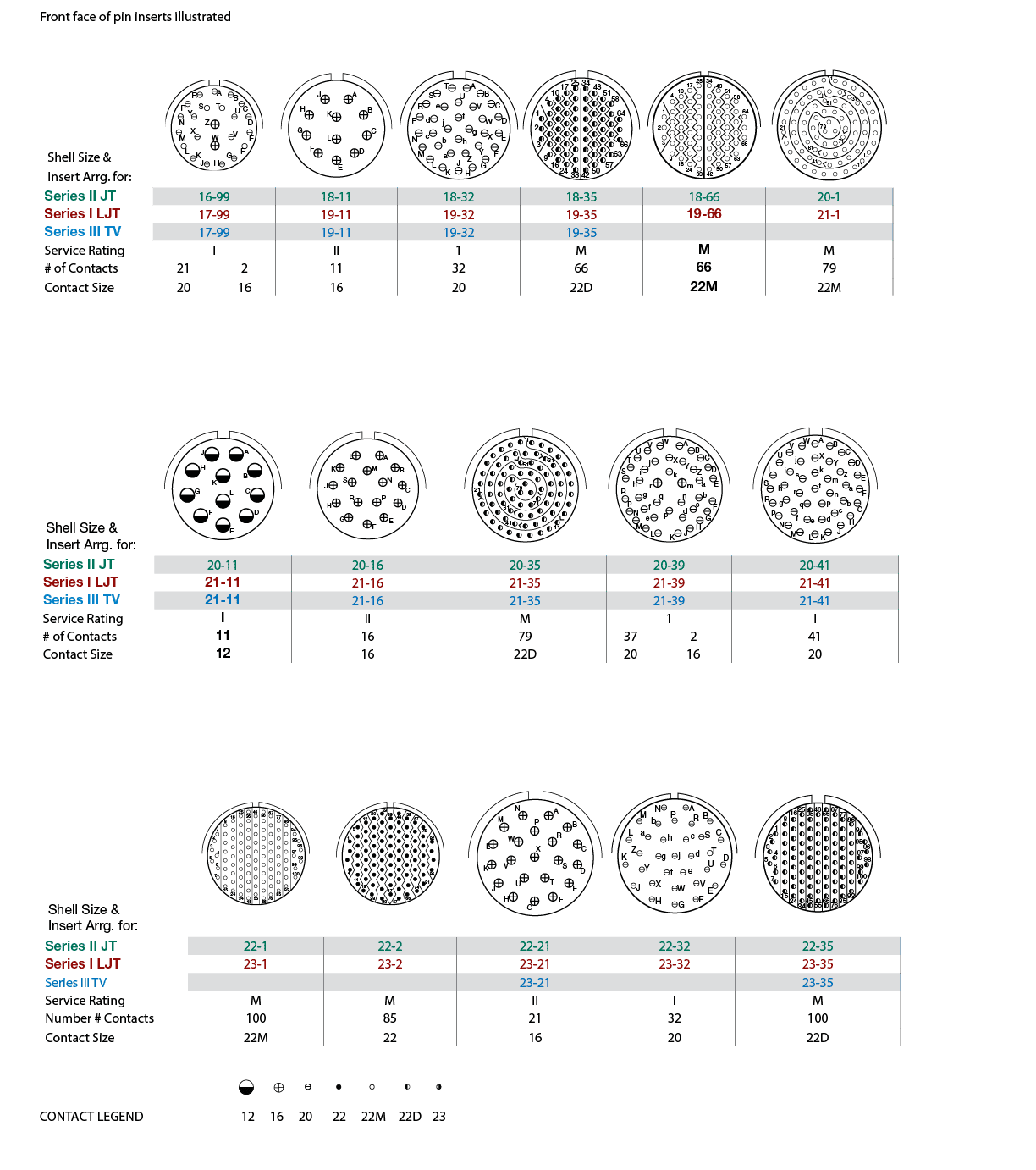
Image from Amphenol Aerospace
- Series 1 — Bayonet: Quick-disconnect coupling system for blind mating or difficult-to-access areas. They are scoop-proof to protect the contacts. High vibration resistance and suitable for high-wind and moisture environments.
- Series II — Low-Profile Bayonet: Reduced height for size- and weight-sensitive applications including aviation, communications, Test & Measurement, and medical. Non-scoop-proof, accepts pin sizes #12 to #22D. (These connectors were originally released as the Bendix JT “Pancake” and are now qualified to MIL-DTL-27599.)
- Series III — Stub-ACME Thread: Triple-start threading for fast mating and high-vibration and high-temperature applications. Scoop-proof. The most prevalent military and aerospace variant. Meets Boeing specification BACC63 and Airbus specification EN3645.
- Series IV — Breech Lock: 90° quarter-turn engagement with visual, tactile, and audible confirmation. Used in missiles and other military and aerospace applications that require robust mating and extreme resistance to vibration and shock. is required. Insert arrangements per MIL-STD-1560.
Reading the Part Number
A MIL-DTL-38999 part number encodes series, shell size, insert arrangement, gender, finish, and optional features in a defined sequence specified in the governing document. For example, “D38999/26WE35SN” identifies Series III (26), shell size W (size 17), insert arrangement E35, solder-cup contacts, and electroless nickel finish. Consult the MIL-DTL-38999 specification or a QPL supplier’s configurator for the complete designator matrix.
Technical Specificactions
| IDENTIFICATION | |
| Governing Standard(s) | MIL-DTL-38999 Rev N w/Amd 1 (Oct 2023); MIL-DTL-27599 (Series II equivalent). Formerly MIL-C-38999. |
| Standard Issuing Body | U.S. Department of Defense / Defense Logistics Agency (DLA) |
| Common Name / Series | “38999”; “38-triple-nine”; D38999; Series I, II, III, IV |
| Industry Category | Circular MIL-Spec, Environmentally Sealed |
| Manufacturer(s) | QPL-38999 multi-source: Amphenol Aerospace, ITT Cannon, Glenair, TE Connectivity, Souriau (Eaton) |
| MECHANICAL SPECIFICATIONS | |
| Shell / Housing Shape | Circular |
| Shell Material & Finish | Aluminum alloy (default, impact extruded or machined per Sec. 3.3.2.1); stainless steel (classes E, H, K, L, N, S, Y); composite resin (classes J, M). Shell finishes include: cadmium (finishes A, B, U, W; SAE-AMS-QQ-P-416), electroless nickel (finishes F, G, M, R), passivated S/S (classes E, H, Y), zinc-nickel (class Z), tri-nickel alloy (class AA), nickel fluorocarbon polymer (class T), and tin-zinc (classes V, AB). Max temperature varies by class: 150°C (class A), 175°C (classes B, J, T, V, Z, AB), 200°C (classes C, F, G, M, R, Y, AA) per Table II. |
| Size / Shell Size Codes | Shell sizes #9 through #25 (odd numbers only for Series I/III/IV; even numbers only for Series II). Series III/IV shell size letter codes per Table I: 9=A, 11=B, 13=C, 15=D, 17=E, 19=F, 21=G, 23=H, 25=J. |
| Mounting Type(s) | Panel mount: jam-nut (with mounting nut per MS3186 for Series I/II or MIL-DTL-38999/28 for Series III/IV); flange mount. In-line plug styles also available. |
| Plug / Receptacle Styles | Straight plug; right-angle plug; jam-nut receptacle; flange receptacle; hermetic receptacle (glass-to-metal sealed). Contact termination styles: crimp removable (environment resisting), solder cup, eyelet, or feed-thru (hermetic, per Sec. 3.4.1.2). |
| Mating Cycles (rated) | 500 cycles for most connectors; 250 cycles for Series II with spring fingers and lanyard release plugs; 1,500 cycles for composite classes J and M (per Sec. 4.5.8.1, tested at 300 cycles/hour maximum). |
| Locking Mechanism | Series I & II: Bayonet (non-threaded) coupling with audible click detent at full engagement (Sec. 3.4.6.2.1). Series III: Triple-start stub-ACME threaded, self-locking; mates in ~360°; anti-decoupling device required; red mating band on receptacle (Sec. 3.4.6.2.2). Series IV: 90° quarter-turn breech-lock with audible/tactile detent at mated and ready-to-mate positions; red mating band on plug (Sec. 3.4.6.2.3). |
| Keying / Polarization | Integral key and keyway polarization accomplished before coupling ring engagement (Sec. 3.4.6.3). Normal position (designator N) plus alternate positions A, B, C, D defined by rotation angles per Figures 5, 6, and 7. Series I/II: main key/keyway rotates for alternates; minor keys stay fixed. Series III/IV: main key/keyway stays fixed; minor keys rotate. |
| CONTACT SPECIFICATIONS | |
| Contact Arrangements | Insert arrangements defined by MIL-STD-1560; more than 50 QPL-approved arrangements (Sec. 3.4.1.4). Contact sizes #8 (coax/twinax), #10, #12, #16, #20, #22, #22D, #22M, and #23 available per Table IV. |
| Contact Material & Plating | Contacts qualified to SAE-AS39029. Hermetic receptacle contacts (Sec. 3.3.6.1): gold-plated minimum 0.000050 inch (50 μin / 0.00127 mm) per MIL-DTL-45204 over suitable underplate (no silver underplate). Heavy gold option (designators G/U): minimum 0.000100 inch (100 μin / 0.00254 mm) gold over minimum 0.000050 inch nickel. Rhodium option (designators R/M): minimum 0.000050 inch rhodium per ASTM B634 over minimum 0.000150 inch nickel. Hermetic contacts: nickel-iron 52 alloy or equivalent (Sec. 3.3.2.3). |
| Termination Method(s) | Crimp removable (standard for environment resisting classes; contacts per SAE-AS39029, installation tools per SAE-AS81969/1, /8, and /14). Fixed solder cup, eyelet, or feed-thru (hermetic receptacles only, per Sec. 3.4.1.2). |
| Current Rating (per contact) | Not defined directly in MIL-DTL-38999; current ratings are specified in SAE-AS39029 for each contact style/size. Contact resistance test (Table VIII, hermetic connectors with sockets only) uses: 17 A for size 12, 10 A for size 16, 5 A for size 20, 3 A for sizes 22D and 23-22. |
| Voltage Rating | Dielectric withstanding voltage per Table III (test voltage, AC rms, 60 Hz): Service rating M → 1,300 VAC at sea level; Service N → 1,000 VAC; Service I → 1,800 VAC; Service II → 2,300 VAC. Maximum leakage current: 2 mA. No electrical breakdown or flashover (Sec. 3.15). |
| SEALING & ENVIRONMENTAL | |
| IP / Sealing Rating | Altitude immersion test per EIA-364-03 (Sec. 4.5.9): mated connectors must maintain ≥1,000 MΩ insulation resistance and meet dielectric withstanding voltage after immersion. Hermetic classes not subject to immersion test. |
| Sealing Type & Material | Environmental resistance: interfacial resilient seal with individual pin barriers (“donut rings” or raised barriers) on pin inserts (Sec. 3.4.3.4); peripheral O-ring seal on receptacles of Series I, II, III; Series IV plugs incorporate O-ring peripheral seal. Wire sealing: integral grommet for environment resisting classes (Sec. 3.4.3.1). Gaskets, grommets, and interfacial seals: silicone or fluorosilicone elastomer per Sec. 3.3.2.1g. Hermetic: fused vitreous glass-to-metal seals (Sec. 3.3.2.3b). |
| Operating Temperature Range | −65°C to +200°C maximum as stated in Sec. 1.1. Upper limit varies by class per Table II: 150°C (classes A, D, U); 175°C (classes B, J, T, V, W, Z, AB); 200°C (classes C, F, G, H, K, L, M, N, R, S, Y, AA). Lower limit is −65°C for all classes (thermal cycling condition VI, per Sec. 4.5.4). |
| EMI / RFI Shielding | Conductive shell with spring fingers provides EMI shielding (not applicable to finish C / class C). Shielding effectiveness per Table X (EIA/ECA-364-26): Series III/IV classes F–M, R–S at 100 MHz: ≥90 dB; at 1 GHz: ≥85 dB; at 10 GHz: ≥65 dB. Series II finishes B/F/N/R/T/V/Z/AA/AB at 100 MHz: ≥65 dB (no rating above 1 GHz). Not applicable to class C (anodic non-conductive finish) or Series II/IV connectors without spring fingers. |
| Vibration & Shock (rated) | Vibration (Sec. 3.27 / 4.5.23): No electrical discontinuity or decoupling permitted. Series III sine: 10–2,000 Hz; 254 mm/s (10–50 Hz), 1.5 mm DA (50–140 Hz), 60G (140–2,000 Hz); 36 hours total (Sec. 4.5.23.2.1). Series I & IV sine: MIL-STD-202-204 Condition G (Sec. 4.5.23.2.2). Series II random: EIA-364-28 (Sec. 4.5.23.1). Series III no resonance below 300 Hz when mated (Sec. 3.4.6.2.2). Shock (Sec. 3.28 / 4.5.24): No discontinuity or decoupling. |
| MATERIALS & COMPLIANCE | |
| Insulator Material | Environment resistance: reinforced epoxy resin or other suitable rigid dielectric (Sec. 3.3.2.1c for aluminum; 3.3.2.2c for S/S). Composite classes J/M: corrosion-resistant high-performance virgin resins with or without filler (Sec. 3.3.2.4a). Hermetic: fused vitreous glass-to-metal for contact styles P/C/X/R/G; vitreous seal plus rigid dielectric for styles D/S/Z/M/U (Sec. 3.3.2.3b). Gaskets and seals: silicone or fluorosilicone elastomer. |
| RoHS / REACH | Cadmium-finished classes (A, B, J, U, W) carry standard RoHS military/aerospace exemptions. RoHS-compatible finishes available: electroless nickel (classes F, G, M, R), passivated S/S (classes E, H, Y), zinc-nickel (class Z), tri-nickel alloy (class AA), tin-zinc (classes V, AB), nickel fluorocarbon polymer (class T). Tin content of connectors and solder shall not exceed 97%; tin shall be alloyed with minimum 3% lead by mass — except class V (Sec. 3.3.1.3). |
| Qualification / QPL | QPL-38999, administered by DLA. Manufacturers must establish and maintain a QPL system per Sec. 3.2.1. Series III also qualifies to Boeing BACC63 and Airbus EN3645. Space-grade classes G and H require O-rings per MIL-DTL-25988/3, AMS7269, or equivalent. |
Markets and Applications
The MIL-DTL-38999 is specified across defense and commercial markets that demand environmental sealing, multi-source availability, and high contact density in a compact package.
Major markets include military and commercial aircraft (fighters, transports, rotorcraft, UAVs); weapons systems and guided munitions; armored ground vehicles; naval vessels and shipboard electronics; space launch vehicles, satellites, and spacecraft (using the D38999 space-grade variant); Oil & Gas downhole and surface equipment; industrial instrumentation and Test & Measurement; heavy transportation; and medical devices.
It has been included in the F-35 Joint Strike Fighter, C-17 Globemaster III, Black Hawk helicopter, Abrams MBT, and various satellite bus programs.
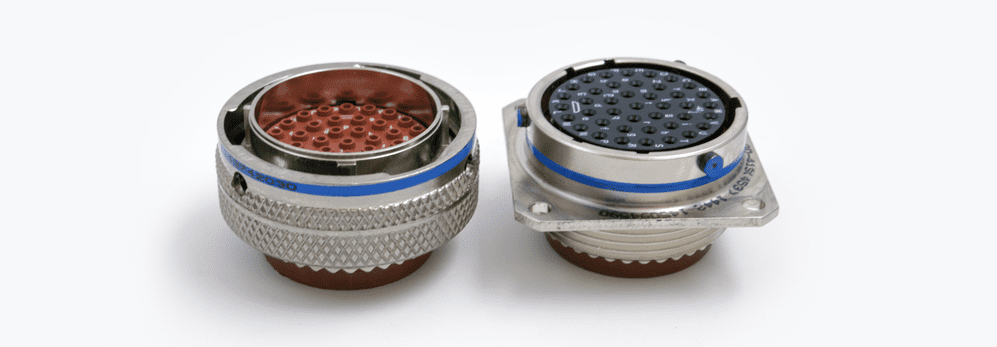
Amphenol’s MIL-DTL-38999 Series II and commercial JT series connectors are available in nine shell sizes with EMI shielding and error-proof positioning. This product is also qualified to the MIL-DTL-27599 specification for Series II connectors.
SUPPLIERS
Manufacturers: Amphenol Aerospace, Amphenol Air LB, Amphenol Pcd, Cinch Connectivity Solutions, ITT Cannon, Radiall, Sealtron, Smiths Interconnect, TE Connectivity, and others
Distributors: CDM Inc.; DigiKey; Heilind Electronics; Interstate Connecting Components (ICC) — value-added assembler, division of Heilind; Kensington Electronics, Mouser Electronics; PEI-Genesis — value-added assembler; Powell Electronics; TTI Inc.
Related Products
- MIL-DTL-5015
- MIL-STD 1560
- MIL-STD-1760
- MIL-DTL-27599
- EN3645

- Connectivity Is Reshaping Police and Security Vehicle Fleets - September 8, 2026
- Thermal Management Strategies with Liquid Cooling Connectors - August 11, 2026
- Rodent-Resistant Electronics - July 28, 2026