Printing at the Edge of Possibility: How TE Connectivity Leverages Micro-3D Printing
When connector geometries become too small for conventional tooling – or too complex to justify a mold before the design is proven – manufacturers face a difficult decision about how to move forward: when does it still make sense to cut a mold?
Article Contributed by Boston Micro Fabrication
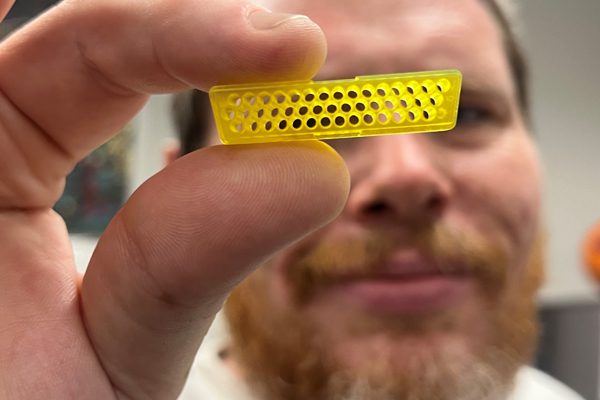
For TE Connectivity, those challenges are increasingly pushing micro-3D printing into applications where precision, speed, and material performance are critical. The company has used the technology to develop high-bandwidth data connectors with sub-100-micron features, to produce tiny biocompatible components for medical sensors qualified for blood contact, and to take low-volume connector components directly into production without conventional tooling.
TE Connectivity (TE) has been preparing for these kinds of challenges for decades. Since 1986, when industrial 3D printing was still a dream, the company was already experimenting with stereolithography and treating additive manufacturing as a serious engineering tool. Nearly four decades later, additive manufacturing’s role has shifted considerably. TE Connectivity’s engineers now develop connectors with smaller features and tighter positional requirements, often for customers whose production volumes vary enormously. The core challenge is deciding how to make each component while its design is still evolving – and, ultimately, whether a mold will be needed at all.
An early commitment to additive manufacturing
That early commitment reflects something structural about how TE operates. TE Connectivity has since built additive manufacturing into its global development infrastructure. Despite operating at considerable scale – with approximately 93,000 employees, 10,000 engineers, and plants across multiple continents – much of its most demanding prototyping and development work is centered at the Engineering Prototyping Innovation Center (EPICenter) and with the AD&M Rapid Response Team in Harrisburg, Pennsylvania. The EPICenter functions as an internal service bureau across connector applications. From data infrastructure and medical devices to aerospace systems, it runs more than 40 additive machines and prints over 150,000 connector parts a year. Harrisburg’s RRT also serves as a proving ground; once validated there, processes can be replicated regionally, at sites in Europe, Asia, and North America, as demand grows, bringing production closer to need and reducing shipping requirements.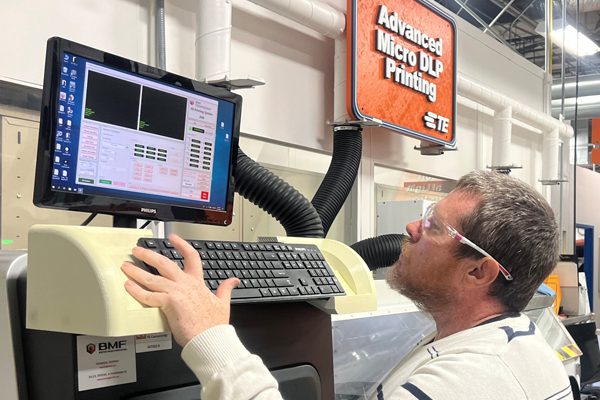
Ben Dopp, Senior Manufacturing and Process Development Engineer within TE Connectivity’s Aerospace, Defense & Marine (AD&M) group, has spent a decade inside these operations. He estimates the company has produced several million additive parts in that time, rising from around 40,000 parts a year in 2019 to over 100,000 in 2025. The process used for any given part depends on its geometry, material requirements, volume, and intended use. That decision-making framework, more than any single technology, is what shapes how TE approaches the connector problems that occur when conventional methods reach their limits.
Where conventional methods run out of room
The pressures driving greater use of micro-3D printing will be familiar to any connector engineer: devices continue to miniaturize, component density rises, and data rates climb into frequencies where a few microns of positional error degrade performance. The markets TE operates in compound that pressure with the shift towards lower-volume, higher-mix work – particularly in aerospace and defense – where development cycles are shortening and a single program may require only a few hundred units.
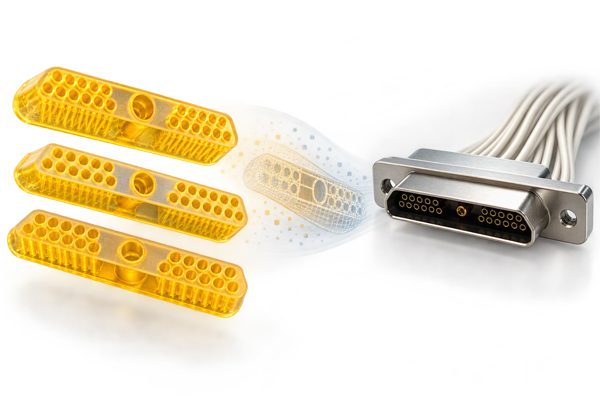
Micro-injection molding faces challenges on two fronts: technical and economic. Geometrically, features below a couple of hundred microns quickly encounter hard limits around draft angles, ejection paths, and tool access. Economically, tooling lead times of weeks make iterative design costly, and at sub-500-unit volumes the investment rarely justifies itself. As Ben puts it, “micro-additive manufacturing lets TE Connectivity say ‘yes’ to work that would otherwise be uneconomical to mold.”
That challenge led his team to evaluate Boston Micro Fabrication (BMF) in 2019, drawn by a micro-precision 3D-printing platform built for fine-feature work beyond the reach of conventional tooling. The investment decision was shaped by practical criteria: cost, footprint and, critically, an open material platform that would not confine TE to a proprietary material set. After assessing sample parts, TE installed its first BMF microArch system in a California lab before moving it to EPICenter in 2020. A second system has since been added within the AD&M group. Ben estimates that 10-micron resolution is sufficient for almost 99% of TE’s connector applications – a capability that sits at the heart of BMF’s technology.
The underlying process, Projection Micro Stereolithography (PµSL), exposes each layer at once rather than tracing it point by point, providing both the resolution needed for functional micro-features and the repeatability required for production. Since adoption of the BMF systems, the printers have served two distinct purposes: accelerating connector development before any commitment to tooling and producing parts directly where volumes or timelines make that the most viable route.
Testing the connector before cutting the mold
An early project with TE Connectivity’s data connectivity team illustrated the development case clearly. The team was working on high-frequency connectors for server-to-server and board-to-board connections operating well above 100 Gb/s. As the components shrank, the increasingly fine features pushed existing prototyping tools to their limits. A micro-mold could produce the parts but meant committing substantial investments before the design had been fully evaluated.
Instead, TE printed the carrier, cover, and several other assembly components. Across at greater than ten design iterations, engineers ran mechanical and electrical tests without the need for new tooling at each stage – maintaining true position within 30 µm and producing walls thinner than 100 µm throughout.
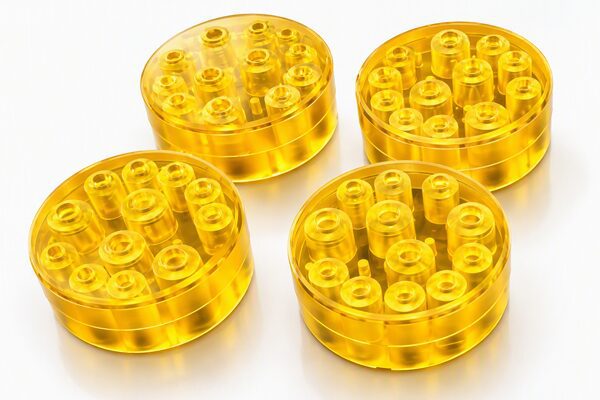
The value lay in accuracy and repeatability. A printed prototype is only useful if its dimensions and assembled position are accurate enough to inform the next engineering decision, and consistent enough that every part measures within tolerance. Here, they were. TE used the printed assemblies throughout development, then moved directly to hard tooling – bypassing soft tooling entirely. An aluminum soft tool alone can take four to eight weeks, plus conditioning, costing near $100,000. Postponing that commitment gave the team the room to complete its testing before locking the design. The same approach carried over to next generation high-frequency project efforts.
Precision is only the starting point
While the data connector project demonstrated the value of micro-3D printing during design and development, a medical sensor application presented a different challenge: turning micro-scale precision into a repeatable production process.
The component – roughly 1×1×2 mm – required through-holes, pockets, and locating features, along with a material qualified for blood contact. Using BMF’s micro-3D printing system, TE evaluated two compatible biomaterials, both of which met cytotoxicity and biocompatibility requirements. With initial demand at around 9,000 parts a year, the team engineered a production process capable of yielding around 2,000 parts per day, demonstrating that micro-3D printing could meet both the dimensional accuracy and throughput demands of the application. Capacity was not the full challenge; once output rose, handling and inspecting components smaller than a grain of rice became the binding constraint.
The work underscored that successfully printing a highly accurate micro-scale component is only the first step. Material performance, orientation, cleaning, handling, and inspection must all be addressed to turn a successful prototype into a repeatable production process. That experience has since helped TE apply the technology to other demanding medical applications, including an intracranial sensor.
The same focus on the wider production process applies beyond medical applications. Another connector effort showed how a small process change can reshape the work that follows. The AD&M Rapid Response Team needed a flat flange extending from the side of a component, with height controlled tightly to ensure it is seated correctly within the housing and ensuring proper stack up tolerancing. Printing the overhang with supports would normally leave marks requiring machining.
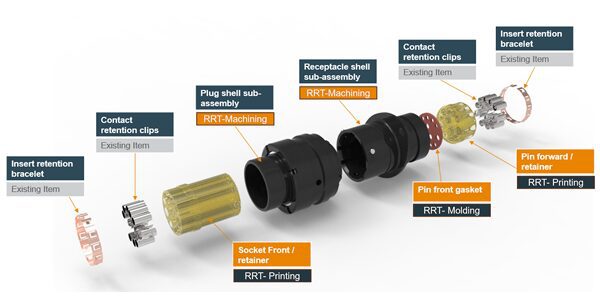
Instead, Ben and the RRT adjusted light exposure and timing on a per layer basis to form the flange directly, achieving accuracy of less than 20 µm and eliminating a secondary machining operation that had taken around 20 minutes of skilled machinist time per part.
The example reinforces a lesson seen across TE Connectivity’s applications: the economics of micro-3D printing depend on more than the printing process itself. Cleaning, inspection, support removal, handling, and secondary machining can all determine whether a process is viable at the required volume.
When the printed part becomes the production part
While high-volume connector applications may ultimately justify an investment in hard tooling, the economics are very different for low-volume production. In TE’s aerospace, defense and marine team, for example, a customer may need only a few hundred specialized connectors a year, volumes at which the cost and lead time of a mold can be difficult to justify. In those cases, TE manufactures many parts directly on BMF micro-3D, and other printing platforms.
The work spans barrel-style, RF/coaxial connections, alignment features, along with other fine-detail geometries where positional accuracy is critical. Ben points to a connector that began as a small sample run and is now in printed production at around 500 units a year, with TE Connectivity supplying the finished parts throughout that include 3D-printed, machined, and custom-molded silicone seals via their RRT team. Other rapid-response work follows the same logic: a fully assembled, TE-manufactured functional connector delivered in roughly four weeks.
Production-scale micro-3D printing also brings the clear responsibilities of consistent quality, inspection, material documentation, and traceability. According to Ben, TE ‘s role is not just to print the part, but to produce and validate it reliably. This work is supported by the dimensional stability and repeatability of BMF’s platform.
What emerges from TE’s experience is not an argument for additive manufacturing replacing molding. Instead, micro-3D printing is giving its engineers more flexibility over when and whether to commit to conventional tooling. For high-volume applications, it can enable multiple design iterations and functional testing before a mold is cut; for lower-volume, specialized components, it can provide a viable route directly into production.
Across data, medical, and aerospace applications, the decision ultimately comes down to the requirements of the part: its geometry, precision, material, volume and timeline. As those requirements become more demanding, micro-3D printing is expanding the range of connector challenges that TE Connectivity can solve, including some that conventional manufacturing could not address economically or practically.
Learn more about micro-3D printing at Boston Micro Fabrication and TE Connectivity.
Like this article? Check out our other Connector & Cable Special Topics Market Page and our 2026 Article Archives.
Subscribe to our weekly e-newsletters, follow us on LinkedIn, Twitter, and Facebook, and check out our eBook archives for more applicable, expert-informed connectivity content.

- Printing at the Edge of Possibility: How TE Connectivity Leverages Micro-3D Printing - October 13, 2026
- A Five-Layer Clad Solution for High-Performance Battery Interconnects - October 6, 2026
- High Voltage Interlock for Commercial Vehicles: A Must-Have or a Nice to Have? - September 29, 2026