Protecting Every Connection: Securing the Critical “Doors” of Solar Inverters
Today’s solar inverters do far more than convert DC power into AC power. The inverter has become a central hub linking PV panels, battery storage, monitoring systems, communication networks, and the electrical grid.
Article Contributed By: Andrew Barco, Global Program Senior Director for Industrial Ethernet, Weidmüller Global, Reinaldo Cozzo, Business Development Manager-PV, Weidmuller USA, PJ Ochoa, Product Specialist – Field Wiring, Weidmüller USA, and Steffen Thewes, Product Manager – Surge Protection, Weidmüller Group
Solar farms are now larger and more connected, and today’s solar inverters do far more than convert DC power into AC power. The inverter has become a central hub linking PV panels, battery storage, monitoring systems, communication networks, and the electrical grid. Every link depends on a safe, reliable connection. If a power or data interface fails, the impact can quickly affect plant availability, safety, and energy production.
Because the inverter interacts with so many systems, it has several “doors” open to the outside world. These entry points keep power, signals, and data moving, but they can also expose the system to hardware failures, electrical spikes, environmental stress, and cybersecurity concerns. Protecting them starts with dependable connections that support long-term electrical performance, data integrity, and safe operation.
This article looks at three critical inverter doors: the communications and cybersecurity door, the PV surge protection door, and most importantly, the PV connection door that carries generated energy from the PV array into the inverter.
The three critical doors of the solar inverter
The three-door concept is a practical way to think about inverter protection. Each door represents an interface where power, data, or electrical disturbances can enter the system. If one is poorly designed, improperly installed, or left unprotected, it can create reliability issues that affect the entire plant.
The first door is the Communication and Cybersecurity Door, the digital network that connects the inverter to plant monitoring systems, utility operators, SCADA platforms, DER management systems, and remote service tools. Reliable communication hardware, network segmentation, industrial firewalls, and secure remote access help protect uptime while supporting standards such as IEC 61850, IEEE 2030.5, and IEC 62443.
The second door is the PV Surge Protection Door. Lightning, switching events, long outdoor cable runs, and grid disturbances can create voltage spikes capable of damaging inverter electronics. Grounding and bonding are essential, but they do not replace the need for carefully selected surge protective devices. Standards such as IEC 62305, EN 61643-31, UL 1449, NFPA 780, UL 96A, and NEC Article 242 help define how to reduce surge risk and select protection for PV applications.
The third and most important door is the PV Connection Door, where the PV array connects to the inverter. PV connectors may look simple but they carry high-voltage PV power and must remain safe, low-resistance, and weather-resistant for years. Mismatched or poorly assembled connectors can lead to resistance, hot spots, nuisance faults, arc-fault risk, and electrical fires. This is where connector quality, installation discipline, and long-term material performance have the greatest impact on production.
The communications and cybersecurity door
The communications and cybersecurity door is the digital path that connects the inverter to monitoring systems, utility operators, substations, gateways, and remote service tools. As inverter-based resources become more integrated with the grid, networks must support interoperability and security. IEC 61850 and IEEE 2030.5 support communication between grid-connected devices, while IEC 62443 adds a cybersecurity framework for industrial automation and control systems. These standards increasingly appear in broader requirements such as UL 2941.
For inverter communication networks, IEC 62443 is especially useful because it promotes defense in depth. It uses risk-based security levels, access control, monitoring, lifecycle risk management, and zones and conduits to separate critical assets and control communication paths. In practice, this means segmenting DER and inverter networks from enterprise networks, restricting unauthorized access, and securing communication between substations, gateways, and DER management systems.
Redundancy also matters. IEC 62439-3 defines protocols such as Parallel Redundancy Protocol and High-availability Seamless Redundancy, which help keep communication running if a network link fails. Managed industrial switches with traffic separation, PRP, HSR, and RedBox functionality can connect older single-attached devices into a high-availability architecture without replacing every device.
Many installed inverters were deployed before these practices became common, so existing sites may lack newer protections until major upgrades occur. Network segmentation, industrial firewalls, secure remote access, and managed Industrial Ethernet switches can limit access, contain problems, and improve resilience in legacy environments.
Weidmüller supports this approach with Industrial Security Routers with integrated firewall and VPN functionality, managed Industrial Ethernet switches for segmentation, and the u-link secure remote-access platform. Together, these solutions support secure zones and conduits, controlled remote maintenance, network isolation, and resilient communications for inverter, energy storage, and grid-edge applications.
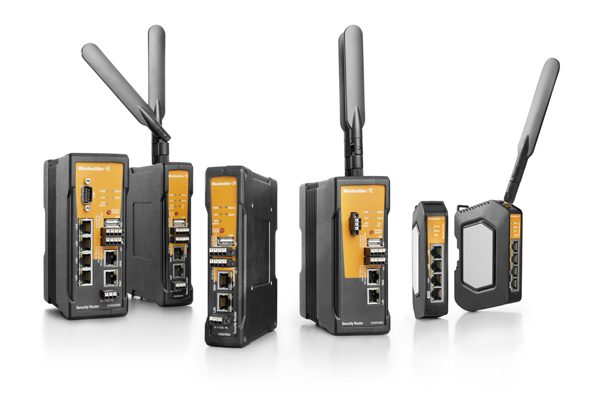
Industrial Security Routers with integrated firewall and VPN functionality help segment inverter networks, control remote access, and strengthen cybersecurity for solar and grid-edge applications.
The PV surge protection door
The PV surge protection door protects the inverter from overvoltage events that can enter from the DC array, the grid, or nearby electrical activity. Although the AC side may operate at lower voltage and include systems such as GFDI and AFCI, damaging surges can still enter from either side. Lightning, long outdoor conductor runs, and power switching can create fast voltage spikes beyond what inverter electronics can withstand.
For solar applications, the PV side deserves special attention. PV arrays cover large outdoor areas, and long conductor runs can pick up induced surges during lightning events. Even without a direct strike, transient energy can travel through PV conductors and reach the inverter input. Research referenced by the South African Institute of Electrical Engineers has indicated that lightning is a significant contributor to PV module damage, and similar surge events can damage inverter electronics if not properly diverted.
Lightning protection standards help define the overall approach. IEC 62305 provides guidance on lightning risk, protection zones, grounding, bonding, and surge protection. In the United States, related topics are addressed through NFPA 780 and UL 96A. Grounding provides the path, but a surge protective device is necessary to divert surge energy away from the inverter and toward that path.
EN 61643-31, UL 1449, and NEC Article 242 help define SPD performance, classification, and selection for PV applications. In North America, selection must account for voltage limitation, insulation coordination, available fault current, and PV circuit behavior. For UL PV applications, the prospective short-circuit current of the PV array is a key driver. For UL AC applications, the SPD short-circuit current rating is especially important because UL Type 1 SPD testing does not rely on an external fuse in the same way IEC does.
Weidmuller’s VARITECTOR PU US series provides one path forward for inverter surge protection in PV applications. The series is UL listed, supports North American requirements, and aligns with EN 61643-11 for global use. Options are available for PV applications from 600 to 1500 VDC and AC applications up to 600 VAC, with visual status indication and remote signaling options. Selected PV-side SPDs help reduce surge-related inverter failure and improve long-term availability.
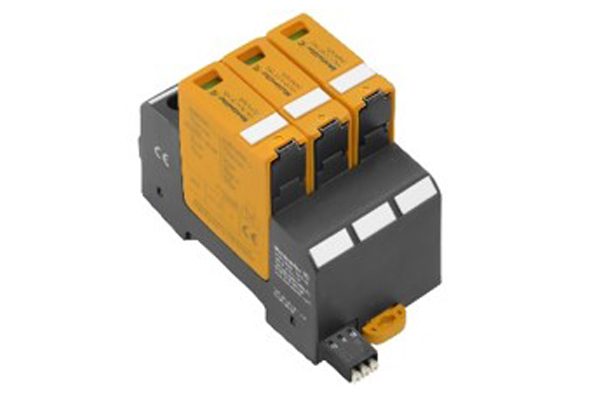
VARITECTOR surge protective devices help protect PV inverter interfaces from lightning-induced surges and grid-related voltage spikes, supporting long-term equipment reliability and plant availability.
The PV connection door
The PV connection door is the key focal point because it is where generated power from the PV array enters the inverter. Unlike AC circuits, PV source circuits do not pass through a natural zero crossing that can help extinguish an arc. If a poor connection creates sparks or an arc fault, especially near 1,500 VDC, the fault can be harder to interrupt and detect than in AC applications.
In PV systems, poor-quality components, aging materials, and installation issues on the PV side are frequently associated with fire risk. PV-side arcing, localized overheating, faulty connectors, damaged cable connections, and poor installation practices are common contributors to PV fire incidents. A weak connection can begin as a slight increase in resistance, then become heat buildup, housing damage, nuisance faults, and eventually an arc or fire hazard.
The best approach is to increase the safety margin of the electromechanical components responsible for PV power connectivity. In string inverter applications, many PV connectors may appear physically compatible but are not approved to be mated together. Certification, assembly instructions, contact geometry, material compatibility, sealing performance, and long-term contact force all affect whether a connection remains safe and low resistance over the life of the plant.
A high-quality PV connector should be designed for solar applications and evaluated to standards such as UL 6703 and IEC 62852. Key requirements include a 1,500 VDC rating, IP67 or better environmental protection, UV resistance, secure locking, and reinforced housing. Beyond ratings, contact material, surface treatment, contact resistance, crimp quality, thermal cycling performance, and moisture resistance often separate a long-lasting connection from a future hot spot.
For engineers and installers, the takeaway is clear: do not treat the PV connector as a commodity item. Use approved connector pairings, follow assembly instructions, verify crimping tools, and torque requirements, avoid cross-mating connector families, and inspect connections before energization. Manufacturers with proven electrical connectivity experience can provide a stronger foundation for long-term reliability.
Weidmuller’s new UL-approved WM4C PV connectors build on this reliability approach. The UL version uses the same design as the IEC variant, with the key difference being the clip, which ensures the connector cannot be disconnected without a tool and allows the design to meet UL requirements. With technical performance ratings up to 1,500 VDC and 35 A, the WM4C is a suitable PV connector for photovoltaic applications where secure mating, reliable installation, and long-term connection integrity are critical.
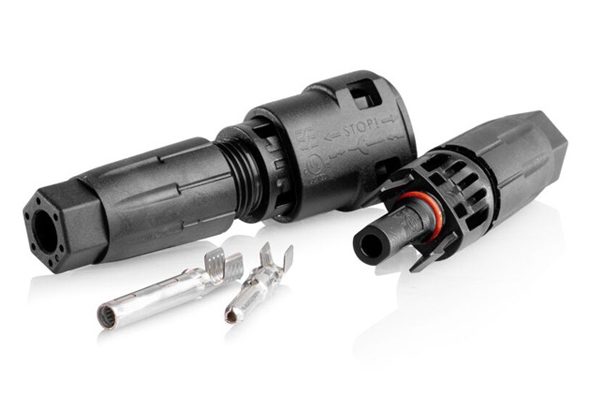
Weidmüller WM4C UL Field Connectors: UL-approved WM4C PV connectors provide secure, tool-required disconnection and performance ratings up to 1,500 VDC and 35 A for reliable PV-side inverter connections.
Solar inverters are no longer just power converters. They are the connection hub of the modern solar plant, linking power generation, monitoring, communication, storage, and the grid. That makes every interface important because a weak connection can quickly become lost production, equipment damage, downtime, or a safety risk.
Protecting the communications network keeps data secure and available. Protecting the PV surge path defends sensitive electronics from lightning and grid-related voltage spikes. But the PV connection door deserves the most attention because it carries the energy that powers the operation. Connector quality, proper installation, approved mating, sealing, and long-term material performance determine whether that connection remains safe and dependable.
Every connection matters. Building a more reliable solar plant starts with treating each inverter interface as a critical protection point and treating the PV connection as the place where safety, uptime, and long-term energy production are won or lost.
See more energy solutions at Weidmüller.
Like this article? Check out our other Alternative Energy, our Connector & Cable Special Topics Market Page and our 2026 Article Archives.
Subscribe to our weekly e-newsletters, follow us on LinkedIn, Twitter, and Facebook, and check out our eBook archives for more applicable, expert-informed connectivity content.

- Protecting Every Connection: Securing the Critical “Doors” of Solar Inverters - September 1, 2026
- Board-to-Board Connectors in Harsh Environments - August 11, 2026
- Camera Connectivity for ADAS Systems and Autonomous Driving - August 4, 2026