Flexibility and More: Top Nine Benefits of Flat Cable Assemblies
As electronics shrink and applications grow more demanding, flat cables are emerging as a compelling alternative to traditional round wire bundles, offering superior flexibility, space efficiency, and reliability across industries.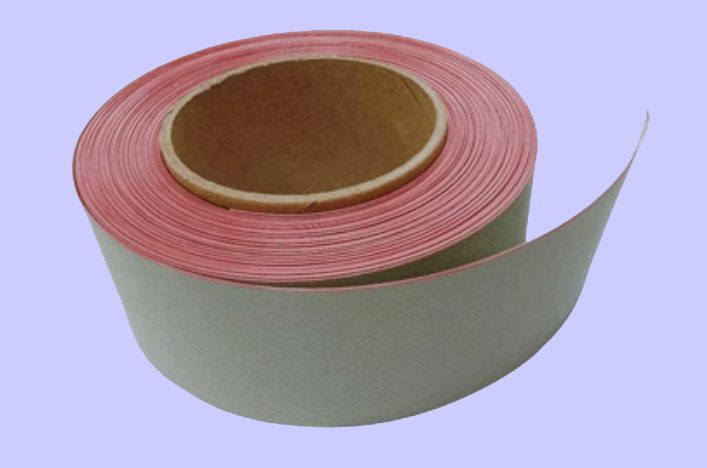
Article Contributed By Doug Allen and Brian Wang, JPC Connectivity
When designing application-specific cable assemblies, most engineers default to traditional round wire bundles. In many cases, this is the most effective approach, but for a growing number of applications, advancements in flat cable technology offer significant advantages over round cables.
Flat cables were originally developed in the 1950s for use in the mainframe computer industry. By using silicon rubber to mold” a flat cable containing multiple wires (conductors) of the same size, engineers were able to craft a better solution and replace batches of stiff, bulky, round cables with a streamlined, flat, flexible ribbon cable.
Over the decades, flat cable technology has improved and have been broadly used in applications for the military, aerospace, automotive, motion control devices, factory automation, robotics, and high-end computing. The major advantages center on their excellent flexibility, strength, packaging efficiency, and electric noise abatement. As commercial and consumer electronic devices continue to shrink in size, with complex systems inside packages as small as hearing aid, manufacturers continue to innovate to create flat cable solutions for all sized applications.
Common flat cable types
Flat Cables (FC)
Flat cables (referred to as FC), which come in both round and flat conductions, are typically manufactured using the extrusion method, although some are molded.
Flexible Flat Cables (FCC)
Flexible flat cable (referred to as FFC) only comes in flat conductors and can be laminated or extruded.
Flexible Printed Circuits (FPC)
Flexible printed circuits are a type of thin, flexible circuit board on which conductive traces are printed. They take up less space than rigid PCBs, making them a good choice for very small applications.
Extruded Vs. Laminated
The two most common methods of manufacturing produce flat cable that are either extruded or laminated.
Extruded
Extruded flat cables are manufactured using a uniform extrusion process that allows multiple wires to be placed in a flat, flexible cable at continuous lengths. This method allows precise control over wire spacing, insulation thickness, and the overall cable shape and color.
Extruded flat cables come in variety of conductor sizes, alloys, and plastic insulation types such as TPE, PVC, and silicon rubber to meet application specific needs. To meet challenging routing requirements, extruded flat cables can also be cut between the insulation and folded in different directs to produce multiple routing options. These types of complex flat cable assemblies offer easy handling and can help in significantly reducing labor costs during installation.
Laminated
Laminated flat cables offer a slimmer profile and are produced in a lamination process that encapsulates the conductors within multiple layers of ultra-thin insulating tapes. Laminated flat cables generally consist of tin- or gold-plated copper conductors insulated with polyester or polyimide tape. Laminated flat cables are typically more expensive then extruded and are most often used when space efficiency is a primary factor.
While flat cables as a whole are generally better at heat dissipation then round cables, due to their extremely thin insulation profile, laminated flat cables also offer superior heat dissipation over extruded flat cables
Round Cables Vs. Flat Cables
Round Cables
The majority of cable assemblies in the world are round, so they will continue to dominate in the field, and most applications will still be solved with round cables. For high torsion (twisting motion) applications that don’t require a great deal of side-to-side flexing, round cables are much better suited for the task, as flat cables are great for flex on a single plane, but are not designed for high torsion applications that are often found in areas such as factory automation installations.
However, standard round cables tend to corkscrew or kink under repeated bending and often lead to failures in the field. Flat cables typically have a much higher flex capability on a single plane and can carry higher current due to better heat dissipating efficiency. This makes flat cables ideal for high flex, no-torsion applications.
Flat Cables
While flat cables are not a direct replacement for round cables in all applications, there are an increasing number of applications that lend themselves to a flat cable assembly where the flex and installation requirements contribute to a longer service life and lower installation costs. Flat cable assemblies also have the advantage of being folded into multiple, unique shapes that simplify installation and provide multiple routing patterns. Flat cables can also be rolled into spools for easy termination and transportation in the factory or in the field.
Because flat cable wires are protected individually and not heavily insulated like round cables are, they tend to be much lighter (about half the weight compared to round cable of the same specifications) and offer greater flexibility (up to 15 million flex cycles).
Top 9 Flat Cable / Flat Flexible Cable Benefits
- Space Efficiency: Flat cables occupy about 50% of the space of comparable round cables and using their low profile can hug surfaces and take advantage of tight or normally unused space.
- Greater Strength: Flat cables are mechanically very strong because all conductors and insulators equally share tensile loads.
- Better Heat Dissipation: Flat cables provide better heat dissipation than round cables because there is more surface area for a given volume.
- Reliability: With its parallel conductor design, flat cables eliminate many of the common sources of wiring errors and malfunctions. Because the conductors are registered one-to-one with the terminating connectors or board, the proper contact assignment is practically automatic.
- Easy of Handling: Flat cable easily bends, folds and is easily fastened using clamps, adhesives and double-sided tape, eliminating the installation and lacing difficulties associated with round wire cabling.
- Flexibility: Flat cable is extremely flexible when bent in the same plane of its thin cross section. This characteristic lends itself well to applications were continuous or high flex is needed, such as in rotating arms, doors, and drawers.
- Consistent Electrical Qualities: Since the conductor spacing is fixed and the geometry of the cable is constant, the electrical qualities such as time, delay, capacitance, impedance, inductance, crosstalk, and attenuation are consistent.
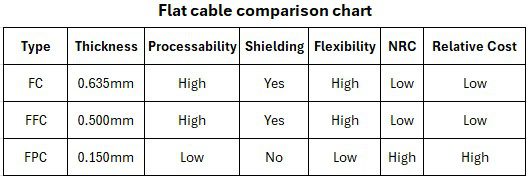
- Low Non-Recurring Cost (NRC): FC/FFC has a low non-recurring cost (NRC) because if the cabling tolerance does not meet the design, then no additional tooling is required to recut the cable. The FC/FFC can be filed terminated and can be reused for other applications while FPC have a high non-recurring cost since each tooling and design is used specifically on a specific project and cannot fall outside of the design tolerance.
- Shielding: FC/FFC can be made with one/two sided, or individual conductor shielding for protection against EMI interferences. FC/FFC also have alternative material (copper or aluminum) shielding depending on design requirements while FPC thinness limits it shielding capabilities.
Applications
The applications for flat cables (FC, FFC, or FPC) range from military and medical to consumer electronics, industrial machinery, and automated processing equipment.
Flat Cables (FC & FFC) are perfect for applications such as LCD displays and servers where they can be terminated using ZIP/LIF connectors. They can also be folded and tucked away in small cervices to optimize space and terminating paths.
FC / FFC Applications: Robotics, automotive, factory automation, GPS devices, medical equipment, monitoring systems, infusion pumps, servers, routers, LCD displays, dash cams, and computers.
FPC Applications: Hearing aids, flexible solar cells in satellites, cameras, calculators, printers, laptops, antennas, cell phones, LCD televisions, digital navigation equipment, and military instruments.
FPCs are relatively expensive, have high tooling costs and can’t be terminated in the field like FCs and FCCs. Since the FPC is printed per unit, any tolerance outside of design would need retooling. FC and FFC cannot be used in replacement of FPC and vice versa. However, they are perfectly suitable and relatively cost effective in many high-tech applications.
Round cables dominate the interconnectivity landscape and are a standard solution based on their low cost of production, ease of access and wide range of termination options. However, as new advancements in flat cable technology continue to immerge, a wider base of applications now point to utilizing flat cable assemblies.
There are multiple types of flat cables, and depending on the applications, some are better suited than others.
FPCs, while expensive, are an effective solution when space savings is a priority. An integrated connection using through holes is advantageous, but they’re not well suited for high motion industrial applications.
As factory automation, machine vision, and electric vehicle applications requiring high flex continue to grow, the use of flat cable assemblies will also continue to grow in those markets.
While FC & FFC are used primarily because of their low cost effective and high versatility, the added advantages are that they bolster high flex cycles and can be field terminated and repaired.
Customization options are available, such as conductor plating, punching terminal ends, and the addition of a horizontal line mark past the support tape to help with insertion. More custom options are available for your specific FC/FFC connectivity applications.
Visit JPC Connectivity to learn more about cable solutions for advanced technologies.
Like this article? Check out our other articles on Miniaturization and Cable Assemblies, our Wire and Cable Assemblies Market Page, and our 2025 and 2026 Article Archive.
Subscribe to our weekly e-newsletters, follow us on LinkedIn, Twitter, and Facebook, and check out our eBook archives for more applicable, expert-informed connectivity content.

- Printing at the Edge of Possibility: How TE Connectivity Leverages Micro-3D Printing - October 13, 2026
- A Five-Layer Clad Solution for High-Performance Battery Interconnects - October 6, 2026
- High Voltage Interlock for Commercial Vehicles: A Must-Have or a Nice to Have? - September 29, 2026