Electronic Technology is in the Wind
Wind energy is big business and the electronic systems that keep the turbines running efficiently and safely have become a necessity.

Electronics play a key role in wind energy generation and distribution. As this market expands, the technology that keeps it reliable, efficient, and safe becomes even more consequential. Wind is the largest source of renewable electricity generation in the United States, providing more than 10% of the country’s electricity and 25% of the electricity produced in nine states. Wind energy accounted for 37.5% of renewable electricity generation in the EU in 2025 and the installed capacity of wind power in Asia (excluding the Middle East) totaled 1,135 GW in 2024.
The wind turbines themselves have become much larger and more productive. In the United States, an individual blade can weigh between 15 and 20 tons. “Twenty years ago, the blades were half the length they are now. They weren’t that expensive and they weren’t undergoing that much load,” said Sam Crisanti, Senior Wind Engineer at Weidmuller USA. “Now, blades are so large and expensive, undergoing so many dynamic loading conditions that almost every new turbine, even offshore, is required to have a CMS, a condition monitoring system. The CMS is becoming more valuable in the industry because as blades are getting bigger they need to be monitored to prevent catastrophic failures.”
The CMS monitors the structural health of blades using early detection. “Weidmuller’s BLADEcontrol is a highly advanced CMS that detects wear in the blades, such as cracks, lightning-related damage, rotor imbalances, and spar web delamination,” said Crisanti. “BOLTcontrol is a monitoring system specifically for the bolted connections on the turbine. A single bolt can be up to two inches in diameter and can weigh 10 kilograms, or 20 pounds. It’s important to know if those bolted connections are not torqued to the right spec, if they’re coming loose, if there are broken studs, not only for performance reasons, but for safety reasons too. You don’t want any bolts flying off your turbine or rolling around damaging the high-end electronics.” BOLTcontrol physically contains the bolts and detects if they are broken or loosening.
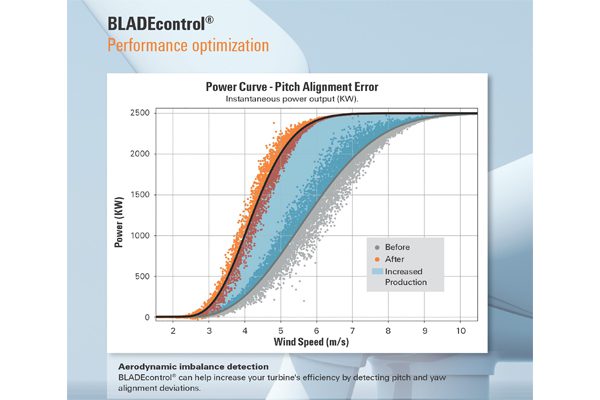
BLADEcontrol WebVis pitch alignment
Crisanti explained that, in the wind turbine blade industry, damage is classified into five major categories. Categories 1-3 are less severe and nearly all damages in Categories 1 and 2 require no action, just monitoring. “BLADEcontrol detects Categories 3, 4, and 5. Category 3 and 4 can generally be repaired while the blade is up-tower. Category 5 damages, if they’re detected through monitoring or because they can be seen (sometimes as cracks), require that the turbine is stopped immediately due to the risk of a blade falling off. The main benefit and financial incentive to having an advanced CMS system is catching the damage while it’s Category 3 or 4 and relatively inexpensive to repair. If the blade has a Cat 5 damage, you’re shutting down the turbine, which means lost time that you’re paying for, and if a blade falls off, that’s half million up to $2 million if it collapses the whole turbine,” he said.
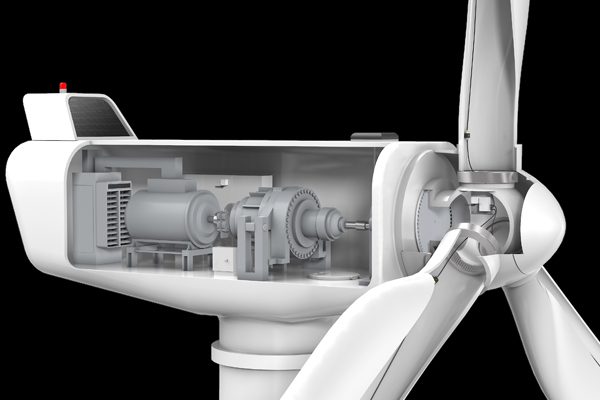
BLADEcontrol NXT
BLADEcontrol NXT (“Next”), the latest version of BLADEcontrol, features more advanced sensors, gyroscopes, and fiber optic connection, for more in-depth monitoring and more modes to detect damages earlier. “From a software side, we’re really embracing the open source movement, and our new controller is running on Weidmuller’s u-OS, an open Linux-based operating system,” said Crisanti.
How wind turbines communicate
Getting all that energy from a wind farm to the grid efficiently and reliably requires a sophisticated communication device. In North America, it is commonly called a DER (distributed energy resource) controller. In Europe it is referred to as a PPC (power plant controller).
When wind turbines or other energy-generating assets are attached to the electric grid, standards are followed that help the communication and the power interface. In North America, the standard is IEEE 1547 for assets below 60,000 volts. In Europe, it is VDE-AR-N 4110 (medium voltage) or VDE-AR-N 4120 (high voltage).
The wind turbine connects to the electric grid and communicates with the electric utility control center. “These centralized control centers operate many DERs spread across large geographies, maybe even multiple states. The DER Controller and software standardizes the communication and the power interface — the various ways of operating the DER that help keep the local grid stable and ensure the electric power is optimized for greatest efficiency,” said Christian Dunlap, Energy Industry Manager for WAGO in the U.S. and Canada. “Typically, we would put a WAGO DER Controller, basically a programmable logic controller (PLC), at the point of common coupling (PCC), which is where the wind turbines attach to the electric grid. The controller is loaded with a preconfigured software application that allows the client (an EPC or systems integrator, for example) to be compliant with the grid standard.”
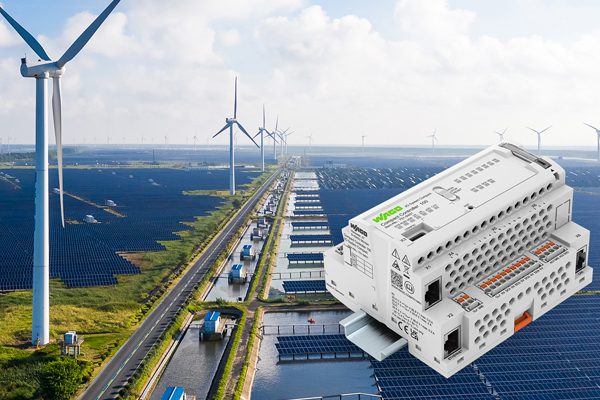
DER Controller – IEEE 2030.5
In North America the communications protocols are either DNP3 or IEEE 2030.5 for the northbound connectors (going from the controller to the electric grid) and SunSpec Modbus for the southbound connectors (going from the controller to the generating asset). In Europe, the protocols are IEC 60870-5-101 and -104. “These open standards allow engineers or system integrators to commission their projects faster because there is less custom coding and more use of standard communications,” said Dunlap.
Currently, the widely adopted northbound communication standards are DNP3 in North America and IEC 60870 in Europe. However, IEEE 2030.5 is required by law in California and Hawaii. It is also widely used in Australia and is gaining popularity in the UK. “There are many reasons for the switch to IEEE 2030.5 including security and the ability for widespread deployments that don’t take up much communications bandwidth,” Dunlap said.
WAGO uses a single programming environment called CODESYS, an open IEC 61131-3 PLC programming toolkit, to program these DER Controllers. “In addition, we can run open source code on the controllers. The CODESYS-based IEEE1547-2018 software can be loaded on any one of our controllers,” said Dunlap. To be compliant with the standard, the software can run on just the controller, but sometimes additional programming is necessary to make it fully compliant with the local grid parameters. “Depending on the application, input/output cards can be added if needed. If the system is out of compliance for some reason, a discrete output signal can open a relay to knock it off the grid. Or a three-phase input card can be added to measure the output power being generated by the wind turbine. Every location will have slightly different parameters that have to be input into the program, but the majority of the work has already been done.”
In some cases, DER Controllers are used in systems that aren’t attached to the grid. “They call it ‘behind the [electric] meter’ where they’re generating their own power to run their own facility. Whatever the load might be — lighting, data centers, refrigeration — the same standard is still used,” Dunlap added. Customers often want to use these in a micro grid attached to commercial or industrial sites. In addition to controlling the wind turbine, they might attach to a battery energy storage system. “Having a ‘Swiss Army knife’ of protocols available is extremely important for the flexibility and customization of these systems.”
Choosing a DER Controller
“Because this device is controlling assets like wind turbines worth many millions of dollars, customers want to make sure that they can be operated well and protect not only the grid, but also control the plant site in a way that’s not going to cause any sort of damage to the equipment,” said Dunlap. He explained that having the controller certified by an independent nationally recognized test lab (NRTL) is one of the main criteria customers use for selecting a DER Controller. In addition, the hardware that it is installed on must be industrial/utility grade so it is rugged and supported well. Elevated cybersecurity, particularly for mission-critical applications, is becoming increasingly necessary as well.
To learn more about the companies mentioned in this article, visit the Preferred Supplier pages for WAGO and Weidmuller.
Like this article? Check out our other Alternative Energy articles, our Connector & Cable Special Topics Market Page and our 2026 Article Archives.
Subscribe to our weekly e-newsletters, follow us on LinkedIn, Twitter, and Facebook, and check out our eBook archives for more applicable, expert-informed connectivity content.

- Electronic Technology is in the Wind - September 1, 2026
- 38999 Connectors Product Roundup - September 1, 2026
- September 2026 New Connectivity Products - September 1, 2026