SpaceWire is the Network Protocol of Choice for Space Agencies
Standardized by ESA in 2003, SpaceWire has been embraced for numerous missions by NASA, JAXA, Roscosmos, and others.

SpaceWire has become one of the leading data-handling networks for use on spacecraft. Standardized by the European Space Agency (ESA), it is widely adopted by space agencies, major aerospace companies, and universities. Since 2003, when the baseline ESA specification, ECSS-E-ST-50-12C, was released, this high-speed, reliable, standardized networking protocol has been on many ESA, NASA, JAXA, and Roscosmos missions. Some notable examples are the James Webb Space Telescope (JWST), Gaia star-mapper, Magnetospheric Multiscale Mission (MMS), ASTRO-H (Hitomi), BepiColombo (Mercury Polar Orbiter & Mercury Magnetospheric Orbiter), and ExoMars 2016 and 2022. A revised version of the standard (ECSS-E-ST-50-12C Rev.1) was released on May 15, 2019, which included updates to cable assemblies, improvements, and clarifications.
“SpaceWire connects instruments to the mass-memory, data processors, and control processors using point-to-point data links and routing switches,” said Stéphane Hermant, Axon’ Cable’s technical authority for power distribution and high-speed digital links for space. “It provides 2 Mb/s to 400 Mb/s bi-directional, full-duplex data links, which connect SpaceWire-enabled equipment.” This is accomplished with low power consumption and low error rates.
“It’s a specification that defines the design for how to send signals, how to receive signals, what the signals need to look like, and then what is needed for the medium between the electronics, which is generally the cable assembly,” said Ryan Satrom, Sr. Signal Integrity Engineer, Omnetics Connector Corporation.
SpaceWire vs. USB or Ethernet
SpaceWire has similarities to USB and Ethernet but requires some enhanced protections for the space environment to maximize signal integrity. “Like USB or Ethernet, the SpaceWire link is made of dedicated transmission lines through cables with associated connectors, but the materials used for conductors, dielectric, shielding, and jackets are selected to resist in-orbit aggressions,” said Hermant. The materials for SpaceWire must avoid outgassing and withstand temperature extremes, shock and vibration, and radiation.
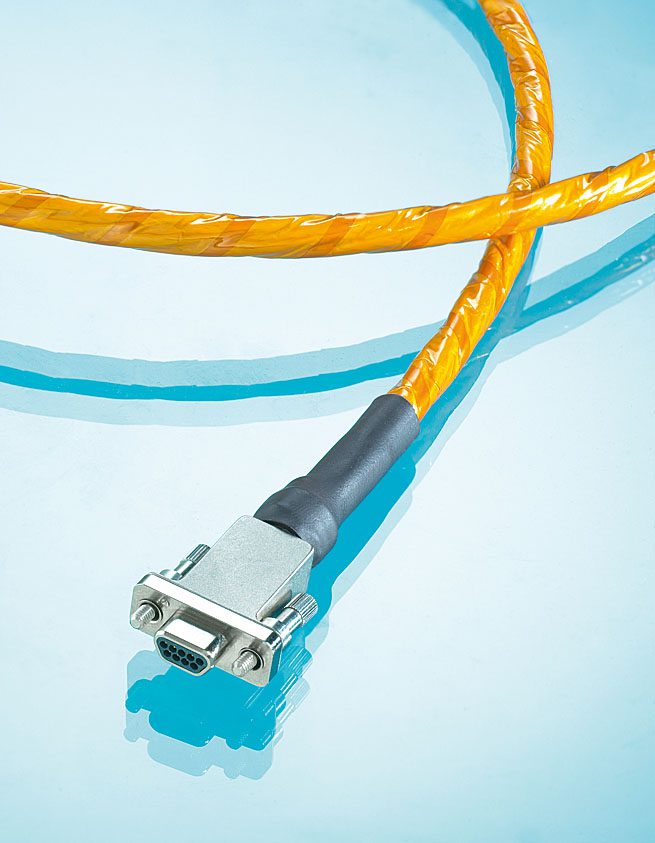
Axon’ SpaceWire cables withstand the space environment and are validated by qualifications and space heritage.
In general, Ethernet and USB are the most common specifications and protocols, at much higher speeds than SpaceWire. “At 400 Mb/s, SpaceWire is considered high speed, but, in the cable assembly world, the most commonly used Ethernet protocols are 1 GbE (Gigabit Ethernet) and 10 GbE; with even higher speed Ethernets for things like backplanes and data centers,” said Satrom. In terms of pinout, he added, SpaceWire is more like Ethernet, as both are comprised of four differential 100 Ω pairs designed to transfer high-speed data, while USB has multiple variants. “I would say, however, there are two specific differences. One is different requirements for insertion loss and crosstalk. The other is SpaceWire’s specification for materials that help it operate in the environment of space.”
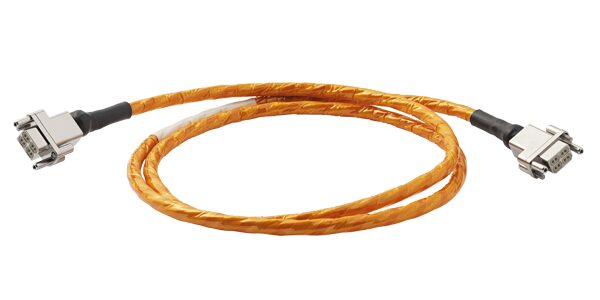
To meet increasing data rate needs, Axon’ developed the MicroMach family of connectors, founded by ESA and dedicated to run up to 400Mb/s (ESCC 3409/002 standard). Standard SpaceWire cables are only capable of 200Mb/s.
The challenges of space
To ensure SpaceWire’s electrical performance, the components must be protected against radiation, extreme temperatures or temperature shifts, shock and vibration, and other harsh environment conditions. “Axon’ widely uses high-strength copper alloy conductors, polyimide or PEEK braid jacket and PTFE dielectric for the harsh environment cables. For connections, we rely on the important flight heritage of the highly reliable twist pin contacts of the Micro-D connector system,” said Hermant.
“Gore makes a 26- and 28-gauge SpaceWire cable, kind of our go-to, using a very specific fluoropolymer variant suitable for space,” said Satrom.
Minimizing size and weight is critical in space applications. “Using light materials like Celloflon (cellular PTFE), fluoride alveolar dielectrics and aluminum conductors, Axon’ built efficient cable like LowMass SpaceWire, reducing by a factor of around 50% the weight of a classic SpaceWire media following ESA specification ESCC3902/004.01,” Hermant said.
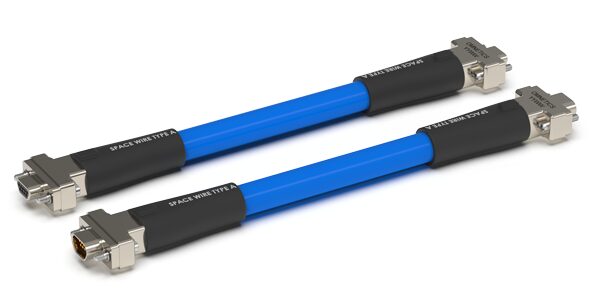
The 2019 specification includes two variants for connectors. “The Type A connector is a nine-pin Micro-D. To meet the Type A requirements, there is really no wiggle room for design. But there is also a Type B, that basically is a user-defined option,” said Satrom. He explained that this opens the door to smaller options that use space-ready cabling and meet the electrical requirements. “Nano-D would be the next size down for a smaller, robust, rugged connector. Type B, at least anecdotally, is a popular option for customers who say the Micro-D is too big.” He shared that finding a smaller alternative to Type A that adheres to the specification without the need to incur the expense of testing multiple options would likely be where the future is heading.
Ensuring against failure into the future
The complexity of the cable assemblies complicates the manufacturing process. Many different materials are used and multiple insulation or wrap layers in the cable are necessary for it to perform in the extreme conditions of space. “Because of the electrical requirements, you need to take care to not remove extra jackets or foils, because that can have an adverse effect on the crosstalk. This makes the cable costly in terms of materials, and costly to assemble,” said Satrom.
Specific procedures apply throughout the manufacturing and verification phases of SpaceWire cable assemblies, following rules set out by the space agencies for cables, connectors and wiring. “Critical procedures like crimping and soldering are monitored. This is the reason our people in charge of manufacturing and control are trained and evaluated regularly,” said Hermant. “In the same way, Axon’s manufacturing and control documents are registered and followed by the French Space Agency CNES. To provide redundancy, in a spaceflight application, an additional pair of routing switches is included with duplicate links to the modules. It is straightforward to support traditional cross-strapped, redundant modules using SpaceWire.”
SpaceFibre is the latest generation of SpaceWire network technology for spacecraft on-board data-handling applications. “It runs over electrical or fiber-optic cables and operates at very high data rates up to 10Gb/s,” Hermant said. “Axon’ is qualified with ESCC3409/001 on this network with electrical High Speed Serial Link and is also a member of ESA Optical Interfaces Working Group to issue an Optical Interfaces ESA Specification. Axon’ has worked actively on Fiber-Optic media and connections for many years and would like to develop the photonic links for the future decades.”
To learn more about the companies mentioned in this article, visit the Preferred Supplier pages for Axon’ Cable and Omnetics Connector Corporation.
Like this article? Check out our other articles on our Wire and Cable Assemblies Market Page, and our 2025 and 2026 Article Archive.
Subscribe to our weekly e-newsletters, follow us on LinkedIn, Twitter, and Facebook, and check out our eBook archives for more applicable, expert-informed connectivity content.

- ODVA Embraces ix Industrial - September 22, 2026
- PCB Connectors Product Roundup - September 22, 2026
- Safety First: Preventing EMI in Medical Devices - September 15, 2026