Posts

Medical Device Design: Challenges of Miniaturization and Harsh Rural-Clinic Environments

Medical Device Design – Challenges of Miniaturization and Harsh Rural-Clinic Environments Smaller, lighter, more portable, and more affordable are the primary objectives for just about every medical device manufacturer. The demand to succeed in achieving these attributes is particularly strong from remote medical clinics in rural settings, where funds are often scarce. In light ofRead More

Not Old, Just Older: Legacy Connectors in Current Designs

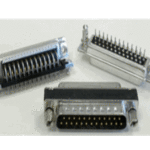
By Raymond Yuen, Portfolio Director – Commercial at FCI ElectronicsLegacy connectors are dependable, reliable devices that offer design engineers a no-risk solution that has been proven in the field for decades. These interconnect products typically offer the most cost-effective solution, as these commodity devices are standardized and do not involve customized engineering or specialty designs toRead More

Problem Solved: Wound Coil Manufacturability Issues

Typical hand-wound coils meet existing performance goals by as much as a 2/3-design and 1/3-art process. Predictability is very difficult because of the human element involved in hand winding. As the frequencies increase, the design aspects become less and less predictable. As a result, the art aspect, the number of iterations performed until matching is achieved, will increase.

Problem Solved: ITT’s VEAM Connector in Rail Applications

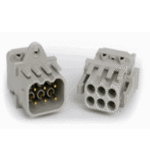
February 19, 2013 – In the highly competitive world of train manufacturing, there is increasing demand to replace the relatively large heavy metal connectors inside the cable car with smaller and lighter ones that still meet the strict smoke- and fire-resistant standards mandated by the industry. To meet these requirements, ITT’s Interconnect Solutions team created the VEAM Rectangular Plastic Connector.

Mold Presses – Fully Automated Encapsulation of Cables

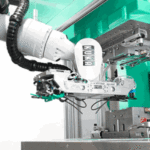
Thanks to the small footprint and high degree of freedom, production units with six-axis robotic systems offer high flexibility and functionality, even in the most restricted spaces, and work well with low hall heights, clean room applications, or link facilities. Arburg walks you through an application solution for mold presses that allow for fully automated encapsulations of cables.

Ethernet Networks Progress to 400 Gb/s

February 5, 2013 – Recently, the IEEE 802.3 Higher Speed Ethernet Consensus Ad Hoc group decided to focus its efforts on the next data rate of 400 Gb/s. The evolution of Ethernet technology hasbeen nothing short of remarkable: The next speed is in development before the current one has even reached the masses.

Socket To Me – The Selection and Use of High Performance Insulating Materials

February 5, 2013 -In many cases, materials that have stood the test of time simply will not work in today’s high-performance chipsets, and the designer must consider alternate materials for use in these powerful packages. Rich Orstad reviews some of these materials and provides guidance for proper selection and use in BGA, split chip, and test socket assemblies.

Big Future for Titanium Compounds in Electronics

January 22, 2013 – Titanium compounds perform an increasing variety of electronic functions, and their utility has proved far broader than silicon compounds. Dr. Peter Harrop examines current and future uses of the compound in next-generation applications and beyond. 

Analysis of the World’s Top 100 Electronic Connector Manufacturers
x