What is an ExpressCard Connector?
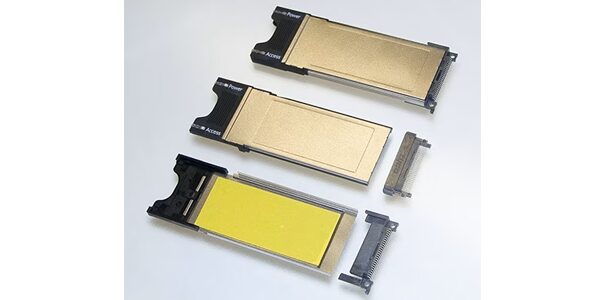
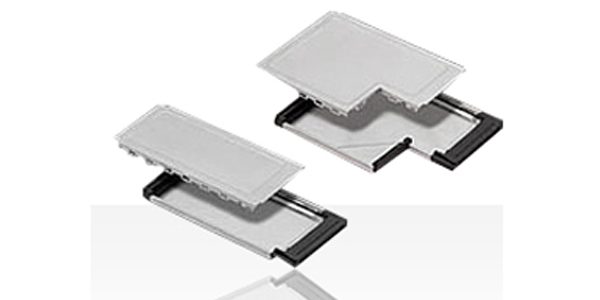
An ExpressCard connector is the 26-position, single-row interconnect defined by the ExpressCard standard, which links a removable expansion module to a slot in a laptop or desktop computer. One 34 mm-wide connector carries a PCI Express x1 lane and a USB 2.0 interface (plus SuperSpeed USB in ExpressCard 2.0) along with power, and it serves both the ExpressCard/34 and the wider ExpressCard/54 module formats.
Developed by the PCMCIA as the successor to the PC Card (CardBus) and first known as NEWCARD, ExpressCard slots were common on higher-end laptops from the mid-2000s into the early 2010s. Typical modules included mobile broadband modems, FireWire, eSATA and Ethernet adapters, smart card readers, and flash storage. TE Connectivity contributed mechanical and electrical engineering input to the specification during its development.
Technical Standard
The ExpressCard Standard was created by PCMCIA member companies, with assistance from the USB Implementers Forum (USB-IF) and PCI-SIG, and first appeared in 2003 as the replacement for PC Card and CardBus. Release 2.0, introduced in March 2009 at CeBIT, added SuperSpeed USB and PCI Express 2.0 rates of up to 5 Gb/s while staying forward and backward compatible with earlier modules and slots. After PCMCIA dissolved, the specification and its compliance program moved to the USB-IF; the standard was last revised in 2009 and is no longer under active development.
Design Highlights
Instead of the wide parallel bus used by PC Card, ExpressCard reuses two fast serial links already built into the computer, PCI Express and USB, so a module talks directly to the chipset without a bridge chip. One 26-position connector with 1.0 mm contact pitch serves both module widths, and longer power and ground contacts mate first and break last so modules can be hot-plugged safely. The simple beam-on-blade contact system is rated for 5,000 mating cycles on the host side and up to 10,000 on the module side, and the USB-IF compliance program checks that connectors from different suppliers intermate. The standard is now a legacy technology: USB, Thunderbolt and internal Mini PCIe/M.2 slots took over its roles, so remaining demand is mostly the installed base and a few business, rugged, and broadcast systems.
Markets & Applications
Notebook and laptop computing, mobile broadband and wireless communications, professional video and broadcast, security and identification (smart card and biometric readers), data storage, and rugged and industrial portable computing.
Named examples include ExpressCard/34 slots in Apple MacBook Pro models (January 2006 to June 2009, and the 17-inch model until 2012), Lenovo ThinkPad T43 (2005), Dell Precision and Latitude laptops, and ExpressCard/54 slots in Panasonic Toughbook rugged laptops. Modules include Sony SxS flash media for XDCAM EX camcorders, Belkin’s 2006 ExpressCard docking station, Common Access Card (CAC) readers and external graphics enclosures.
Technical Specifications
| IDENTIFICATION | |
| Governing Standard(s) | ExpressCard Standard Release 1.x; ExpressCard Standard Release 2.0 (2009) |
| Standard Issuing Body | PCMCIA (originator); maintained by the USB-IF since PCMCIA dissolved |
| Common Name / Series | ExpressCard (originally NEWCARD); ExpressCard/34 and ExpressCard/54 |
| Industry Category | Memory card / card-edge (I/O) |
| MECHANICAL SPECIFICATIONS | |
| Shell / Housing Shape | Rectangular module, 75 mm long × 5 mm thick; /34 is 34 mm wide, /54 is 54 mm wide (L-shaped) |
| Shell Material & Finish | Module cover sets commonly stainless steel (supplier-specific) |
| Size / Shell Size Codes | Common 34 mm-wide connector end for both formats; optional 70 mm-long variant sits flush with the host surface |
| Mounting Type(s) | Surface-mount, right-angle host connector; module connector with surface-mount solder tails |
| Plug / Receptacle Styles | 26-position module (card) connector mating with 26-position right-angle host connector |
| Mating Cycles (rated) | Host: 5,000 cycles. Module: 5,000 cycles, with 10,000 cycles optional for high-durability modules |
| CONTACT SPECIFICATIONS | |
| Contact Arrangements | 26 positions, single row, 1.0 mm pitch; longer power and ground contacts mate first and break last |
| Contact Material & Plating | Copper alloy with gold-plated mating area (typical; supplier-specific) |
| Termination Method(s) | Surface-mount solder tails |
| Voltage Rating | 1.5 V or 3.3 V supply (per standard) |
| SEALING & ENVIRONMENTAL | |
| EMI / RFI Shielding | Metal top and bottom cover set on module (supplier-specific) |
| MATERIALS & COMPLIANCE | |
| Insulator Material | LCP, UL 94V-0 (typical; supplier-specific) |
| RoHS / REACH | RoHS-compliant versions available from major suppliers |
| Qualification / QPL | USB-IF ExpressCard Compliance Program; compliant connectors carry a Compliance ID (e.g., EC100028, Amphenol FCI) |
| Applicable Test Standards | EIA-364 series (e.g., EIA-364-13 mating/unmating force; EIA-364-1000.01 test groups) |
| ELECTRICAL PERFORMANCE (if defined by spec) | |
| Data Rate / Bandwidth | Release 1.x: PCI Express x1 at 2.5 Gb/s and USB 2.0 at 480 Mb/s. Release 2.0 adds PCI Express 2.0 (5 GT/s) and USB 3.0 SuperSpeed (5 Gb/s) |
Suppliers
Manufacturers: TE Connectivity
Distributors: DigiKey, Kensington Electronics, Mouser , Sager Electronics, TTI Inc.,
Related Products
Like this article? Check out our other Meet the Connector and Connector Basics articles, our Military and Aerospace Market Page, and our 2026 Article Archives.
Subscribe to our weekly e-newsletters, follow us on LinkedIn, Twitter, and Facebook, and check out our eBook archives for more applicable, expert-informed connectivity content.

- What is an ExpressCard Connector? - November 10, 2026
- ODU-MAC® Silver-Line – Connections that make a difference - November 3, 2026
- What is a Power D or Combo D Connector? - November 3, 2026