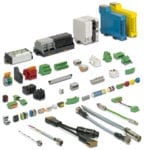
Connector Basics

Five Connector Considerations for Data Center Servers

We rely on data centers to bring connectivity to the world in an efficient, economical, and sustainable manner. The connectors designed into these increasingly important connectivity hubs make a surprisingly big impact on their operating costs and performance. Today’s “big data” landscape is pushing many services to the cloud and tasking data centers with handlingRead More


DC Data Centers: A Necessary Paradigm Shift for Sustainability and Savings

DC power supplies enable leaner, more powerful data center system architectures that — through skillful planning — can also mitigate total system cost. But first, we must make a paradigm shift. DC data centers Vast amounts of unused electricity simply disappear in data centers, lost to tedious, continuous, and ultimately unnecessary conversion and transformation processes. ButRead More

Connectors Fly High on Commercial Aircraft

Thousands of new commercial aircraft are currently in production. They will contain lightweight, powerful, high-speed electronics systems that will enable connectivity on a level the skies have never seen. Commercial aircraft come in many shapes and sizes, from small executive jets to large, long-haul, wide-body planes that carry hundreds of passengers. Electronics are taking aRead More

Soldier Wearables and Heads-Up Displays Challenge Connectors

US Army leaders and their industrial partners are looking at new ways to equip dismounted soldiers with lighter weight, wireless, more capable, and more integrated electronic systems. The goal of a major revamp of the Adaptive Squad Architecture (ASA) is to harmonize both the individual dismounted soldier and the squad as an integrated combat platform,Read More

Four Factors to Consider When Specifying Connectors for Military Wearables

Choosing the right connectors for soldier-worn electronics can help improve soldier effectiveness and safety in the field. The average soldier in the field today carries between 87 and 121 pounds (39 to 59 kilograms) of gear and equipment, including an increasing amount of soldier-worn electronics. Improving battlefield effectiveness starts with ensuring every ounce of thatRead More

How to Specify Heavy-Duty Connectors and Cable Assemblies for Harsh Industrial Applications

Designing and specifying cable assemblies for use in harsh environments presents a number of challenges. Industrial equipment can be subjected to harsh conditions, such as high temperatures, water, high humidity, particulate ingress, electromagnetic interference (EMI), vibration, and impact from close proximity to moving factory components. Over time, exposure to these conditions begins to impede assemblyRead More

Six Specification Considerations for Medical Connectivity Components

As medical equipment continues to scale down in size and up in connectivity and capabilities, new materials, device designs, and industry standards combine to create innovative medical connectivity components that satisfy rigorous form, fit, safety, and performance requirements. By John Koon and Connector Supplier medical connectivity components As medical equipment continues to scale down inRead More

Chip-on-Tip Technology Enables Minimally Invasive Medical Devices

Chip-on-tip endoscopy technology relies on microminiature sensors, illumination, and lenses. Market pressures are driving these critical medical devices to shrink in diameter and cost while maintaining, if not adding, functionality. Meeting these demands requires ingenuitive engineering and manufacturing techniques. Chip-on-tip technology is dramatically improving medical care by enabling minimally invasive imaging. The term chip-on-tip typicallyRead More

Common Misperceptions of Custom Connectors

There are many misperceptions regarding custom connectors: They are too risky, too expensive, and take too long to develop. But new processes are addressing these concerns. Device development is undergoing a transformation. Pressure to reduce costs, reduce size, and make devices that can leverage the Internet of Things (IoT) and 5G is driving a lotRead More

The Differences Between MIL-DTL-38999 Series I, II, and III Connectors

These circular connectors were originally designed to meet requirements for cable-to-panel applications in the military and aerospace market. Now they are used across a wide range of industries that benefit from their high-performance qualities. By Air Electro, Inc. The engineers and procurement professionals in both the civil and military aerospace industries work with QPL-approved (QualifiedRead More

Rugged Mil-Spec Connectors Strengthen Military System Deployment

A tour of the West 2019 conference turns up new mil-spec connectivity products that meet size, weight, and power goals, and deliver peak performance under pressure. For military and aerospace applications, the consequences of system failures are unthinkable. To accomplish mission-critical tasks, these systems depend on the high-reliability performance of rugged mil-spec connectors and cables.Read More

Rugged Connectors Expand into New Applications

5G and the Industrial Internet of Things are pushing advanced electronics into rough new territory. Rugged connectors can provide the robust connectivity needed, although sometimes a custom connector is required. Rugged connectors come into play when electronic equipment is designed for use in an extreme environment. This can be broadly defined: Extreme conditions may beRead More

2026 World Connector Market Handbook 2025-2031F
x