Molex’s Next-Generation PoE Plus Single-Port Controller PDJack Connector
March 5, 2013 – Integrated drop-in solution simplifies implementation of Power-over-Ethernet.
March 5, 2013 – Integrated drop-in solution simplifies implementation of Power-over-Ethernet.
March 5, 2013 – Non-magnetic combination D-subminiature connectors ideal for medical imaging equipment.
March 5, 2013 – With the highest voltage rating for both UL and IEC, it is ideal for worldwide use.
January 22, 2013–New IEC 60320-style C22 inlet with power line filter fills market gap.
March 5, 2013 – This exclusive report details Avnet’s product pricing and lead-time trending data in 15 broad product categories.
March 5, 2013 – Document provides guidance on tracking, management, disclosure, and reporting of conflict materials.

February 12, 2013 – The medical market for cable assemblies grew 6% in 2011 to $4.2 billion worldwide, down from a year-over-year growth of 29% in 2010. How did it fare in 2012? Dave Pheteplace breaks down the facts and figures and shares Bishop’s outlook for 2013.
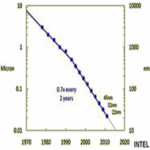
The next generation of connectors will need to work in small, high-power applications that must keep their cool in difficult conditions. But a lack of standards and constant cost pressures means it won’t be easy.
The race to faster connection links, both internal and external, have driven the connector industry to develop entirely new products that have bumped their rated bandwidth from a few hundred megahertz to 25+ Gb/s. The introduction of the universal serial bus (USB) 3.0 caused some skeptics to question the practical value of 5 Gb/s I/O links, as so few applications could take advantage of that data rate. USB 3.0 is now appearing on a host of computers and peripherals, which enable them to support new generations of emerging high-speed applications.
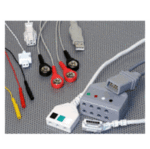
Electronics have become as prevalent in the operating room as the expected scalpels and masks—even the scalpels have been updated for the high-tech world. Cable assemblies are used to connect everything from patient monitoring devices to electrosurgical “scalpels.” We will examine the type of assemblies found in the operation room, their electrical, mechanical, quality, and packaging requirements, and the trends in this very specialized segment of the cable assembly market.
February 21, 2013—Distributor provides cost-effective resolution for customers’ PCB interconnect requirements.
February 21, 2013—Manufacturer passed its review of the 54 new substances added to the SVHC list.