
Featured Articles
  • USB-C Serves Industrial Design with Rugged Variants 

    The USB-C connector has quickly moved from consumer applications into harsh environments. With 20 Gb/s data rates and IP-rated sealed variants, this connector can handle industrial conditions and serve in controllers, robotics, and peripherals for the factory floor. A new class of rugged USB-Cs and cables elevates this ubiquitous interface. It’s been nearly two years sinceRead More

  • The Power of Having Options

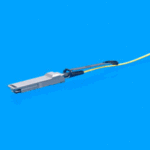
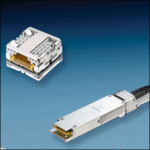
    The input/output panel of AI equipment is a prime example of how evolving demands have spawned the introduction of alternative solutions that address bandwidth demand, signal density, field serviceability, energy efficiency, thermal management, and utilization of both copper and fiber optic options. Most people would agree that having multiple choices to solve a problem isRead More

Technology

Tech Meets Fashion at TE’s Wearables Lab

As consumers try to warm up to Google Glass, Apple’s iWatch, and their Fitbit wristbands, TE unveils its latest “collection”: A Silicon Valley-based incubator team to enable the next generation of wearable devices.   Nicholas Langston, Jr., insists he’s the luckiest guy you’ll ever meet. Langston heads up TE Connectivity’s Wearables Lab in Menlo Park, Calif.,Read More

Military Wearables Enhance Soldier Capabilities

Military wearables enhance soldier capabilities, but the next generation of battlefield equipment will require an evolution in connector technology.   New wearables, including augmented reality technology and devices connected to the Internet of Things (IoT), will not (yet) make the new soldier or airman look like Iron Man, although “Iron Man Suit” is the nickname usedRead More

The Era of Smart Wearables is Coming

Connectivity will be key to expanding the world of wearables in the future.   The world of technology is going through another transformation. We went from mainframes to desktop PCs in about two decades; from desktops to laptop PCs in one; and from laptops to smartphones and tablets in less than that. Another revolution isRead More

Opinion: US Oversight of the Internet

As US politicians debate the future of the Internet, Bishop & Associates’ John MacWilliams makes the case for leaving oversight in the hands of the US.   The World Wide Web evolved out of DARPA Net in the late 1980s, emerging from an NSF/university technology dotcom system, and then as an open Internet in theRead More

Silicon Photonics – Are We Past the Hype?

From its inception, silicon/CMOS photonics was supposed to revolutionize optical communications, but has yet to come to fruition. How much progress has been made so far?   Both Intel and Luxtera have been working on silicon/CMOS photonics for more than 13 years. While we have a few products, its promise of lower-cost, lower-power-consumption optical devicesRead More

Embedded Optical Engines Find Their Niche

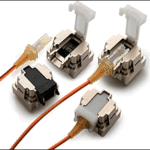
Demand for higher data rates, panel density, and practical channel lengths with acceptable signal integrity have put pressure on copper connectivity to deliver the most practical solution. Embedded optical transceiver technology emerges to address this need.   Copper circuits still rule the high-speed electronic world, but optical alternatives continue to chip away at that dominance in nicheRead More

How to Specify Optical Modules

Optical modules are key components in networking equipment, and specifying the right modules can heavily influence overall system performance. Here, Erin Byrne of TE offers tips on key considerations. Optical modules are key components in networking equipment, and specifying the right modules can heavily influence overall system performance. There are several issues to consider whenRead More

Connectors in Medical Robotics

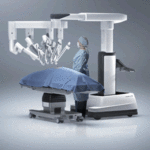
Traditionally employed in heavy industrial applications, robots are moving into other industries. In the medical field, they are used for surgery, therapy, diagnostics, and much more.   Robots for specialized medical applications such as surgery bring together robotics and biology, and we’re seeing an increase in the number of robots specifically designed and developed for thisRead More

Cloud Computing and the Rise of Silicon Photonics

The rapid growth of cloud computing requires data centers to scale up, but traditional copper presents limitations in distance, bandwidth, and efficiency.   The business of today’s data-driven world is being conducted in the Cloud. The rapid growth of cloud computing requires data centers to dramatically scale up in order to handle the oceans ofRead More

Intra-Data Center Optics

Fiber optics are poised to enable network functionality like never before with increased data rates and bandwidth inside the data center.   The need to change the data center network from a hierarchal one to a leaf-spine or more meshed one has arisen from the ever-increasing need for compute and storage access and the useRead More

Backplane Architectures Proliferate

As system speeds increase to multi-gigabit levels and beyond, ensuring signal integrity in high-speed channels requires major backplane connector performance upgrades.   Backplane architecture has served the electronics industry well for many years. Circuitry embedded in up to 40 layers of the backplane can create custom point-to-point, broad parallel bus structures or full mesh networks, essentiallyRead More

International Microwave Symposium 2015 Wrap-Up

With a record-breaking number of exhibitors, this year’s International Microwave Symposium featured state-of-the-art developments in RF, microwave, and millimeter-wave products.   The International Microwave Symposium presented by the IEEE Microwave Theory and Techniques Society (MTT-S) is the premier International event for microwave theory and practice. In addition to the flagship IMS Conference, “Microwave Week 2015”Read More

Analysis of the World’s Top 100 Electronic Connector Manufacturers
x