

Featured Articles
  • USB-C Serves Industrial Design with Rugged Variants 

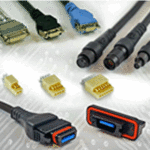
    The USB-C connector has quickly moved from consumer applications into harsh environments. With 20 Gb/s data rates and IP-rated sealed variants, this connector can handle industrial conditions and serve in controllers, robotics, and peripherals for the factory floor. A new class of rugged USB-Cs and cables elevates this ubiquitous interface. It’s been nearly two years sinceRead More

  • The Power of Having Options

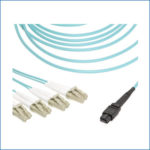
    The input/output panel of AI equipment is a prime example of how evolving demands have spawned the introduction of alternative solutions that address bandwidth demand, signal density, field serviceability, energy efficiency, thermal management, and utilization of both copper and fiber optic options. Most people would agree that having multiple choices to solve a problem isRead More

Technology

Automotive Meets IoT in the Connected Car

With pervasive connectivity, powerful features emerge that change the entire automotive ecosystem in the connected car. In recent years, in-car systems have been supplemented by basic Internet connectivity, allowing drivers and passengers to remain “plugged in” to the business and social networks they take for granted when at home or in the office. But whatRead More

Modern Hyperboloid Contacts for Circular I/O Connectors

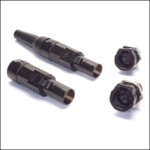
When choosing modern hyperboloid contacts for circular I/O connectors, the specific requirements of the application are key considerations.   Circular connectors are ubiquitous in medical electronics, instrumentation, and military and aerospace equipment. The round configuration lends itself to input/output applications that see frequent mating and un-mating. Plug and receptacle alignment is intuitive to enhance ease of use.Read More

Fiber Optics: Knocking on the Copper Door

Fiber optics has long been touted as the next big thing. After 30 years of expectation, is that reality finally here? Fiber optics has long been defined as a technology that will become mainstream within five years…for at least the last 30 years. That may finally be changing. We don’t see fiber replacing copper toRead More

How to Specify Small Form Factor Optical Connectors

Over the last three decades, a myriad of optical connectors have come and gone, but small form factor connectors are making the choice easier these days. Molex offers tips on how to specify small form factor optical connectors.    In a maturing market, there are clear winners that prove superior and push out competing technologies.Read More

Five Things to Know About OFC 2015

The annual Optical Fiber Communications Conference continues to grow, and ProLab’s Giacomo Losio reports on the top five technologies that everyone was talking about.   OFC 2015 was a very busy show. Sometimes you go to a two-day event and think it could have been condensed into one, but in OFC’s case it could have been three andRead More

The Continuing Impact of RoHS

Pure tin plating has been almost universally adopted, but the looming expiration of a critical exemption is poised to bite manufacturers of screw machined contacts. Bob Hult examines the continuing impact of RoHS. Just when you thought the connector industry had bit the bullet and removed all lead from its products, the looming expiration ofRead More

Connectors at Work: Insulator Materials

The material used in a connector design significantly impacts its overall performance. Bob Stanton of Omnetics takes a look at how insulator materials affect connectors at work.   The choice of the material of which a connector is made can greatly affect reliability and performance, and often depends on the environment and application in which the connector isRead More

LED Lighting: The Connection Counts

Everywhere you turn, you can find LEDs in almost any lighting form factor, and connections are more challenging than a screw-in light bulb. Andrew Bogaczyk of Phoenix Contact explains how to connect LEDs and why the connection counts.   LEDs continue to dominate the lighting marketplace; everywhere you turn, you can now find LEDs in almost any formRead More

Active Optical Cables Go the Distance

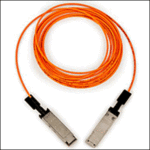
One solution to the signal integrity and reach issues in copper cabling is the use of active copper cable assemblies. Bob Hult takes a look at today’s technology and where it could lead the industry.   The long predicted demise of high-speed copper cables continues to be delayed/frustrated by continuing improvements in the technology of data transmission.Read More

How to Choose Fiber Optic Cleavers

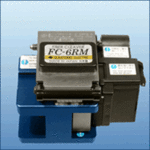
Commonly overlooked when making a fusion splicer purchase, fiber optic cleavers are crucial tools that ensure perfectly smooth fiber ends. Sumitomo Electric Lightwave offers tips on how to choose fiber optic cleavers.   The fiber cleaver is a tool commonly overlooked when making a fusion splicer purchase. Just ask any technician who has worked the lateRead More

Are AI and IoT a Threat to Mankind?

There’s lots of talk about the benefits of the Internet of Things, particularly in the industrial arena, but is there a down side? Arthur Visser asks the question: Are AI and IoT a threat to mankind?   If you have been following the news recently, you probably heard that Professor Stephen Hawking, one of theRead More

Photonic Systems Manufacturing Consortium Update

The goal of PSMC is to address the technology gaps and challenges that limit the advancement of hardware technology for integrated photonic system manufacturing. Learn more about how to get involved. The Photonic Systems Manufacturing Consortium (PSMC) is a collaborative program organized by the International Electronics Manufacturing Initiative (iNEMI) and the MIT Microphotonics Center (MIT-MphC), and funded by theRead More

Analysis of the World’s Top 100 Electronic Connector Manufacturers
x