
Featured Articles
  • The Power of Having Options

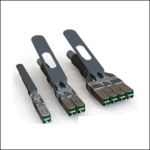
    The input/output panel of AI equipment is a prime example of how evolving demands have spawned the introduction of alternative solutions that address bandwidth demand, signal density, field serviceability, energy efficiency, thermal management, and utilization of both copper and fiber optic options. Most people would agree that having multiple choices to solve a problem isRead More

  • Connectivity Is Reshaping Police and Security Vehicle Fleets

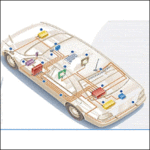
    Police and security patrol vehicles are adopting new and emerging technologies from both the military and automotive worlds. This unique market combines defense-grade signal integrity demands with automotive-grade ruggedization requirements, often in the same harness. Police and security patrol cars have become mobile electronics platforms, with huge investments in recent years outfitting these fleet vehiclesRead More

New Technologies

To 400Gb/s and Beyond: High-speed Interconnects Evolve to Meet the Needs of Data Center Communications

by Jim David – Portfolio Director; Amphenol High-Speed Interconnects High-speed interconnects adapt to data centers’ ever-changing signal, bandwidth, and density requirements.   The emergence of large scale and mega-data centers has driven the need for not only increased data management capability, but also increased the complexity, design, and configuration of these enormous facilities. Meeting dataRead More

Vehicles Rely on FAKRA Connectors to Assure Performance

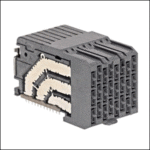
Today’s FAKRA connectors perform up to 6GHz and meet the rugged mechanical and environmental requirements of the automotive industry. Higher Frequency RF Adds to System Complexity Vehicles are incorporating an ever-increasing amount of telecommunications technology, ranging from data I/O to safety systems, that involves wireless connectivity for cellular, short range, and broadcast capabilities. These connectedRead More

Connectors in Embedded Computers: Upgrading Performance while Downsizing

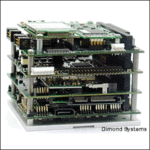
Two conferences highlighted the ongoing changes in wiring, thermals, backplanes, and many more connector technologies. Bob Hult provides the buzz from VITA’s 2017 Embedded Tech Trends forum, and then another look at DesignCon 2017.   Embedded computers have existed in the shadow of much larger computer markets for commercial and communication applications. Unlike general purposeRead More

Trends to improve speed, size and pricing continue

Connector makers upgraded lines, extended product families and unveiled new interfaces to meet customer demands for increased circuit density and higher data rates.   2016 Connector Trends In a continuation of trends we’ve seen for several years now, a host of faster, smaller, and more affordable electronic components propelled the connector industry forward in 2016. ConnectorRead More

Disruptive Innovations Impact Electronic Interconnects

Change has been an integral part of human experience since the beginning. What is new is the incredible rate and volume of change that is impacting the entire electronics industry. What disruptive innovations will impact your world? Over much of its existence, the electronic connector industry has been able to support new interconnect requirements throughRead More

Autonomous Carsharing: Your Robot is Now Arriving

Robotic carsharing services will put fleets of autonomous vehicles at our app-driven beck and call. What do these super-cheap, super-safe connected vehicle systems mean for the transportation industry?   Most cars spend most of their time parked and not being of any use to anyone, but carsharing schemes are changing that. “Street rental” services like GetaroundRead More

Copper Replacing Copper?

Seeking a way to deliver bandwidth more effectively, some have investigated the removal of high-speed circuits from the PCB by replacing them with discrete or ribbon twin-axial copper cables. For many years, engineers have bemoaned the eventual limitations of copper printed circuit board conductors in ever-higher-speed circuits: Surely the laws of physics would create barriers toRead More

Interconnects Morph to Meet the Need for Speed

The need to transmit more data at higher speeds is changing system design. New strategies include developing connectors specifically for high-speed operations, maintaining signal integrity at high speeds, and using new protocols. Today, interconnect technology has morphed to meet the need for speed.   The continuous growth in IP services and access speeds has ledRead More

The Hottest Connector Technology of 2016 (So Far!)

With the first half of 2016 behind us, Bishop & Associates’ Dave Brearley takes a look at the hot products and technologies that are dominating the year so far.   The Hottest Connector Technology of 2016 (So Far!) Writing about connector innovations is always fun; recent developments are no exception. Innovative connector solutions have beenRead More

Great Connector Inventions: Connector “Chicklets” Revolutionize Backplanes

Chicklets revolutionized automation by increasing the overall speed and efficiency of designing in backplane connectors. The Germans are renowned for developing and enforcing mechanical standards that are used worldwide. German companies developed the DIN 41612 connector family and the Eurocard chassis standards, which remain the basis for many other standards, such as VME architectures usedRead More

Plugs Improve Flexible LED Strips

A new direct-plug solution makes connecting LED strips almost as easy as screwing in a light bulb.      Electronics designers and developers are always looking for suitable connection solutions for flexible LED strips. Reliability, functionality, size, and electrical requirements are important considerations in connection systems for electronic assemblies involving LEDs. A new direct-plug solutionRead More

Driverless Cars Shrink LiDAR Technology

As autonomous vehicles and advanced driver assistance systems become mainstream, LiDAR sensors become smaller, cheaper, and consumer-friendly. Will this impact automotive connector design?   Light Detection and Ranging, or LiDAR, is a core source of data for driverless car systems like that being developed by Google, and the huge, expensive, mechanical LiDAR units used onRead More

Analysis of the World’s Top 100 Electronic Connector Manufacturers
x