

Featured Articles
  • XPO, Addressing the I/O Panel Bottleneck

    Introduced at OFC 2026, the new XPO pluggable modules provide a solution to the challenges of signal density, thermal management, field serviceability, and power efficiency. Continuing advances in artificial intelligence face multiple constraints including power consumption, access to memory, thermal management, and limitations of copper connectivity. Solving these challenges could still result in hobbled systemsRead More

  • Connector Company Gives Orthotics Startup a Hand

    A power orthotics startup worked with Würth Elektronik to develop a powerful new solution for the 100 million people living with limited hand mobility. Article Contributed by: Würth Elektronik Würth Elektronik partnered with Mannheim startup Powered Orthotics to engineer a medical-grade wearable solution for the 100 million people worldwide living with limited hand function. Stroke,Read More

Technology

Great Connector Inventions: Connector “Chicklets” Revolutionize Backplanes

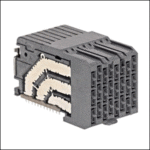
Chicklets revolutionized automation by increasing the overall speed and efficiency of designing in backplane connectors. The Germans are renowned for developing and enforcing mechanical standards that are used worldwide. German companies developed the DIN 41612 connector family and the Eurocard chassis standards, which remain the basis for many other standards, such as VME architectures usedRead More

IMS 2016 Recap: Industry Growth and New Microwave Products

At IMS 2016, 5G and microwave applications dominated, according to our man on the floor, Bishop & Associates’ David Shaff. IMS 2016 or, more appropriately, “Microwave Week,” continues to reflect the growth of wireless technology. Organized by the IEEE Microwave Theory and Technique Society (MTT-S), this year’s IMS began with the RFIC Symposium, continued withRead More

Great Connector Inventions: 2mm Metral

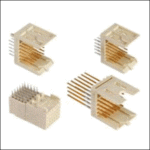
The development of the 2mm Metral connector changed the telecom industry forever.   The connector industry is very interesting, in part, because of exciting inventions developed by engineers – some of which have such an impact that the direction of the industry is changed. In the late ‘80s, telecom OEMs were outgrowing the capabilities ofRead More

Electronic Connectors Shrink to Fit

Incredible advances in processor and memory technology have mandated shrinking all other electronic components from chip capacitors to connectors and the circuitry that joins them. The connector industry has responded to these challenges by introducing new classes of high-density microminiature connectors.   A basic pillar of the electronics industry has been its ability to stuff more functionality inRead More

Plugs Improve Flexible LED Strips

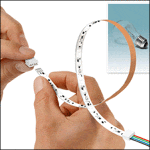
A new direct-plug solution makes connecting LED strips almost as easy as screwing in a light bulb.      Electronics designers and developers are always looking for suitable connection solutions for flexible LED strips. Reliability, functionality, size, and electrical requirements are important considerations in connection systems for electronic assemblies involving LEDs. A new direct-plug solutionRead More

Device Connection Integration in the SMT Process

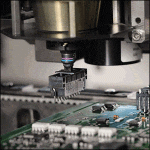
Can the same connector be used in both through-hole reflow and surface-mount device processes? Weidmuller looks at how pin length can make all the difference in meeting the requirements of IPC-A-610 E. Today’s PCB is a platform for electronic components that creates circuits varying from simple to highly sophisticated. Requirements such as the miniaturization of components,Read More

Driverless Cars Shrink LiDAR Technology

As autonomous vehicles and advanced driver assistance systems become mainstream, LiDAR sensors become smaller, cheaper, and consumer-friendly. Will this impact automotive connector design?   Light Detection and Ranging, or LiDAR, is a core source of data for driverless car systems like that being developed by Google, and the huge, expensive, mechanical LiDAR units used onRead More

The Connected Car: A Revolution in Mobility

Since the modern automobile was invented, its basic functionality and shape has remained essentially the same. However, the environment in which vehicles operate and the data to which they connect are changing dramatically, and components will play a significant role in the automotive revolution.   The connected car has the power to shake up theRead More

USB Type-C: What You Need to Know

Depicted as “one cable to connect them all,” in reality there will be more than one type of USB-C cable. Mouser Electronics offers a primer on what you need to know about USB Type-C technology.   USB Type-C (USB-C) is a new technology that promises to de-clutter our lives by channeling up to 10Gb/s ofRead More

The 10 Commandments of USB

The increasing complexity of and demands on networks may be solved with USB technology, but to simplify installations, be sure to follow these 10 rules.   As an industrial, medical, laboratory, or field services interface, USB has many benefits that outweigh the risks. However, you can reduce your odds of disaster with simple fixes – likeRead More

Which Materials Enhance USB Performance?

High-performance polyamides provide improved reliability and safety in next-generation USB-C connectors.     USB-C connectors will need to carry more power than previous generations in a much smaller form factor, which makes the performance properties of the materials used for holding all the conductive elements together especially critical. Reliability is a key requirement, so theRead More

microQSFP MSA Group Releases Specification for Next-Generation Data Communications Connectivity

The microQSFP Specification Version 2.0 enables development of new compact transceivers that address future 100G port density, data speed, and system thermal requirements.   The members of the microQSFP (micro Quad Small Form-Factor Pluggable) Multi-Source Agreement (MSA) group today announced that it has released the microQSFP Specification Version 2.0, which allows system designers, optical module manufacturers,Read More

2026 World Connector Market Handbook 2025-2031F
x