How to Specify

Specifying medical device connectors

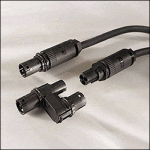
Designing handhelds, wearables, and tomorrow’s smaller medical devices comes with a unique set of design challenges. Engineers and designers are striving to drive size, weight, and cost from their devices, looking critically at every component, including medical device connectors.   Handhelds, wearables and more: Smaller medical devices mean smaller, multi-tasking connectors New technology in connectorRead More

Making Connections in LED Lighting

Considering connectors at the start of the design process results in an optimized LED lighting design.   LED lighting is very different from traditional lighting systems. Modern LED assemblies offer vastly improved power efficiency and longevity, and they can be extremely compact. However, their electronics are much more complex to design than those of incandescent lightRead More

Custom Designs for SWaP-Focused Connectors

The SWaP initiative employed by the US military and NASA has helped connector manufacturers focus on improving smaller and lighter connectors, in particular for custom designs.   As we demand our circuits do more and in smaller packages, we still need reliable power and signal transfer. Today’s designers have a number of new tools andRead More

How to Specify Mini-SAS HD Connectors and Cable Assemblies

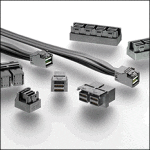
There are a number of variables to consider when choosing Mini-SAS HD interconnects, and here TE offers tips on how to specify Mini-SAS HD connectors and cable assemblies to achieve the necessary performance level. † Serial Attached SCSI (SAS) connectors are essential for interconnecting storage systems in the data center. SAS defines the standard interconnectRead More

How to Specify 40G Cabling

40-gigabit applications over various media types are intended to reduce bottlenecks by providing improved speed within and between data centers.     The exponential growth of Internet and mobile device data traffic has had a huge impact on data center servers, high-performance computing clusters, and network storage equipment that serve and manage this traffic. 40-gigabit applicationsRead More

How to Specify Nanominiature Connectors

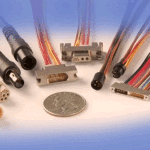
Nanominiature connectors provide an ideal solution for challenging wiring systems in the constantly evolving aerospace industry. Here, Radiall offers tips on how to specify the connectors for these applications.     To address the challenges airframers experience in the civil and military aerospace industry, a new format for multipin connectors was introduced. The nanominiature connectorRead More

How to Specify COTS Mixed-Layout Connectors for Military Vehicles

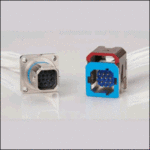
Learn more about the latest lightweight COTS options for mixed-layout connectors from Erich Reichenbach of Reichenbach International.     Connectors for the military should be small, lightweight, rugged, reliable, and versatile as they are exposed to various demanding applications and environments. Here are some suggestions for specifying military COTS connectors. Size, Weight, and Shape By conserving fuel, aRead More

Downhole and Subsea Applications Require Unique Connectors

The main markets for subsea and high-pressure connectors require unique designs that mate when submerged, plus fiber optics and hermetic assemblies. When designers think about exotic applications, they might think about deep space. However, these are gentle applications compared to the severe environmental requirements for connectors used in downhole and subsea projects, where temperatures can exceed +250°CRead More

Materials Ensure Connector Reliability in Harsh Environments

Connectors in the oil and gas industry must withstand high pressure, high temperature, and corrosive environments subject to heavy vibration and occasional shock loading. Materials are the key to ensure connector reliability in harsh environments.   The oil and gas industry demands high reliability in drilling and completion equipment, including electrical connectors used downhole. ConnectorsRead More

How to Specify Connectors for Downhole Applications

Demanding requirements for downhole applications start with high pressure and high temperature and go on to encompass many other factors. Here, AMETEK reviews the main considerations for choosing a connector for these harsh applications.   There are few environments that test the extreme functionality of a harsh environment connector more than those found deep down in anRead More

How to Specify High-Transmission I/O Connectors

Today’s requirements for input/output connectors demand smaller size and faster data transmission. Hirose advises designers on how to specify high-transmission I/O connectors by looking at a multitude of requirements and trade-offs.   An I/O connector is an interconnect that joins a circuit from inside to the outside of electronic equipment. I/O interconnects are used to connect data,Read More

How to Specify Optical Modules

Optical modules are key components in networking equipment, and specifying the right modules can heavily influence overall system performance. Here, Erin Byrne of TE offers tips on key considerations. Optical modules are key components in networking equipment, and specifying the right modules can heavily influence overall system performance. There are several issues to consider whenRead More

Analysis of the World’s Top 100 Electronic Connector Manufacturers
x